[blog] Announcing Deno 2. In exploring this latest release of the JavaScript runtime, Simon uncovered a Jupyter notebook kernel in there. Nice option for those that want notebooks!
Want to get this update sent to you every day? Subscribe to my RSS feed or subscribe via email below:
Trust. Without trust, AI coding assistants won’t become a default tool in a developer’s toolbox. Trust is the #1 concern of devs today, and it’s something I’ve struggled with in regards to getting the most relevant answers from an LLM. Specifically, am I getting back the latest information? Probably not, given that LLMs have a training cutoff date. Your AI coding assistant probably doesn’t (yet) know about Python 3.13, the most recent features of your favorite cloud service, or the newest architectural idea shared at a conference last week. What can you do about that?
To me, this challenge comes up in at least three circumstances. There are entirely new concepts or tools that the LLM training wouldn’t know about. Think something like pipe syntax as an alternative to SQL syntax. I wouldn’t expect a model trained last year to know about that. How about updated features to existing libraries or frameworks? I want suggestions that reflect the full feature set of the current technology and I don’t want to accidentally do something the hard (old) way. An example? Consider the new “enum type” structured output I can get from LangChain4J. I’d want to use that now! And finally, I think about improved or replicated framework libraries. If I’m upgrading from Java 8 to Java 23, or Deno 1 to Deno 2, I want to ensure I’m not using deprecated features. My AI tools probably don’t know about any of these.
I see four options for trusting the freshness of responses from your AI assistant. The final technique was brand new to me, and I think it’s excellent.
Fine-tune your model
Use retrieval augmented generation (RAG)
Ground the results with trusted sources
“Train” on the fly with input context
Let’s briefly look at the first three, and see some detailed examples of the fourth.
Fine-tune your model
Whether using commercial or open models, they all represent a point-in-time based on their training period. You could choose to repeatedly train your preferred model with fresh info about the programming languages, frameworks, services, and patterns you care about.
The upside? You can get a model with knowledge about whatever you need to trust it. The downside? It’s a lot of work—you’d need to craft a healthy number of examples and must regularly tune the model. That could be expensive, and the result wouldn’t naturally plug into most AI coding assistance tools. You’d have to jump out of your preferred coding tool to ask questions of a model elsewhere.
Use RAG
Instead of tuning a serving a custom model, you could choose to augment the input with pre-processed content. You’ll get back better, more contextual results when taking into account data that reflects the ideal state.
The upside? You’ll find this pattern increasingly supported in commercial AI assistants. This keeps you in your flow without having to jump out to another interface. GitHub Copilot offers this, and now our Gemini Code Assist provides code customization based on repos in GitHub or GitLab. With Code Assist, we handle the creation and management of the code index of your repos, and you don’t have to manually chunk and store your code. The downside? This only works well if you’ve got the most up-to-date data in an indexed source repo. If you’ve got old code or patterns in there, that won’t help your freshness problem. And while these solutions are good for extra code context, they may not support a wider range of possible context sources (e.g. text files).
Ground the results
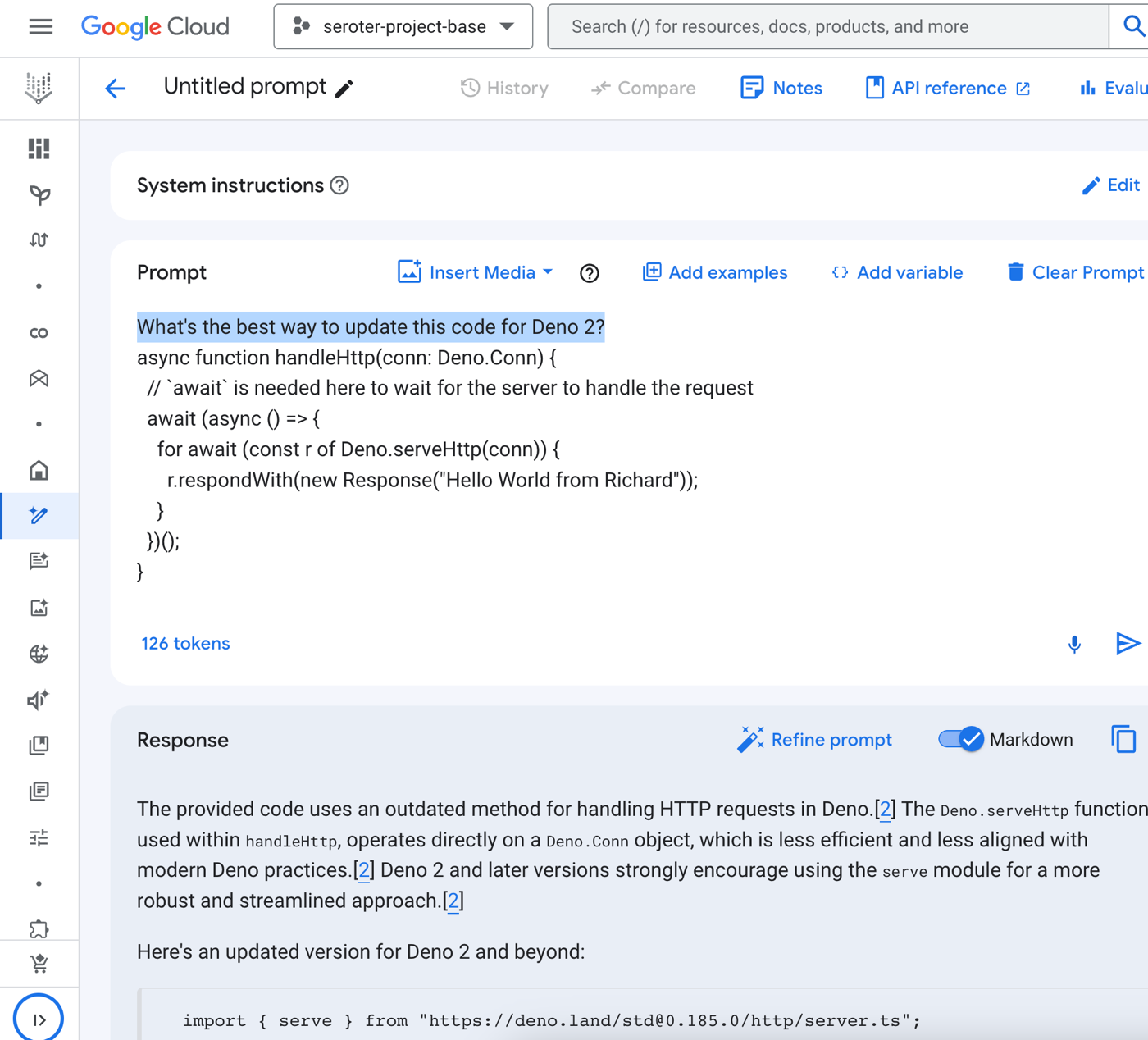
This approach gives you more confidence that the results are accurate. For example, Google Cloud’s Vertex AI offers “ground with Google Search” so that responses are matched to real, live Google Search results.
If I ask a question about upgrading an old bit of Deno code, you can see that the results are now annotated with reference points. This gives me confidence to some extent, but doesn’t necessarily guarantee that I’m getting the freshest answers. Also, this is outside of my preferred tool, so it again takes me out of a flow state.
Train on the fly
Here’s the approach I just learned about from my boss’s boss, Keith Ballinger. I complained about freshness of results from AI assistance tools, and he said “why don’t you just train it on the fly?” Specifically, pass the latest and greatest reference data into a request within the AI assistance tool. Mind … blown.
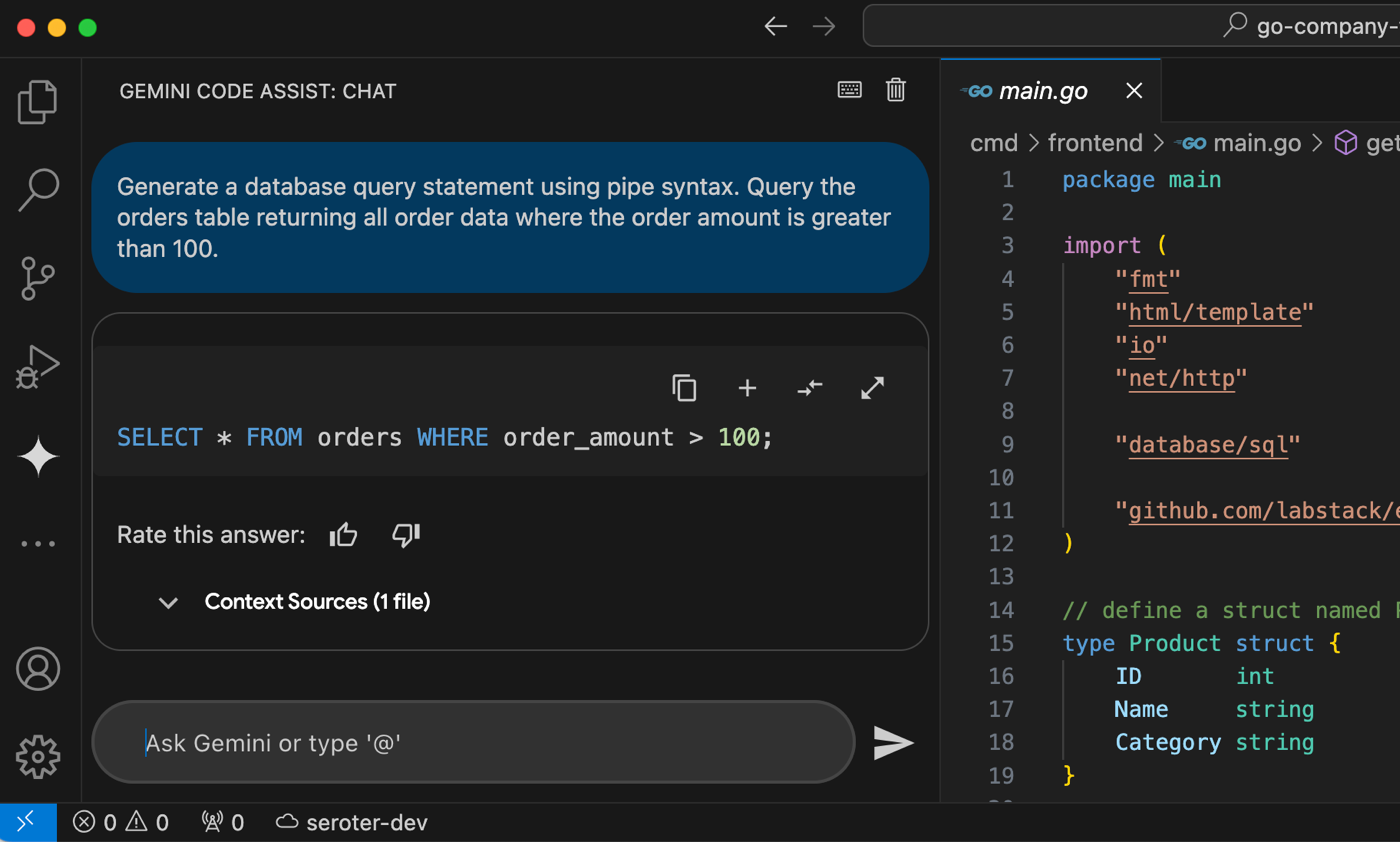
How might it handle entirely new concepts or tools? Let’s use that pipe syntax example. In my code, I want to use this fresh syntax instead of classic SQL. But there’s no way my Gemini Code Assist environment knows about that (yet). Sure enough, I just get back a regular SQL statement.
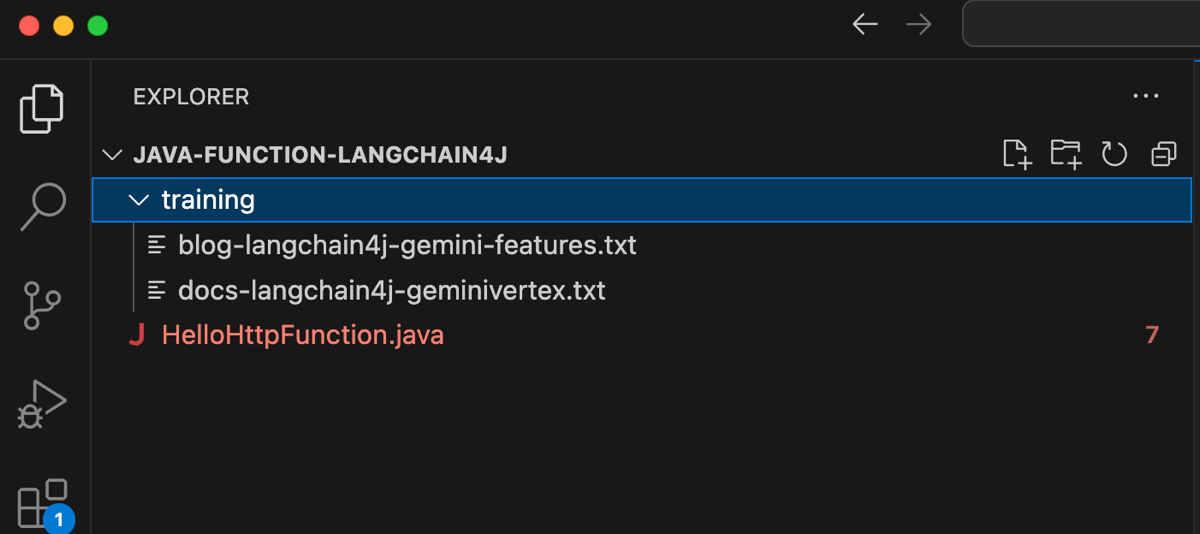
But now, Gemini Code Assist supports local codebase awareness, up to 128,000 input tokens! I grabbed the docs for pipe query syntax, saved as a PDF, and then asked Google AI Studio to produce a Markdown file of the docs. Note that Gemini Code Assist isn’t (yet) multi-modal, so I need Markdown instead of passing in a PDF or image. I then put a copy of that Markdown file in a “training” folder within my app project. I used the new @ mention feature in our Gemini Code Assist chat to specifically reference the syntax file when asking my question again.
Wow! So by giving Gemini Code Assist a reference file of pipe syntax, it was able to give me an accurate, contextual, and fresh answer.
What about updated features to existing libraries or frameworks? I mentioned the new feature of LangChain4J for the Gemini model. There’s no way I’d expect my coding assistant to know about a feature added a few days ago. Once again, I grabbed some resources. This time, I snagged the Markdown doc for Google Vertex AI Gemini from the LangChain4J repo, and converted a blog post from Guillaume to Markdown using Google AI Studio.
My prompt to the Gemini Code Assist model was “Update the service function with a call to Gemini 1.5 Flash using LangChain4J. It takes in a question about a sport, and the response is mapped to an enum with values for baseball, football, cricket, or other.” As expected, the first response was a good attempt, but it wasn’t fully accurate. And it used a manual way to map the response to an enum.
What if I pass in both of those training files with my prompt? I get back exactly the syntax I wanted for my Cloud Run Function!
So great. This approach requires me to know what tech I’m interested in up front, but still, what an improvement!
Final example. How about improved or replicated framework libraries? Let’s say I’ve got a very old Deno app that I created when I first got excited about this excellent JavaScript runtime.
// from https://deno.com/blog/v1.35#denoserve-is-now-stable
async function handleHttp(conn: Deno.Conn) {
  // `await` is needed here to wait for the server to handle the request
  await (async () => {
    for await (const r of Deno.serveHttp(conn)) {
      r.respondWith(new Response("Hello World from Richard"));
    }
  })();
}

for await (const conn of Deno.listen({ port: 8000 })) {
  handleHttp(conn);
}
This code uses some libraries and practices that are now out of date. When I modernize this app, I want to trust that I’m doing it the best way. Nothing to fear! I grabbed the Deno 1.x to 2.x migration guide, a blog post about the new approach to web servers, and the launch blog for Deno 2. The result? Impressive, including a good description of why it generated the code this way.
I could imagine putting the latest reference apps into a repo and using Gemini Code Assist’s code customization feature to pull that automatically into my app. But this demonstrated technique gives me more trust in the output of tool when freshness is paramount. What do you think?
Flying home today, and thankful for decent wifi on this flight. Not good enough to do real work, but good enough to catch up email and do some tech reading. Enjoy the weekend.
[article] How to Give Busy People the Time to Innovate. I liked many of the points in this article, and it’s something that matters if you need time for innovation, or want to free up your team to do creative work.
[blog] Valkey Momentum: Seven Months In. Here’s some excellent, well-rounded research from Rachel that explores the Redis project and its viable alternatives.
Today was the last full day of my trip to Sweden, and it was a busy one. I was part of the keynote at our Google Cloud Summit Nordics, participated in a panel interview, did three customer briefings, delivered a 45-minute talk and demo, and did a press interview. Back home tomorrow!
[article] The State of Security in 2024. Here’s new survey data from O’Reilly that tells us what security professionals are worried about, and what they’re learning about.
Another packed day in Stockholm, with a keynote rehearsals for keynotes tomorrow. What a treat to get to work with and learn from folks around the world!
[blog] What is Infrastructure as Data? What does this even mean? Is it all about having a serializable data structure that gets applied to infrastructure? Brian explores.
[article] Stop Ignoring Your High Performers. I was convicted about this point when I read Andy Grove’s book a few years back. You might mistakenly think high performers have it all figured out and should be left alone. That’s wrong. Spend MORE time with these folks.
[blog] Don’t deploy these applications on serverless. For those whose serverless worldview consists of Amazon Lambda, this advice makes sense. For devs that use more modern runtimes (*cough* Cloud Run *cough*), these aren’t necessarily the same concerns.
[blog] Defining statistical models in JAX? We don’t make a lot of noise about JAX and why it’s awesome for ML Engineers. But many folks love using it.
[blog] Writing a circuit breaker in Go. How are you protecting your systems from cascading failures? Circuit breaker is one pattern to apply. This post looks at building one in Go.
Today was another packed day here in Sweden, but I’m learning things and hopefully proving helpful to the folks here. I still made time for reading, and you’ll find some good ones below.
[blog] Protocol Buffer as data type in Spanner. Protobufs are used to serialize structured data, and now the Spanner database supports storing and retrieving them.
It was a good flight to Stockholm, and I had some time yesterday to walk around, build tech demos, and meet friends for dinner. Today was bonkers, but discussions with five customers yielded some great insights. Enjoy the reading list below.
[article] How to Build an AI Agent With Semantic Router and LLM Tools. It’s going to keep getting easier to implement this stuff for “free” within managed services and frameworks instead of building the plumbing yourself, but it’s good to know the fundamentals.
It was quite a busy day, but I’m ending the workday with a chance to catch up a bit. I’m off to Stockholm tomorrow, and am looking forward to a week with customers and colleagues.
[article] How to Measure Product-Market Fit. Not a long piece, but a good one if you’re looking for an approach (and metrics) to figure out if you’ve got an idea with traction.
[blog] Introducing Stripe’s new API release process. Stripe is often (rightfully) held up as a good example of developer-friendly docs and tools. This is a refresh on how they version and communicate API changes.
[article] A Guide to Being a Great Panelist. Have you seen much advice on this topic? I have not. This is a good look at what you should do if you’ve been invited to participate in a panel.
What a day. I’ve got an international trip this weekend, and I’m not feeling prepared. Hopefully a day full of meetings tomorrow will relieve the pressure 😜
[article] Redis Users Want a Change. Relatedly, this survey shows that a lot of folks are looking for something like Valkey as their Redis alternative.
[blog] Keep your project structure simple! Does your project structure always reflect a certain pattern? Derek likes this example of matching the app’s behavior, not some pre-selected structure.
[article] OpenStack is ready for the VMware refugees. There’s not a ton of choice for those running big, self-managed compute infrastructure. It’s good that OpenStack has stayed around.
[blog] Evaluating Mitigations & Vulnerabilities in Chrome. This is a detailed and quite interesting look at how the Chrome Security Team assesses potential harm from exploits, and where we invest the most.
Want to get this update sent to you every day? Subscribe to my RSS feed or subscribe via email below:
I had a day trip to San Francisco today, so a shorter reading list overall. Still some good ones in here!
[article] Using AI to jump-start code samples. Good experiment! It seems that AI generated code samples is one way to scale the work. But did it work and did the engineers like it? Tom shares his experience.