Category: Salesforce.com

  • January 2013 Trip to Europe to Speak on (Cloud) Integration, Identity Management

    In a couple weeks, I’m off to Amsterdam and Gothenburg to speak at a pair of events. First, on January 22nd I’ll be in Amsterdam at an event hosted by middleware service provider ESTREME. There will be a handful of speakers, and I’ll be presenting on the Patterns of Cloud Integration. It should be a fun chat about the challenges and techniques for applying application integration patterns in cloud settings.

    Next up, I’m heading to Gothenburg (Sweden) to speak at the annual Integration Days event hosted by Enfo Zystems. This two day event is held January 24th and 25th and features multiple tracks and a couple dozen sessions. My session on the 24th, called Cross Platform Security Done Right, focuses on identity management in distributed scenarios. I’ve got 7 demos lined up that take advantage of Windows Azure ACS, Active Directory Federation Services, Node.js, Salesforce.com and more. My session on the 25th, called Embracing the Emerging Integration Endpoints, looks at how existing integration tools can connect to up-and-coming technologies. Here I have another 7 demos that show off the ASP.NET Web API, SignalR, StreamInsight, Node.js, Amazon Web Services, Windows Azure Service Bus, Salesforce.com and the Informatica Cloud. Mikael Hakansson will be taking bets as to whether I’ll make it through all the demos in the allotted time.

    It should be a fun trip, and thanks to Steef-Jan Wiggers and Mikael for organizing my agenda. I hope to see some of you all in the audience!

  • 2012 Year in Review

    2012 was a fun year. I added 50+ blog posts, built Pluralsight courses about Force.com and Amazon Web Services, kept writing regularly for InfoQ.com, and got 2/3 of the way done my graduate degree in Engineering. It was a blast visiting Australia to talk about integration technologies, going to Microsoft Convergence to talk about CRM best practices, speaking about security at the Dreamforce conference, and attending the inaugural AWS re:Invent conference in Las Vegas. Besides all that, I changed employers, got married, sold my home and adopted some dogs.

    Below are some highlights of what I’ve written and books that I’ve read this past year.

    These are a handful of the blog posts that I enjoyed writing the most.

    I read a number of interesting books this year, and these were some of my favorites.

    A sincere thanks to all of you for continuing to read what I write, and I hope to keep throwing out posts that you find useful (or at least mildly amusing).

  • Keeping Your Salesforce.com App From Becoming Another Siebel System

    Last week I was at Dreamforce (the Salesforce.com mega-conference) promoting my recently released Pluralsight course, Force.com for Developers. Salesforce.com made a HUGE effort to focus on developers this year and I had a blast working at the Pluralsight booth in the high-traffic “Dev Zone.” I would guess that nearly 75% of the questions I heard from people at our booth seeking training was how they could quickly create Apex developers. Apex is the programming language of Force.com, and after such a developer-focused week, Apex seemed to be on everyone’s mind. One nagging concern I had was that organizations seem to be aggressively moving towards the “customization” aspect of Salesforce.com and run the risk of creating the same sorts of hard-to-maintain apps that infest their on-premises data centers.

    To be sure, it’s hard (if not impossible) to bastardize a Salesforce.com app in the same way that organizations have done with Siebel and other on-premises line of business apps. I’ve seen Siebel systems that barely resemble their original form and because of “necessary updates” to screens, stored procedures, business logic and such, the system owners are terrified of trying to upgrade (or touch!) them. With Salesforce.com, the more you invest in programming logic, pages, triggers and the like, the more likely that you’ll have a brittle application that may survive platform upgrades, but is a bear to debug and maintain. Salesforce.com is really pushing this “develop custom apps!” angle with all sorts of new tools and ways to build rich, cool apps on the platform. It’s great, but I’ve seen firsthand how Salesforce.com customers get hyped up on customization and end up with failed projects or unrealized expectations.

    So, how can you avoid accidentally building a hard-to-maintain Salesforce.com system? A few suggestions:

    • (Apex) code is a last resort. Apex is cool. It may be the sole topic of my next Pluralsight course and you can do some great stuff with it. If you’ve written C# or Java, you’ll feel at home writing Apex. However, if you point a C# developer (and Salesforce.com rookie) at a business problem, their first impulse will be to sling some code. I saw this myself with developers working on a Microsoft Dynamics CRM system. They didn’t know the platform, but they knew the programming language (.NET), so they went and wrote tons of code for things that actually could be solved with a bit of configuration. Always use configuration first. Why write a workflow in code if you can use actual Force.com workflows? Why build a custom Apex web service if the out-of-box one solves almost all your needs? Make sure developers learn how to use the built-in validation rules, formula fields, Visualforce controls, and security controls before they go off and solve a problem the wrong way.
    • Embrace the constraints. Sometimes “standards” can be liberating. I actually like that PaaS platforms provide some limits that force you to work within their constraints. Instead of instantly thinking about how you could rework Outbound Messaging or make an UI look like an existing internal app, try to rework your processes or personal constraints and embrace the way the platform works. Maybe you’re thinking of doing daily data synchronizations to a local data warehouse because you want reports that are bit visually different than what Salesforce.com offers. However, maybe you can make due with the (somewhat limited) report formats that Salesforce.com offers and avoid a whole integration/synchronization effort. Don’t immediately think of how you’ll change Salesforce.com, but instead think about how you can change your own expectations.
    • Learn to say no to business users. This is a tough one. Just because you CAN do a bunch of stuff in Salesforce.com, doesn’t mean that you should. Yes, you can make it so that data that natively sits on three different forms will sit on a single, custom form. Or, you can add a custom control that kicks off a particular action from an unusual portion of the workflow. But what technical debt are you incurring by making these slight “tweaks” to satisfy the user’s demands? To be sure, usability is super important, but I’ve seen many users who just try to re-create their existing interfaces in new platforms. You need a strong IT leader who can explain how specific changes will increase their cost of support, and instead, to bullet point #2, help the end users change their expectations and embrace the Salesforce.com model. Build fast, see what works, and iterate. Don’t try and do monolithic projects that attempt to perfect the app before releasing it to the users.

    Maybe I’m getting worried for nothing, but one reason that so many organizations are looking at cloud software is to make delivery of apps happen faster and support of those apps easier. It’s one thing to build a custom app in an environment like Windows Azure or Cloud Foundry where it’s required that developers build and deploy custom web solutions (that use a set of environment-defined services). But for PaaS platforms like Salesforce.com or Dynamics CRM, the whole beauty of them is that they provide an extremely configurable platform of a wide range of foundation services (UI/reporting/data/security/integration) that encourages rapid delivery and no-mess upgrades by limiting the need for massive coding efforts. I wonder if we cause trouble by trying to blur the lines between those two types of PaaS solutions.

    Thoughts? Other tips for keeping PaaS apps “clean”? Or is this not really a problem?

  • My Latest Pluralsight Course, Force.com for Developers, is Available

    I’ve spent the last few months working on a new course for the folks at Pluralsight, and I’m pleased to say that it’s now up and available for viewing. I’ve been working with the Force.com platform for a few years now, and jumped at the chance to build full course about it. Force.com for Developers is a complete introduction into all aspects of this powerful platform-as-a-service (PaaS) offering. Salesforce.com and Force.com are wildly popular and have a well-documented platform, but synthesizing so much content is daunting. That where I hope this course can help.

    The course is broken up as follows:

    • Introduction to Force.com. Here I describe what PaaS is, how Salesforce.com and Force.com differ, the core services provided by Force.com, compare it to other PaaS platforms, and introduce the application that we build upon throughout the entire course.
    • Using the Force.com Database. This module walks through all the steps needed to create complete data models, relate objects together, and craft queries against the data.
    • Configuring and Customizing the Force.com User Interface. One of the nicest aspects of Force.com is how fast you can get an app up and running. But, you often want to change the look and feel to suit your needs. So, in this module, we look at how to customize the existing page layouts or author entirely new pages in the Visualforce framework.
    • Building Reports on Force.com. Sometimes reporting is an afterthought on custom applications, but fortunately Force.com makes it really easy to build impactful, visual reports. This module walks through the various report types, including “custom”, and shows how to build and consume reports.
    • Adding Business Logic to Force.com Applications. Unless all we need is a fancy database and user interface, we’ll likely want to add business logic to a Force.com app. Here I show you how to use out-of-the-box validation rules for simple logic, and write Apex code to handle unique scenarios. Apex is an interesting language that should feel natural to anyone who has used an OO language before. The built-in database operators make data manipulation remarkably simple.
    • Leveraging Workflows in Force.com. Almost an extension to the business logic discussion, workflows are useful for building automated or people-driven processes. Here I show both the wizard-based tools as well as a Cloud Flow Designer for quickly constructing data collection workflows.
    • Securing Force.com Applications. Security isn’t always the most exciting topic for developers, but Force.com has an extremely robust security model that warrants special attention. This module walks through all the security layers (object/field/record) with demonstrations of how security changes will impact the user’s experience.
    • Integrating with Force.com. Here’s the topic that I’m most comfortable with: integration. The Force.com platform has one of the most extensive integration frameworks that you’ll find in a cloud application. You can build even-driven apps, or leverage both SOAP and REST APIs for interacting with application data.

    As usual, I’m promising myself that I’ll take a few months off from training as school is kicking up again and life remains busy. But, I really enjoy the exploration that comes from preparing training material, so there’s a good chance that I’ll start looking for my next topic!

  • Measuring Ecosystem Popularity Through Twitter Follower Count, Growth

    Donnie Berkholz of the analysis firm RedMonk recently posted an article about observing tech trends by monitoring book sales. He saw a resurgence of interest in Java, a slowdown of interest in Microsoft languages (except PowerShell), upward movement in Python, and declining interesting in SQL.

    While on Twitter the other day, I was looking at the account of a major cloud computing provider, and wondered if their “follower count” was high or low compared to their peers. Although follower count is hardly a definitive metric for influence or popularity, the growth in followers can tell us a bit about where developer mindshare is moving.

    So, here’s a coarse breakdown of some leading cloud platforms and programming languages/frameworks and both their total follower counts (in bold) and growth in 2012. These numbers are accurate as of July 17,  2012.

    Cloud Platforms

    1. Google App Engine64,463. The most followers of any platform, which was a tad surprising given the general grief that is directed here. They experienced a  27% growth in followers for 2012 so far.
    2. Windows Azure 44,662. I thought this number was fairly low given the high level of activity in the account. This account has experienced slow, steady follower growth of 21% since start of 2012.
    3. Cloud Foundry26,906. The hype around Cloud Foundry appears justified as developers have flocked to this platform. They’ve seen jagged, rapid follower growth of 283% in 2012.
    4. Amazon Web Services17,801. I figured that this number would be higher, but they are seeing a nice 58% growth in followers since the beginning of the year.
    5. Heroku16,162. They have slower overall follower growth than Force.com at 42%, but a much higher total count.
    6. Force.com9,746. Solid growth with a recent spike putting them at 75% growth since the start of the year.

    Programming Languages / Frameworks

    1. Java60,663. The most popular language to follow on Twitter, they experienced 35% follower growth in 2012.
    2. Ruby on Rails29,912. This account has seen consistent growth by 28% this year.
    3. Java (Spring)15,029. Moderate 30% growth this year.
    4. Node.js12,812. Not surprising that this has some of the largest growth in 2012 with 160% more followers this year.
    5. ASP.NET7,956. I couldn’t find good growth statistics for this account, but I was surprised at the small size of followers.

    Takeaways? The biggest growth in Twitter followers this year belongs to Cloud Foundry and Node.js. I actually expected many of these numbers to be higher given that many of them are relatively chatty accounts. Maybe developers don’t instinctively follow platforms/languages, but rather follow interesting people who happen to use those platforms.

    Thoughts? Any surprises there?

  • Is AWS or Windows Azure the Right Choice? It’s Not That Easy.

    I was thinking about this topic today, and as someone who built the AWS Developer Fundamentals course for Pluralsight, is a Microsoft MVP who plays with Windows Azure a lot, and has an unnatural affinity for PaaS platforms like Cloud Foundry / Iron Foundry and Force.com, I figured that I had some opinions on this topic.

    So why would a developer choose AWS over Windows Azure today? I don’t know all developers, so I’ll give you the reasons why I often lean towards AWS:

    • Pace of innovation. The AWS team is amazing when it comes to regularly releasing and updating products. The day my Pluralsight course came out, AWS released their Simple Workflow Service. My course couldn’t be accurate for 5 minutes before AWS screwed me over! Just this week, Amazon announced Microsoft SQL Server support in their robust RDS offering, and .NET support in their PaaS-like Elastic Beanstalk service. These guys release interesting software on a regular basis and that helps maintain constant momentum with the platform. Contrast that with the Windows Azure team that is a bit more sporadic with releases, and with seemingly less fanfare. There’s lots of good stuff that the Azure guys keep baking into their services, but not at the same rate as AWS.
    • Completeness of services. Whether the AWS folks think they offer a PaaS or not, their services cover a wide range of solution scenarios. Everything from foundational services like compute, storage, database and networking, to higher level offerings like messaging, identity management and content delivery. Sure, there’s no “true” application fabric like you’ll find in Windows Azure or Cloud Foundry, but tools like Cloud Formation and Elastic Beanstalk get you pretty close. This well-rounded offering means that developers can often find what they need to accomplish somewhere in this stack. Windows Azure actually has a very rich set of services, likely the most comprehensive of any PaaS vendor, but at this writing, they don’t have the same depth in infrastructure services. While PaaS may be the future of cloud (and I hope it is), IaaS is a critical component of today’s enterprise architecture.
    • It just works. AWS gets knocked from time to time on their reliability, but it seems like most agree that as far as clouds go, they’ve got a damn solid platform. Services spin up relatively quickly, stay up, and changes to service settings often cascade instantly. In this case, I wouldn’t say that Windows Azure doesn’t “just work”, but if AWS doesn’t fail me, I have little reason to leave.
    • Convenience. This may be one of the primary advantages of AWS at this point. Once a capability becomes a commodity (and cloud services are probably at that point), and if there is parity among competitors on functionality, price and stability, the only remaining differentiator is convenience. AWS shines in this area, for me. As a Microsoft Visual Studio user, there are at least four ways that I can consume (nearly) every AWS service: Visual Studio Explorer, API, .NET SDK or AWS Management Console. It’s just SO easy. The AWS experience in Visual Studio is actually better than the one Microsoft offers with Windows Azure! I can’t use a single UI to manage all the Azure services, but the AWS tooling provides a complete experience with just about every type of AWS service. In addition, speed of deployment matters. I recently compared the experience of deploying an ASP.NET application to Windows Azure, AWS and Iron Foundry. Windows Azure was both the slowest option, and the one that took the most steps. Not that those steps were difficult, mind you, but it introduced friction and just makes it less convenient. Finally, the AWS team is just so good at making sure that a new or updated product is instantly reflected across their websites, SDKs, and support docs. You can’t overstate how nice that is for people consuming those services.

    That said, the title of this post implies that this isn’t a black and white choice. Basing an entire cloud strategy on either platform isn’t a good idea. Ideally, a “cloud strategy” is nothing more than a strategy for meeting business needs with the right type of service. It’s not about choosing a single cloud and cramming all your use cases into it.

    A Microsoft shop that is looking to deploy public facing websites and reduce infrastructure maintenance can’t go wrong with Windows Azure. Lately, even non-Microsoft shops have a legitimate case for deploying apps written in Node.js or PHP to Windows Azure. Getting out of infrastructure maintenance is a great thing, and Windows Azure exposes you to much less infrastructure than AWS does.  Looking to use a SQL Server in the cloud? You have a very interesting choice to make now. Microsoft will do well if it creates (optional) value-added integrations between its offerings, while making sure each standalone product is as robust as possible. That will be its win in the “convenience” category.

    While I contend that the only truly differentiated offering that Windows Azure has is their Service Bus / Access Control / EAI product, the rest of the platform has undergone constant improvement and left behind many of its early inconvenient and unstable characteristics. With Scott Guthrie at the helm, and so many smart people spread across the Azure teams, I have absolutely no doubt that Windows Azure will be in the majority of discussions about “cloud leaders” and provide a legitimate landing point for all sorts of cloudy apps. At the same time though, AWS isn’t slowing their pace (quite the opposite), so this back-and-forth competition will end up improving both sets of services and leave us consumers with an awesome selection of choices.

    What do you think? Why would you (or do you) pick AWS over Azure, or vice versa?

  • ETL in the Cloud with Informatica: Part 2 – Sending Salesforce.com Data to Dynamics CRM Online

    In my last post, we saw how the Informatica Cloud lets you create bulk data load (i.e. ETL) tasks using a web-based designer and uses a lightweight local machine agent to facilitate the data exchange. In this post, I’ll show you how to transfer data from Salesforce.com to Dynamics CRM Online using the Informatica Cloud.

    In this four-part blog series, I will walk through the following scenarios:

    Scenario Summary

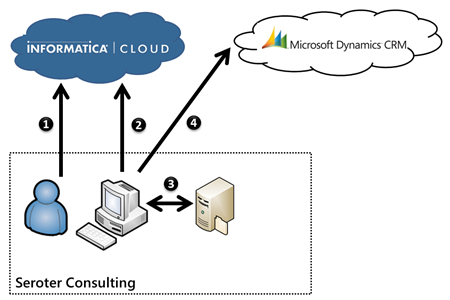
    In this post, I’ll build the following solution.

    2012.03.26informatica17

    In this solution, (1) I leverage the web-based designer to craft the ETL between Salesforce.com and Dynamics CRM Online, (2) use a locally installed Secure Cloud Agent to retrieve ETL details, (3) pull data from Salesforce.com, and finally (4) move that data into Dynamics CRM Online.

    What’s interesting is that even though this is a “cloud only” ETL, the Informatica Cloud solution still requires the use of the Cloud Secure Agent (installed on-premises) to facilitate the actual data transfer.

    To view some of the setup steps (such as signing up for services and installing required software), see the first post in this series.

    Building the ETL Package

    To start with, I logged into the Informatica Cloud and created a new Data Synchronization task.

    2012.03.26informatica18

    On the next wizard page, I created a new connection type for Salesforce.com and provided all the required credentials.

    2012.03.26informatica19

    With that in place, I could select that connection, the entity (“Contact”) to pull data from, and see a quick preview of that data in my Salesforce.com account.

    2012.03.26informatica20

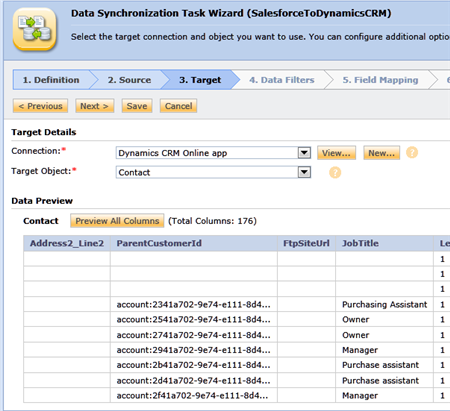
    On the next wizard page, I configured a connection to my ETL target. I chose an existing Dynamics CRM Online connection, and selected the “Contact” entity.

    2012.03.26informatica21

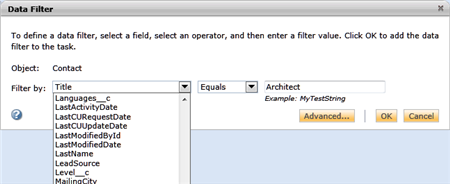
    Instead of transferring all the data from my Salesforce.com organization to my Dynamics CRM Online organization, I  used the next wizard page to define a data filter. In my case, I’m only going to grab Salesforce.com contacts that have a title of “Architect”.

    2012.03.26informatica22

    For the data mapping exercise, it’s nice that the Informatica tooling automatically links fields through its Automatch capability. In this scenario, I didn’t do any manual mapping and relied solely on Automatch.

    2012.03.26informatica23

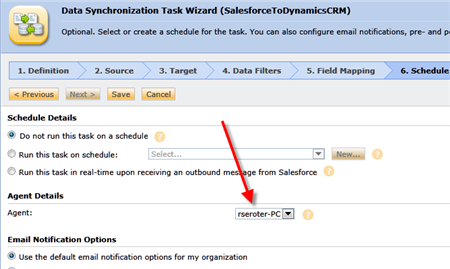
    While, like in my first post, I chose not to schedule this task, you’ll notice here that I *have* to select a Secure Cloud Agent. The agent is responsible for executing the ETL task after retrieving the details of the task from the Informatica Cloud.

    2012.03.26informatica24

    This ETL is now complete.

    Testing the ETL

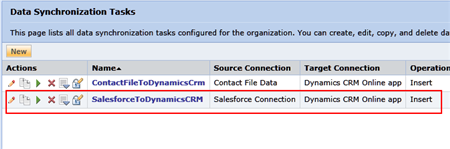
    In my list of Data Synchronization Tasks list, I can see my new task. The green Run Now button will trigger the task.

    2012.03.26informatica25

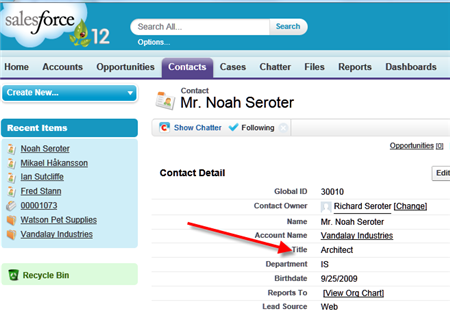
    I have this record in my Salesforce.com application. Notice the “title” of Architect.

    2012.03.26informatica26

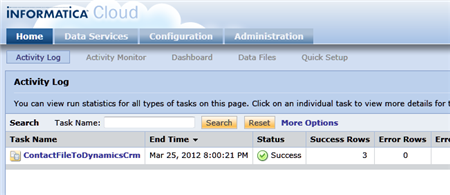
    After a few moments, the task runs and I could see in the Informatica Cloud’s Activity Log that this task completed successfully.

    2012.03.26informatica27

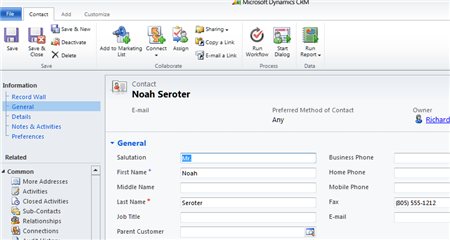
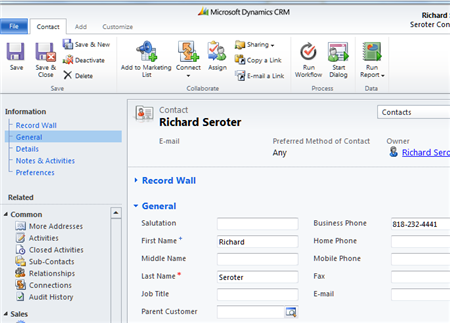
    To be absolutely sure, I logged into my Dynamics CRM Online account, and sure enough, I now have that one record added.

    2012.03.26informatica28

    Summary

    There are lots of reasons to do ETL between cloud applications. While Salesforce.com and Dynamics CRM Online are competing products, many large organizations are going to likely leverage both platforms for different reasons. Maybe you’ll have your sales personnel use Salesforce.com for traditional sales functions, and use Dynamics CRM Online for something like partner management. Either way, it’s great to have the option to easily move data between these environments without having to install and manage enterprise software on site.

    Next up, I’ll show you how to take Dynamics CRM Online data and push it to an on-premises database.

  • ETL in the Cloud with Informatica: Part 1 – Sending File Data to Dynamics CRM Online

    The more software systems that we deploy to cloud environments, the greater the need will be to have an efficient integration strategy. Integration through messaging is possible through something like an on-premises integration server, or via a variety of cloud tools such as queues hosted in AWS or something like the Windows Azure Service Bus Relay. However, what if you want to do some bulk data movement with Extract-Transform-Load (ETL) tools that cater to cloud solutions? One of the market leaders in the overall ETL market, Informatica, has also established a strong integration-as-a-service offering with its Informatica Cloud. They recently announced support for Dynamics CRM Online as a source/destination for ETL operations, so I got inspired to give their platform a whirl.

    Informatica Cloud supports a variety of sources/destinations for ETL operations and leverages a machine agent (“Cloud Secure Agent”) for securely connecting on-premises environments to cloud environments. Instead of installing any client development tools, I can design my ETL process entirely through their hosted web application. When the ETL process executes, the Cloud Secure Agent retrieves the ETL details from the cloud and runs the task. There is  no need to install or maintain a full server product for hosting and running these tasks. The Informatica Cloud doesn’t actually store any transactional data itself, and acts solely as a passthrough that executes the package (through the Cloud Secure Agent) and moves data around. All in all, neat stuff.

    In this four-part blog series, I will walk through the following scenarios:

    Scenario Summary

    So what are we building in this post?

    2012.03.26informatica01

    What’s going to happen is that (1) I’ll use the Informatica Cloud to define an ETL that takes a flat file from my local machine and copies the data to Dynamics CRM Online, (2) the Secure Cloud Agent will communicate with the Informatica Cloud to get the ETL details, (3) the Secure Cloud Agent retrieves the flat file from my local machine, and finally (4) the package runs and data is loaded into Dynamics CRM Online.

    Sound good? Let’s jump in.

    Setup

    In this first post of the blog series, I’ll outline a few of the setup steps that I followed to get everything up and running. In subsequent posts, I’ll skip over this. First, I used my existing, free, Salesforce.com Developer account. Next, I signed up for a 30-day free trial of Dynamics CRM Online. After that, I signed up for a 30-day free trial of the Informatica Cloud.

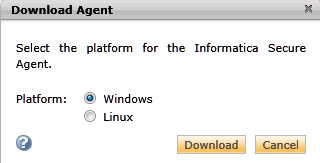
    Finally, I downloaded the Informatica agent to my local machine.

    2012.03.26informatica02

    Once the agent is installed, I can manage it through a simple console.

    2012.03.26informatica03

    Building the ETL Package

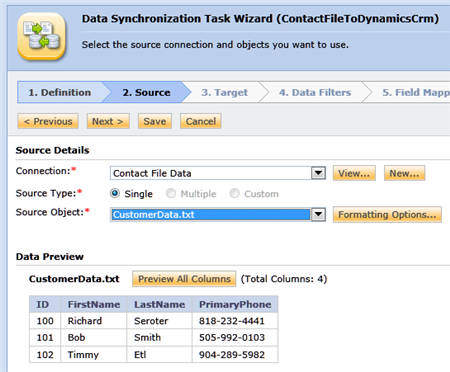
    To get started, I logged into my Informatica Cloud account and walked through their Data Synchronization wizard. In the first step, I named my Task and chose to do an Insert operation.

    2012.03.26informatica04

    Next, I chose to create a “flat file” connection type. This requires my Agent to have permissions on my file system, so I set the Agent’s Windows Service to run as a trusted account on my machine.

    2012.03.26informatica05

    With the connection defined, I could then choose to use a comma delimited formatter, and chose the text file in the “temp” directory I had selected above. I can immediately see a preview that showed how my data was parsed.

    2012.03.26informatica06

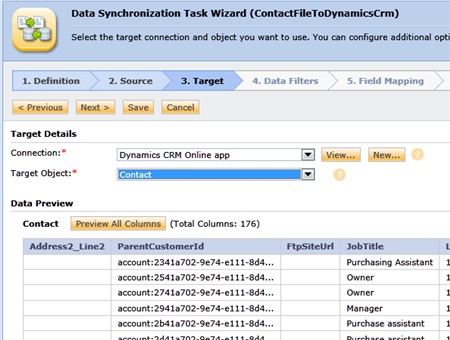
    On the next wizard page, I chose to create a new target connection. Here I selected Dynamics CRM Online as my destination system, and filled out the required properties (e.g. user ID, password, CRM organization name).

    2012.03.26informatica07

    Note that the Organization Name above is NOT the Organization Unique Name that is part of the Dynamics CRM Online account and viewable from the Customizations -> Developer Resources page.

    2012.03.26informatica08

    Rather, this is the Organization Name that I set up when signed up for my free trial. Note that this value is also case sensitive. Once I set this connection, an automatic preview of the data in that Dynamics CRM entity was shown.

    2012.03.26informatica09

    On the next wizard page, I kept the default options and did NOT add any filters to the source data.

    2012.03.26informatica10

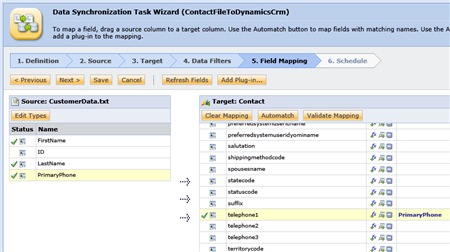
    Now we get to the fun part. The Field Mapping page is where I set which source fields go to which destination fields. The interface supports drag and drop between the two sides.

    2012.03.26informatica11

    Besides straight up one-to-one mapping, you can also leverage Expressions when conditional logic or field manipulation is needed. In the picture below, you can see that I added a concatenation function to combine the FirstName and LastName fields and put them into a FullName field.

    2012.03.26informatica12

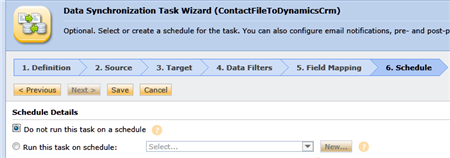
    In addition to Expressions, we also have the option of adding Lookups to the mapping. A lookup allows us to pull in one value (e.g. City) based on another (e.g. Zip) that may be in an entirely different source location. The final step of the wizard involves defining a schedule for running this task. I chose to have “no schedule” which means that this task is run manually.

    2012.03.26informatica13

    And that’s it! I now have an Informatica package that can be run whenever I want.

    Testing the ETL

    We’re ready to try this out. The Tasks page shows all my available tasks, and the green Run Now button will kick the ETL off. Remember that my Cloud Secure Agent must be up and running for this to work. After starting up the job, I was told that it make take a few minutes to launch and run. Within a couple minutes, I saw a “success” message in my Activity Log.

    2012.03.26informatica15

    But that doesn’t prove anything! Let’s look inside my Dynamics CRM Online application and locate one of those new records.

    2012.03.26informatica16

    Success! My three records came across, and in the record above, we can see that the first name, last name and phone number were transferred over.

    Summary

    That was pretty straightforward. As you can imagine, these ETLs can get much more complicated as you have related entities and such. However, this web-based ETL designer means that organizations will have a much simpler maintenance profile since they don’t have to host and run these ETLs using on-premises servers.

    Next up, I’ll show you how you can move data between two entirely cloud-based environments: Salesforce.com and Dynamics CRM Online.

  • Integration in the Cloud: Part 4 – Asynchronous Messaging Pattern

    So far in this blog series we’ve been looking at how Enterprise Integration Patterns apply to cloud integration scenarios. We’ve seen that a Shared Database Pattern works well when you have common data (and schema) and multiple consumers who want consistent access.  The Remote Procedure Invocation Pattern is a good fit when one system desires synchronous access to data and functions sitting in other systems. In this final post in the series, I’ll walk through the Asynchronous Messaging Pattern and specifically demonstrate how to share data between clouds using this pattern.

    What Is It?

    While the remote procedure pattern provides looser coupling than the shared database pattern, it is still a blocking call and not particularly scalable.  Architects and developers use an asynchronous messaging pattern when they want to share data in the most scalable and responsive way possible.  Think of sending an email.  Your email client doesn’t sit and wait until the recipient has received and read the email message.  That would be atrocious. Instead, our email server does a multicast to recipients allows our email client to carry on. This is somewhat similar to publish/subscribe where the publisher does not dictate which specific receiver will get the message.

    So in theory, the sender of the message doesn’t need to know where the message will end up.  They also don’t need to know *when* a message is received or processed by another party.  This supports disconnected client scenarios where the subscriber is not online at the same time as the publisher.  It also supports the principle of replicable units where one receiver could be swapped out with no direct impact to the source of the message.  We see this pattern realized in Enterprise Service Bus or Integration Bus products (like BizTalk Server) which promote extreme loose coupling between systems.

    Challenges

    There are a few challenges when dealing with this pattern.

    • There is no real-time consistency. Because the message source asynchronously shares data that will be processed at the convenience of the receiver, there is a low likelihood that the systems involved are simultaneously consistent.  Instead, you end up with eventual consistency between the players in the messaging solution.
    • Reliability / durability is required in some cases. Without a persistence layer, it is possible to lose data.  Unlike the remote procedure invocation pattern (where exceptions are thrown by the target and both caught and handled by the caller), problems in transmission or target processing do not flow back to the publisher.  What happens if the recipient of a message is offline?  What if the recipient is under heavy load and rejecting new messages? A durable component in the messaging tier can protect against such cases by doing store-and-forward type implementation that doesn’t remove the message from the durable store until it has been successfully consumed.
    • A router may be useful when transmitting messages. Instead of, or in addition to a durable store, a routing component can help manage the central subscriptions for pub/sub transmissions, help with protocol bridging, data transformation and workflow (e.g. something like BizTalk Server). This may not be needed in distributed ESB solutions where the receiver is responsible for most of that.
    • There is limited support for this pattern in packaged software products.  I’ve seen few commercial products that expose asynchronous inbound channels, and even fewer that have easy-to-configure ways to publish outbound events asynchronously.  It’s not that difficult to put adapters in front of these systems, or mimic asynchronous publication by polling a data tier, but it’s not the same.

    Cloud Considerations

    What are things to consider when doing this pattern in a cloud scenario?

    • To do this between cloud and on-premises solutions, this requires creativity. I showed in the previous post how one can use Windows Azure AppFabric to expose on-premises endpoints to cloud applications. If we need to push data on-premises, and Azure AppFabric isn’t an option, then you’re looking at doing a VPN or internet-facing proxy service. Or, you could rely on aggressive polling of a shared queue (as I’ll show below).
    • Cloud provider limits and architecture will influence solution design. Some vendors, such as Salesforce.com, limit the frequency and amount of polling that it will do. This impacts the ability to poll a durable store used between cloud applications. The distributed nature of cloud services. and embrace of the eventual consistency model, can change how one retrieves data.  For example, Amazon’s Simple Queue Service may not be first-in-first out, and uses a sampling algorithm that COULD result in a query not returning all the messages in the logical queue.

    Solution Demonstration

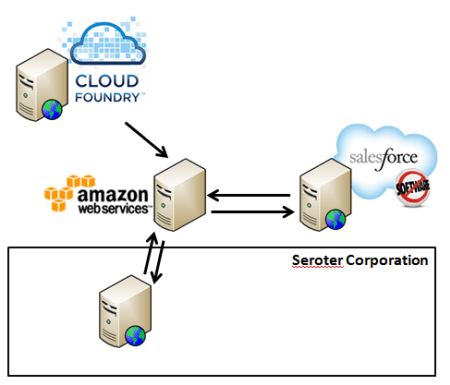
    Let’s say that the fictitious Seroter Corporation has a series of public websites and wants a consistent way to push customer inquiries from the websites to back end systems that process these inquiries.  Instead of pushing these inquiries directly into one or many CRM systems, or doing the low-tech email option, we’d rather put all the messages into a queue and let each interested party pull the ones they want.  Since these websites are cloud-hosted, we don’t want to explicitly push these messages into the internal network, but rather, asynchronously publish and poll messages from a shared queue hosted by Amazon Simple Queue Service (SQS). The polling applications could either be another cloud system (CRM system Salesforce.com) or an on-premises system, as shown below.
    2011.11.14int01

    So I’ll have a web page built using Ruby and hosted in Cloud Foundry, a SQS queue that holds inquiries submitted from that site, and both an on-premises .NET application and a SaaS Salesforce.com application that can poll that queue for messages.

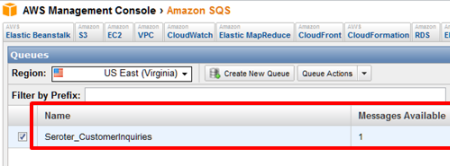
    Setting up a queue in SQS is so easy now, that I won’t even make it a sub-section in this post.  The AWS team recently added SQS operations to their Management Console, and they’ve made it very simple to create, delete, secure and monitor queues. I created a new queue named Seroter_CustomerInquiries.

    2011.11.14int02

    Sending Messages from Cloud Foundry to Amazon Simple Queue Service

    In my Ruby (Sinatra) application, I have a page where a user can ask a question.  When they click the submit button, I go into the following routine which builds up the SQS message (similar to the SimpleDB message from my previous post) and posts a message to the queue.

    post '/submitted/:uid' do	# method call, on submit of the request path, do the following
    
       #--get user details from the URL string
    	@userid = params[:uid]
    	@message = CGI.escape(params[:message])
        #-- build message that will be sent to the queue
    	@fmessage = @userid + "-" + @message.gsub("+", "%20")
    
    	#-- define timestamp variable and format
    	@timestamp = Time.now
    	@timestamp = @timestamp.strftime("%Y-%m-%dT%H:%M:%SZ")
    	@ftimestamp = CGI.escape(@timestamp)
    
    	#-- create signing string
    	@stringtosign = "GET\n" + "queue.amazonaws.com\n" + "/084598340988/Seroter_CustomerInquiries\n" + "AWSAccessKeyId=ACCESS_KEY" + "&Action=SendMessage" + "&MessageBody=" + @fmessage + "&SignatureMethod=HmacSHA1" + "&SignatureVersion=2" + "&Timestamp=" + @ftimestamp + "&Version=2009-02-01"
    
    	#-- create hashed signature
    	@esignature = CGI.escape(Base64.encode64(OpenSSL::HMAC.digest('sha1',@@awskey, @stringtosign)).chomp)
    
    	#-- create AWS SQS query URL
    	@sqsurl = "https://queue.amazonaws.com/084598340988/Seroter_CustomerInquiries?Action=SendMessage" + "&MessageBody=" + @fmessage + "&Version=2009-02-01" + "&Timestamp=" + @ftimestamp + "&Signature=" + @esignature + "&SignatureVersion=2" + "&SignatureMethod=HmacSHA1" + "&AWSAccessKeyId=ACCESS_KEY"
    
    	#-- load XML returned from query
    	@doc = Nokogiri::XML(open(@sqsurl))
    
       #-- build result message which is formatted string of the inquiry text
    	@resultmsg = @fmessage.gsub("%20", " ")
    
    	haml :SubmitResult
    end
    

    The hard part when building these demos was getting my signature string and hashing exactly right, so hopefully this helps someone out.

    After building and deploying the Ruby site to Cloud Foundry, I could see my page for inquiry submission.

    2011.11.14int03

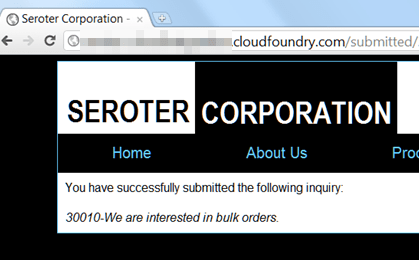
    When the user hits the “Send Inquiry” button, the function above is called and assuming that I published successfully to the queue, I see the acknowledgement page.  Since this is an asynchronous communication, my web app only has to wait for publication to the queue, not invoking a function in a CRM system.
    2011.11.14int04

    To confirm that everything worked, I viewed my SQS queue and can clearly see that I have a single message waiting in the queue.

    2011.11.14int05

    .NET Application Pulling Messages from an SQS Queue

    With our message sitting safely in the queue, now we can go grab it.  The first consuming application is an on-premises .NET app.  In this very feature-rich application, I poll the queue and pull down any messages found.  When working with queues, you often have two distinct operations: read and delete (“peek” is also nice to have). I can read messages from a queue, but unless I delete them, they become available (after a timeout) to another consumer.  For this scenario, we’d realistically want to read all the messages, and ONLY process and delete the ones targeted for our CRM app.  Any others, we simply don’t delete, and they go back to waiting in the queue. I haven’t done that, for simplicity sake, but keep this in mind for actual implementations.

    In the example code below, I’m being a bit lame by only expecting a single message. In reality, when polling, you’d loop through each returned message, save its Handle value (which is required when calling the Delete operation) and do something with the message.  In my case, I only have one message, so I explicitly grab the “Body” and “Handle” values.  The code shows the “retrieve messages” button click operation which in turn calls “receive” operation and “delete” operation.

    private void RetrieveButton_Click(object sender, EventArgs e)
            {
                lbQueueMsgs.Items.Clear();
                lblStatus.Text = "Status:";
    
                string handle = ReceiveFromQueue();
                if(handle!=null)
                    DeleteFromQueue(handle);
    
            }
    
    private string ReceiveFromQueue()
            {
                //timestamp formatting for AWS
                string timestamp = Uri.EscapeUriString(string.Format("{0:s}", DateTime.UtcNow));
                timestamp = DateTime.Now.ToUniversalTime().ToString("yyyy-MM-ddTHH:mm:ss.fffZ");
                timestamp = HttpUtility.UrlEncode(timestamp).Replace("%3a", "%3A");
    
                //string for signing
                string stringToConvert = "GET\n" +
                "queue.amazonaws.com\n" +
                "/084598340988/Seroter_CustomerInquiries\n" +
                "AWSAccessKeyId=ACCESS_KEY" +
                "&Action=ReceiveMessage" +
                "&AttributeName=All" +
                "&MaxNumberOfMessages=5" +
                "&SignatureMethod=HmacSHA1" +
                "&SignatureVersion=2" +
                "&Timestamp=" + timestamp +
                "&Version=2009-02-01" +
                "&VisibilityTimeout=15";
    
                //hash the signature string
    			  string awsPrivateKey = "PRIVATE KEY";
                Encoding ae = new UTF8Encoding();
                HMACSHA1 signature = new HMACSHA1();
                signature.Key = ae.GetBytes(awsPrivateKey);
                byte[] bytes = ae.GetBytes(stringToConvert);
                byte[] moreBytes = signature.ComputeHash(bytes);
                string encodedCanonical = Convert.ToBase64String(moreBytes);
                string urlEncodedCanonical = HttpUtility.UrlEncode(encodedCanonical).Replace("%3d", "%3D");
    
                 //build up request string (URL)
                string sqsUrl = "https://queue.amazonaws.com/084598340988/Seroter_CustomerInquiries?Action=ReceiveMessage" +
                "&Version=2009-02-01" +
                "&AttributeName=All" +
                "&MaxNumberOfMessages=5" +
                "&VisibilityTimeout=15" +
                "&Timestamp=" + timestamp +
                "&Signature=" + urlEncodedCanonical +
                "&SignatureVersion=2" +
                "&SignatureMethod=HmacSHA1" +
                "&AWSAccessKeyId=ACCESS_KEY";
    
                //make web request to SQS using the URL we just built
                HttpWebRequest req = WebRequest.Create(sqsUrl) as HttpWebRequest;
                XmlDocument doc = new XmlDocument();
                using (HttpWebResponse resp = req.GetResponse() as HttpWebResponse)
                {
                    StreamReader reader = new StreamReader(resp.GetResponseStream());
                    string responseXml = reader.ReadToEnd();
                    doc.LoadXml(responseXml);
                }
    
    			 //do bad xpath and grab the body and handle
                XmlNode handle = doc.SelectSingleNode("//*[local-name()='ReceiptHandle']");
                XmlNode body = doc.SelectSingleNode("//*[local-name()='Body']");
    
                //if empty then nothing there; if not, then add to listbox on screen
                if (body != null)
                {
                    //write result
                    lbQueueMsgs.Items.Add(body.InnerText);
                    lblStatus.Text = "Status: Message read from queue";
                    //return handle to calling function so that we can pass it to "Delete" operation
                    return handle.InnerText;
                }
                else
                {
                    MessageBox.Show("Queue empty");
                    return null;
                }
            }
    
    private void DeleteItem(string itemId)
            {
                //timestamp formatting for AWS
                string timestamp = Uri.EscapeUriString(string.Format("{0:s}", DateTime.UtcNow));
                timestamp = DateTime.Now.ToUniversalTime().ToString("yyyy-MM-ddTHH:mm:ss.fffZ");
                timestamp = HttpUtility.UrlEncode(timestamp).Replace("%3a", "%3A");
    
                string stringToConvert = "GET\n" +
                "sdb.amazonaws.com\n" +
                "/\n" +
                "AWSAccessKeyId=ACCESS_KEY" +
                "&Action=DeleteAttributes" +
                "&DomainName=SeroterInteractions" +
                "&ItemName=" + itemId +
                "&SignatureMethod=HmacSHA1" +
                "&SignatureVersion=2" +
                "&Timestamp=" + timestamp +
                "&Version=2009-04-15";
    
                string awsPrivateKey = "PRIVATE KEY";
                Encoding ae = new UTF8Encoding();
                HMACSHA1 signature = new HMACSHA1();
                signature.Key = ae.GetBytes(awsPrivateKey);
                byte[] bytes = ae.GetBytes(stringToConvert);
                byte[] moreBytes = signature.ComputeHash(bytes);
                string encodedCanonical = Convert.ToBase64String(moreBytes);
                string urlEncodedCanonical = HttpUtility.UrlEncode(encodedCanonical).Replace("%3d", "%3D");
    
                //build up request string (URL)
                string simpleDbUrl = "https://sdb.amazonaws.com/?Action=DeleteAttributes" +
                "&DomainName=SeroterInteractions" +
                "&ItemName=" + itemId +
                "&Version=2009-04-15" +
                "&Timestamp=" + timestamp +
                "&Signature=" + urlEncodedCanonical +
                "&SignatureVersion=2" +
                "&SignatureMethod=HmacSHA1" +
                "&AWSAccessKeyId=ACCESS_KEY";
    
                HttpWebRequest req = WebRequest.Create(simpleDbUrl) as HttpWebRequest;
    
                using (HttpWebResponse resp = req.GetResponse() as HttpWebResponse)
                {
                    StreamReader reader = new StreamReader(resp.GetResponseStream());
    
                    string responseXml = reader.ReadToEnd();
                }
            }
    

    When the application runs and pulls the message that I sent to the queue earlier, it looks like this.

    2011.11.14int06

    Nothing too exciting on the user interface, but we’ve just seen the magic that’s happening underneath. After running this (which included reading and deleting the message), the SQS queue is predictably empty.

    Force.com Application Pulling from an SQS Queue

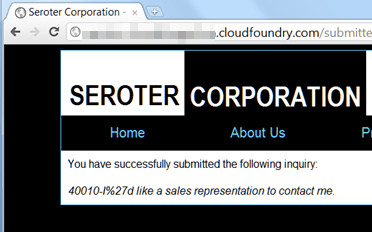
    I went ahead and sent another message from my Cloud Foundry app into the queue.
    2011.11.14int07

    This time, I want my cloud CRM users on Salesforce.com to pull these new inquiries and process them.  I’d like to automatically convert the inquiries to CRM Cases in the system.  A custom class in a Force.com application can be scheduled to execute every interval. To account for that (as the solution below supports both on-demand and scheduled retrieval from the queue), I’ve added a couple things to the code.  Specifically, notice that my “case lookup” class implements the Schedulable interface (which allows it be scheduled through the Force.com administrative tooling) and my “queue lookup” function uses the @future annotation (which allows asynchronous invocation).

    Much like the .NET application above, you’ll find operations below that retrieve content from the queue and then delete the messages it finds.  The solution differs from the one above in that it DOES handle multiple messages (not that it loops through retrieved results and calls “delete” for each) and also creates a Salesforce.com “case” for each result.

    //implement Schedulable to support scheduling
    global class doCaseLookup implements Schedulable
    {
    	//required operation for Schedulable interfaces
        global void execute(SchedulableContext ctx)
        {
            QueueLookup();
        }
    
        @future(callout=true)
        public static void QueueLookup()
        {
    	  //create HTTP objects and queue namespace
         Http httpProxy = new Http();
         HttpRequest sqsReq = new HttpRequest();
         String qns = 'http://queue.amazonaws.com/doc/2009-02-01/';
    
         //monkey with date format for SQS query
         Datetime currentTime = System.now();
         String formattedTime = currentTime.formatGmt('yyyy-MM-dd')+'T'+ currentTime.formatGmt('HH:mm:ss')+'.'+ currentTime.formatGmt('SSS')+'Z';
         formattedTime = EncodingUtil.urlEncode(formattedTime, 'UTF-8');
    
    	  //build signing string
         String stringToSign = 'GET\nqueue.amazonaws.com\n/084598340988/Seroter_CustomerInquiries\nAWSAccessKeyId=ACCESS_KEY&' +
    			'Action=ReceiveMessage&AttributeName=All&MaxNumberOfMessages=5&SignatureMethod=HmacSHA1&SignatureVersion=2&Timestamp=' +
    			formattedTime + '&Version=2009-02-01&VisibilityTimeout=15';
         String algorithmName = 'HMacSHA1';
         Blob mac = Crypto.generateMac(algorithmName, Blob.valueOf(stringToSign),Blob.valueOf(PRIVATE_KEY));
         String macUrl = EncodingUtil.urlEncode(EncodingUtil.base64Encode(mac), 'UTF-8');
    
    	  //build SQS URL that retrieves our messages
         String queueUrl = 'https://queue.amazonaws.com/084598340988/Seroter_CustomerInquiries?Action=ReceiveMessage&' +
    			'Version=2009-02-01&AttributeName=All&MaxNumberOfMessages=5&VisibilityTimeout=15&Timestamp=' +
    			formattedTime + '&Signature=' + macUrl + '&SignatureVersion=2&SignatureMethod=HmacSHA1&AWSAccessKeyId=ACCESS_KEY';
    
         sqsReq.setEndpoint(queueUrl);
         sqsReq.setMethod('GET');
    
         //invoke endpoint
         HttpResponse sqsResponse = httpProxy.send(sqsReq);
    
         Dom.Document responseDoc = sqsResponse.getBodyDocument();
         Dom.XMLNode receiveResponse = responseDoc.getRootElement();
         //receivemessageresult node which holds the responses
         Dom.XMLNode receiveResult = receiveResponse.getChildElements()[0];
    
         //for each Message node
         for(Dom.XMLNode itemNode: receiveResult.getChildElements())
         {
            String handle= itemNode.getChildElement('ReceiptHandle', qns).getText();
            String body = itemNode.getChildElement('Body', qns).getText();
    
            //pull out customer ID
            Integer indexSpot = body.indexOf('-');
            String customerId = '';
            if(indexSpot > 0)
            {
               customerId = body.substring(0, indexSpot);
            }
    
            //delete this message
            DeleteQueueMessage(handle);
    
    	     //create a new case
            Case c = new Case();
            c.Status = 'New';
            c.Origin = 'Web';
            c.Subject = 'Web request: ' + body;
            c.Description = body;
    
    		 //insert the case record into the system
            insert c;
         }
      }
    
      static void DeleteQueueMessage(string handle)
      {
    	 //create HTTP objects
         Http httpProxy = new Http();
         HttpRequest sqsReq = new HttpRequest();
    
         //encode handle value associated with queue message
         String encodedHandle = EncodingUtil.urlEncode(handle, 'UTF-8');
    
    	 //format the date
         Datetime currentTime = System.now();
         String formattedTime = currentTime.formatGmt('yyyy-MM-dd')+'T'+ currentTime.formatGmt('HH:mm:ss')+'.'+ currentTime.formatGmt('SSS')+'Z';
         formattedTime = EncodingUtil.urlEncode(formattedTime, 'UTF-8');
    
    		//create signing string
         String stringToSign = 'GET\nqueue.amazonaws.com\n/084598340988/Seroter_CustomerInquiries\nAWSAccessKeyId=ACCESS_KEY&' +
    					'Action=DeleteMessage&ReceiptHandle=' + encodedHandle + '&SignatureMethod=HmacSHA1&SignatureVersion=2&Timestamp=' +
    					formattedTime + '&Version=2009-02-01';
         String algorithmName = 'HMacSHA1';
         Blob mac = Crypto.generateMac(algorithmName, Blob.valueOf(stringToSign),Blob.valueOf(PRIVATE_KEY));
         String macUrl = EncodingUtil.urlEncode(EncodingUtil.base64Encode(mac), 'UTF-8');
    
    	  //create URL string for deleting a mesage
         String queueUrl = 'https://queue.amazonaws.com/084598340988/Seroter_CustomerInquiries?Action=DeleteMessage&' +
    					'Version=2009-02-01&ReceiptHandle=' + encodedHandle + '&Timestamp=' + formattedTime + '&Signature=' +
    					macUrl + '&SignatureVersion=2&SignatureMethod=HmacSHA1&AWSAccessKeyId=ACCESS_KEY';
    
         sqsReq.setEndpoint(queueUrl);
         sqsReq.setMethod('GET');
    
    	  //invoke endpoint
         HttpResponse sqsResponse = httpProxy.send(sqsReq);
    
         Dom.Document responseDoc = sqsResponse.getBodyDocument();
      }
    }
    

    When I view my custom APEX page which calls this function, I can see the button to query this queue.

    2011.11.14int08

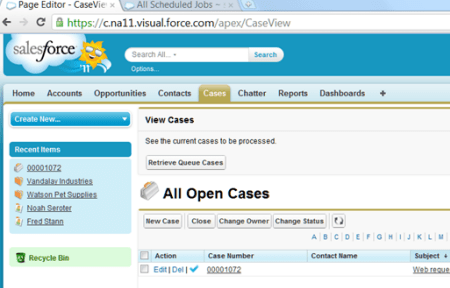
    When I click the button, our function retrieves the message from the queue, deletes that message, and creates a Salesforce.com case.
    2011.11.14int09

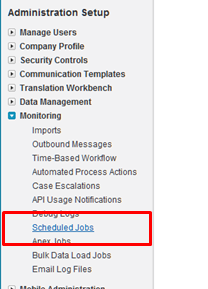
    Cool!  This still required me to actively click a button, but we can also make this function run every hour.  In the Salesforce.com configuration screens, we have the option to view Scheduled Jobs.

    2011.11.14int10

    To actually create the job itself, I had created an Apex class which schedules the job.

    global class CaseLookupJobScheduler
    {
        global void CaseLookupJobScheduler() {}
    
        public static void start()
        {
     		// takes in seconds, minutes, hours, day of month, month and day of week
    		//the statement below tries to schedule every 5 min, but SFDC only allows hourly
            System.schedule('Case Queue Lookup', '0 5 1-23 * * ?', new doCaseLookup());
        }
    }
    

    Note that I use the System.schedule operation. While my statement above says to schedules the doCaseLookup function to run every 5 minutes, in reality, it won’t.  Salesforce.com restricts these jobs from running too frequently and keeps jobs from running more than once per hour. One could technically game the system by using some of the ten allowable polling jobs to set of a series of jobs that start at different times of the hour. I’m not worrying about that here. To invoke this function and schedule the job, I first went to the System Log menu.

    2011.11.14int12

    From here, I can execute Apex code.  So, I can call my start() function, which should schedule the job.

    2011.11.14int13

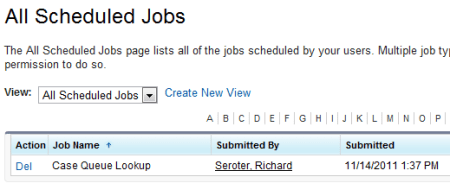
    Now, if I view the Scheduled Jobs view from the Setup screens, I can see that my job is scheduled.
    2011.11.14int14

    This job is now scheduled to run every hour.  This means that each hour, the queue is polled and any found messages are added to Salesforce.com as cases.  You could use a mix of both solutions and manually poll if you want to (through a button) but allow true asynchronous processing on all ends.

    Summary

    Asynchronous messaging is a great way to build scalable, loosely coupled systems. A durable intermediary helps provide assurances of message delivery, but this patterns works without it as well.  The demonstrations in this post shows how two cloud solutions can asynchronously exchange data through the use of a shared queue that sits between them.  The publisher to the queue has no idea who will retrieve the message and the retrievers have no direct connection to those who publish messages.  This makes for a very maintainable solution.

    My goal with these posts was to demonstrate that classic Integration patterns work fine in cloudy environments. I think it’s important to not throw out existing patterns just because new technologies are introduced. I hope you enjoyed this series.

  • Integration in the Cloud: Part 3 – Remote Procedure Invocation Pattern

    This post continues a series where I revisit the classic Enterprise Integration Patterns with a cloud twist. So far, I’ve introduced the series and looked at the Shared Database pattern. In this post, we’ll look the second pattern: remote procedure invocation.

    What Is It?

    One uses this remote procedure call (RPC) pattern when they have multiple, independent applications and want to share data or orchestrate cross-application processes. Unlike ETL scenarios where you move data between applications at defined intervals, or the shared database pattern where everyone accesses the same source data, the RPC pattern accesses data/process where it resides. Data typically stays with the source, and the consumer interacts with the other system through defined (service) contracts.
    You often see Service Oriented Architecture (SOA) solutions built around the pattern.  That is, exposing reusable, interoperable, abstract interfaces for encapsulated services that interact with one or many systems.  This is a very familiar pattern for developers and good for mashup pages/services or any application that needs to know something (or do something) before it can proceed. You often do not need guaranteed delivery for these services since the caller is notified of any exceptions from the service and can simply retry the invocation.

    Challenges

    There are a few challenges when leveraging this pattern.

    • There is still some coupling involved. While a well-built service exposes an abstract interface that decouples the caller from the service’s underlying implementation, the caller is still bound the service exposed by the system. Changes to that system or unavailability of that system will affect the caller.
    • Distinct service and capability offerings by each service. Unlike the shared database pattern where everyone agrees on a data schema and central repository, a RPC model leverages many services that reside all across the organization (or internet). One service may want certificate authentication, another uses Kerberos, and another does some weird token-based security. One service may support WS-Attachment and another may not.  Transactions may or may not be supported between services. In an RPC world, you are at the mercy of each service provider’s capabilities and design.
    • RPC is a blocking call. When you call a service that sends a response, you pretty much have to sit around and wait until the response comes back. A caller can design around this a bit using AJAX on a web front end, or using a callback pattern in the middleware tier, but at root, you have a synchronous operation that holds a thread while waiting for a response.
    • Queried data may be transient. If an application calls a service, gets some data, and shows it to a user, that data MAY not be persisted in the calling application. It’s cleaner that way, but, this prevents you from using the data in reports or workflows.  So, you simply have to decide early on if your calls to external services should result in persisted data (that must then either by synchronized or checked on future calls) or transient data.
    • Package software platforms have mixed support. To be sure, most modern software platforms expose their data via web services. Some will let you query the database directly for information. But, there’s very little consistently. Some platforms expose every tiny function as a service (not very abstract) and some expose giant “DoSomething()” functions that take in a generic “object” (too abstract).

    Cloud Considerations

    As far as I can tell, you have three scenarios to support when introducing the cloud to this pattern:

    • Cloud to cloud. I have one SaaS or custom PaaS application and want to consume data from another SaaS or PaaS application. This should be relatively straightforward, but we’ll talk more in a moment about things to consider.
    • On-premises to cloud. There is an on-premises application or messaging engine that wants data from a cloud application. I’d suspect that this is the one that most architects and developers have already played with or built.
    • Cloud to on-premises. A cloud application wants to leverage data or processes that sit within an organization’s internal network. For me, this is the killer scenario. The integration strategy for many cloud vendors consists of “give us your data and move/duplicate your processes here.” But until an organization moves entire off-site (if that ever really happens for large enterprises), there is significant investment in the on-premises assets and we want to unlock those and avoid duplication where possible.

    So what are the  things to think about when doing RPC in a cloud scenario?

    • Security between clouds or to on-premises systems. If integrating two clouds, you need some sort of identity federation, or, you’ll use per-service credentials. That can get tough to manage over time, so it would be nice to leverage cloud providers that can share identity providers. When consuming on premises services from cloud-based applications, you have two clear choices:
      • Use a VPN. This works if you are doing integration with an IaaS-based application where you control the cloud environment a bit (e.g. Amazon Virtual Private Cloud). You can also pull this off a bit with things like the Google Secure Data Connector (for Google Apps for GAE) or Windows Azure Connect.
      • Leverage a reverse proxy and expose data/services to public internet. We can define a intermediary that sits in an internet-facing zone and forwards traffic behind the firewall to the actual services to invoke. Even if this is secured well, some organizations may be wary to expose key business functions or data to the internet.
    • There may be additional latency. For some application, especially based on location, there could be a longer delay when doing these blocking remote procedure calls.  But more likely, you’ll have additional latency due to security.  That is, many providers have a two step process where the first service call against the cloud platform is for getting a security token, and the second call is the actual function call (with the token in the payload).  You may be able to cache the token to avoid the double-hop each time, but this is still something to factor in.
    • Expect to only use HTTP. Few (if any) SaaS applications expose their underlying database. You may be used to doing quick calls against another system by querying it’s data store, but that’s likely a non-starter when working with cloud applications.

    The one option for cloud-to-on-premises that I left out here, and one that I’m convinced is a differentiating piece of Microsoft software, is the Azure AppFabric Service Bus.  Using this technology, I can securely expose on-premises services to the public internet WITHOUT the use of a VPN or reverse proxy. And, these services can be consumed by a wide variety of platforms.  In fact, that’s the basis for the upcoming demonstration.

    Solution Demonstration

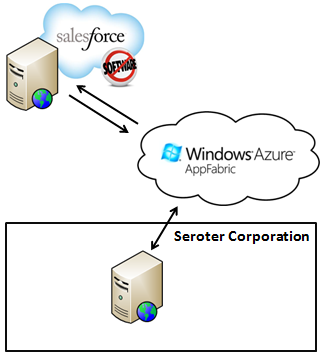
    So what if I have a cloud-based SaaS/PaaS application, say Salesforce.com, and I want to leverage a business service that sits on site.  Specifically, the fictitious Seroter Corporation, a leader in fictitious manufacturing, has an algorithm that they’ve built to calculate the best discount that they can give a vendor. When they moved their CRM platform to Salesforce.com, their sales team still needed access to this calculation. Instead of duplicating the algorithm in their Force.com application, they wanted to access the existing service. Enter the Azure AppFabric Service Bus.

    2011.10.31int01

    Instead of exposing the business service via VPN or reverse proxy, they used the AppFabric Service Bus and the Force.com application simply invokes the service and shows the results.  Note that this pattern (and example) is very similar to the one that I demonstrated in my new book. The only difference is that I’m going directly at the service here instead of going through a BizTalk Server (as I did in the book).

    WCF Service Exposed Via Azure AppFabric Service Bus

    I built a simple Windows Console application to host my RESTful web service. Note that I did this with the 1.0 version of the AppFabric Service Bus SDK.  The contract for the “Discount Service” looks like this:

    [ServiceContract]
        public interface IDiscountService
        {
            [WebGet(UriTemplate = "/{accountId}/Discount")]
            [OperationContract]
            Discount GetDiscountDetails(string accountId);
        }
    
        [DataContract(Namespace = "http://CloudRealTime")]
        public class Discount
        {
            [DataMember]
            public string AccountId { get; set; }
            [DataMember]
            public string DateDelivered { get; set; }
            [DataMember]
            public float DiscountPercentage { get; set; }
            [DataMember]
            public bool IsBestRate { get; set; }
        }
    

    My implementation of this contract is shockingly robust.  If the customer’s ID is equal to 200, they get 10% off.  Otherwise, 5%.

    public class DiscountService: IDiscountService
        {
            public Discount GetDiscountDetails(string accountId)
            {
                Discount d = new Discount();
                d.DateDelivered = DateTime.Now.ToShortDateString();
                d.AccountId = accountId;
    
                if (accountId == "200")
                {
                    d.DiscountPercentage = .10F;
                    d.IsBestRate = true;
                }
                else
                {
                    d.DiscountPercentage = .05F;
                    d.IsBestRate = false;
                }
    
                return d;
    
            }
        }
    

    The secret sauce to any Azure AppFabric Service Bus connection lies in the configuration.  This is where we can tell the service to bind to the Microsoft cloud and provide the address and credentials to do so. My full configuration file looks like this:

    <configuration>
    <startup><supportedRuntime version="v4.0" sku=".NETFramework,Version=v4.0"/></startup><system.serviceModel>
            <behaviors>
                <endpointBehaviors>
                    <behavior name="CloudEndpointBehavior">
                        <webHttp />
                        <transportClientEndpointBehavior>
                            <clientCredentials>
                              <sharedSecret issuerName="ISSUER" issuerSecret="SECRET" />
                            </clientCredentials>
                        </transportClientEndpointBehavior>
                        <serviceRegistrySettings discoveryMode="Public" />
                    </behavior>
                </endpointBehaviors>
            </behaviors>
            <bindings>
                <webHttpRelayBinding>
                  <binding name="CloudBinding">
                    <security relayClientAuthenticationType="None" />
                  </binding>
                </webHttpRelayBinding>
            </bindings>
            <services>
                <service name="QCon.Demos.CloudRealTime.DiscountSvc.DiscountService">
                    <endpoint address="https://richardseroter.servicebus.windows.net/DiscountService"
                        behaviorConfiguration="CloudEndpointBehavior" binding="webHttpRelayBinding"
                        bindingConfiguration="CloudBinding" name="WebHttpRelayEndpoint"
                        contract="IDiscountService" />
                </service>
            </services>
        </system.serviceModel>
    </configuration>
    

    I built this demo both with and without client security turned on.  As you see above, my last version of the demonstration turned off client security.

    In the example above, if I send a request from my Force.com application to https://richardseroter.servicebus.windows.net/DiscountService, my request is relayed from the Microsoft cloud to my live on-premises service. When I test this out from the browser (which is why I earlier turned off client security), I can see that passing in a customer ID of 200 in the URL results in a discount of 10%.

    2011.10.31int02

    Calling the AppFabric Service Bus from Salesforce.com

    With an internet-accessible service ready to go, all that’s left is to invoke it from my custom Force.com page. My page has a button where the user can invoke the service and review the results.  The results may, or may not, get saved to the customer record.  It’s up to the user. The Force.com page uses a custom controller that has the operation which calls the Azure AppFabric endpoint. Note that I’ve had some freakiness lately with this where I get back certificate errors from Azure.  I don’t know what that’s about and am not sure if it’s an Azure problem or Force.com problem.  But, if I call it a few times, it works.  Hence, I had to add exception handling logic to my code!

    public class accountDiscountExtension{
    
        //account variable
        private final Account myAcct;
    
        //constructor which sets the reference to the account being viewed
        public accountDiscountExtension(ApexPages.StandardController controller) {
            this.myAcct = (Account)controller.getRecord();
        }
    
        public void GetDiscountDetails()
        {
            //define HTTP variables
            Http httpProxy = new Http();
            HttpRequest acReq = new HttpRequest();
            HttpRequest sbReq = new HttpRequest();
    
            // ** Getting Security Token from STS
           String acUrl = 'https://richardseroter-sb.accesscontrol.windows.net/WRAPV0.9/';
           String encodedPW = EncodingUtil.urlEncode(acsKey, 'UTF-8');
    
           acReq.setEndpoint(acUrl);
           acReq.setMethod('POST');
           acReq.setBody('wrap_name=ISSUER&wrap_password=' + encodedPW + '&wrap_scope=http://richardseroter.servicebus.windows.net/');
           acReq.setHeader('Content-Type','application/x-www-form-urlencoded');
    
           //** commented out since we turned off client security
           //HttpResponse acRes = httpProxy.send(acReq);
           //String acResult = acRes.getBody();
    
           // clean up result
           //String suffixRemoved = acResult.split('&')[0];
           //String prefixRemoved = suffixRemoved.split('=')[1];
           //String decodedToken = EncodingUtil.urlDecode(prefixRemoved, 'UTF-8');
           //String finalToken = 'WRAP access_token=\"' + decodedToken + '\"';
    
           // setup service bus call
           String sbUrl = 'https://richardseroter.servicebus.windows.net/DiscountService/' + myAcct.AccountNumber + '/Discount';
            sbReq.setEndpoint(sbUrl);
           sbReq.setMethod('GET');
           sbReq.setHeader('Content-Type', 'text/xml');
    
           //** commented out the piece that adds the security token to the header
           //sbReq.setHeader('Authorization', finalToken);
    
           try
           {
           // invoke Service Bus URL
           HttpResponse sbRes = httpProxy.send(sbReq);
           Dom.Document responseDoc = sbRes.getBodyDocument();
           Dom.XMLNode root = responseDoc.getRootElement();
    
           //grab response values
           Dom.XMLNode perNode = root.getChildElement('DiscountPercentage', 'http://CloudRealTime');
           Dom.XMLNode lastUpdatedNode = root.getChildElement('DateDelivered', 'http://CloudRealTime');
           Dom.XMLNode isBestPriceNode = root.getChildElement('IsBestRate', 'http://CloudRealTime');
    
           Decimal perValue;
           String lastUpdatedValue;
           Boolean isBestPriceValue;
    
           if(perNode == null)
           {
               perValue = 0;
           }
           else
           {
               perValue = Decimal.valueOf(perNode.getText());
           }
    
           if(lastUpdatedNode == null)
           {
               lastUpdatedValue = '';
           }
           else
           {
               lastUpdatedValue = lastUpdatedNode.getText();
           }
    
           if(isBestPriceNode == null)
           {
               isBestPriceValue = false;
           }
           else
           {
               isBestPriceValue = Boolean.valueOf(isBestPriceNode.getText());
           }
    
           //set account object values to service result values
           myAcct.DiscountPercentage__c = perValue;
           myAcct.DiscountLastUpdated__c = lastUpdatedValue;
           myAcct.DiscountBestPrice__c = isBestPriceValue;
    
           myAcct.Description = 'Successful query.';
           }
           catch(System.CalloutException e)
           {
              myAcct.Description = 'Oops.  Try again';
           }
        }
    

    Got all that? Just a pair of calls.  The first gets the token from the Access Control Service (and this code likely changes when I upgrade this to use ACS v2) and the second invokes the service.  Then there’s just a bit of housekeeping to handle empty values before finally setting the values that will show up on screen.

    When I invoke my service (using the “Get Discount” button, the controller is invoked and I make a remote call to my AppFabric Service Bus endpoint. The customer below has an account number equal to 200, and thus the returned discount percentage is 10%.2011.10.31int03


    Summary

    Using a remote procedure invocation is great when you need to request data or when you send data somewhere and absolutely have to wait for a response. Cloud applications introduce some wrinkles here as you try to architect secure, high performing queries that span clouds or bridge clouds to on-premises applications. In this example, I showed how one can quickly and easily expose internal services to public cloud applications by using the Windows Azure AppFabric Service Bus.  Regardless of the technology or implementation pattern, we all will be spending a lot of time in the foreseeable future building hybrid architectures so the more familiar we get with the options, the better!

    In the final post in this series, I’ll take a look at using asynchronous messaging between (cloud) systems.