Category: Messaging

  • I’m looking forward these 8 sessions at Google Cloud Next ’20 OnAir (Week 7)

    I’m looking forward these 8 sessions at Google Cloud Next ’20 OnAir (Week 7)

    It’s here. After six weeks of OTHER topics, we’re up to week seven of Google Cloud Next OnAir, which is all about my area: app modernization. The “app modernization” bucket in Google Cloud covers lots of cool stuff including Cloud Code, Cloud Build, Cloud Run, GKE, Anthos, Cloud Operations, and more. It basically addresses the end-to-end pipeline of modern apps. I recently sketched it out like this:

    I think this the biggest week of Next, with over fifty breakout sessions. I like that most of the breakouts so far have been ~20 minutes, meaning you can log in, set playback speed to 1.5x, and chomp through lots of topic quickly. 

    Here are eight of the sessions I’m looking forward to most:

    1. Ship Faster, Spend Less By Going Multi-Cloud with Anthos. This is the “keynote” for the week. We’re calling out a few product announcements, highlighting some new customers, and saying keynote-y things. You’ll like it.
    2. GKE Turns 5: What’s New? All Kubernetes aren’t the same. GKE stands apart, and the team continues solving customer problems in new ways. This should be a great look back, and look ahead.
    3. Cloud Run: What’s New? To me, Cloud Run has the best characteristics of PaaS, combined with the the event-driven, scale-to-zero of serverless functions. This is the best place I know of to run custom-built apps in the Google Cloud (or anywhere, with Anthos).
    4. Modernize Legacy Java Apps Using Anthos. Whoever figures out how to unlock value from existing (Java) apps faster, wins. Here’s what Google Cloud is doing to help customers improve their Java apps and run them on a great host.
    5. Running Anthos on Bare Metal and at the Edge with Major League Baseball (MLB). Baseball’s back, my Slam Diego Padres are fun again, and Anthos is part of the action. Good story here.
    6. Getting Started with AnthosAnthos Deep Dive: Part OneAnthos Deep Dive: Part Two. Am I cheating by making three sessions into one entry? Fine, you caught me. But this three part trilogy is a great way to grok Anthos and understand its value.
    7. Develop for Cloud Run in the IDE with Cloud Code. Cloud Code extends your IDE to support Google Cloud, and Cloud Run is great. Combine the two, and you’ve got some good stuff.
    8. Event-Driven Microservices with Cloud Run. You’re going to enjoy this one, and seeing what’s now possible.

    I’m looking forward to this week. We’re sharing lots of fun progress, and demonstrating some fresh perspectives on what app modernization should look like. Enjoy watching!

  • Google Cloud’s support for Java is more comprehensive than I thought

    Google Cloud’s support for Java is more comprehensive than I thought

    Earlier this year, I took a look at how Microsoft Azure supports  Java/Spring developers. With my change in circumstances, I figured it was a good time to dig deep into Google Cloud’s offerings for Java developers. What I found was a very impressive array of tools, services, and integrations. More than I thought I’d find, honestly. Let’s take a tour.

    Local developer environment

    What stuff goes on your machine to make it easier to build Java apps that end up on Google Cloud?

    Cloud Code extension for IntelliJ

    Cloud Code is a good place to start. Among other things, it delivers extensions to IntelliJ and Visual Studio Code. For IntelliJ IDEA users, you get starter templates for new projects, snippets for authoring relevant YAML files, tool windows for various Google Cloud services, app deployment commands, and more. Given that 72% of Java developers use IntelliJ IDEA, this extension helps many folks.

    Cloud Code in VS Code

    The Visual Studio Code extension is pretty great too. It’s got project starters and other command palette integrations, Activity Bar entries to manage Google Cloud services, deployment tools, and more. 4% of Java devs use Visual Studio Code, so, we’re looking out for you too. If you use Eclipse, take a look at the Cloud Tools for Eclipse.

    The other major thing you want locally is the Cloud SDK. Within this little gem you get client libraries for your favorite language, CLIs, and emulators. This means that as Java developers, we get a Java client library, command line tools for all-up Google Cloud (gcloud), Big Query (bq) and Storage (gsutil), and then local emulators for cloud services like Pub/Sub, Spanner, Firestore, and more. Powerful stuff.

    App development

    Our machine is set up. Now we need to do real work. As you’d expect, you can use all, some, or none of these things to build your Java apps. It’s an open model.

    Java devs have lots of APIs to work with in the Google Cloud Java client libraries, whether talking to databases or consuming world-class AI/ML services. If you’re using Spring Boot—and the JetBrains survey reveals that the majority of you are—then you’ll be happy to discover Spring Cloud GCP. This set of packages makes it super straightforward to interact with terrific managed services in Google Cloud. Use Spring Data with cloud databases (including Cloud Spanner and Cloud Firestore), Spring Cloud Stream with Cloud Pub/Sub, Spring Caching with Cloud Memorystore, Spring Security with Cloud IAP, Micrometer with Cloud Monitoring, and Spring Cloud Sleuth with Cloud Trace.  And you get the auto-configuration, dependency injection, and extensibility points that make Spring Boot fun to use. Google offers Spring Boot starterssamples, and more to get you going quickly. And it works great with Kotlin apps too.

    Emulators available via gcloud

    As you’re building Java apps, you might directly use the many managed services in Google Cloud Platform, or, work with the emulators mentioned above. It might make sense to work with local emulators for things like Cloud Pub/Sub or Cloud Spanner. Conversely, you may decide to spin up “real” instance of cloud services to build apps using Managed Service for Microsoft Active DirectorySecret Manager, or Cloud Data Fusion. I’m glad Java developers have so many options.

    Where are you going to store your Java source code? One choice is Cloud Source Repositories. This service offers highly available, private Git repos—use it directly or mirror source code code from GitHub or Bitbucket—with a nice source browser and first-party integration with many Google Cloud compute runtimes.

    Building and packaging code

    After you’ve written some Java code, you probably want to build the project, package it up, and prepare it for deployment.

    Artifact Registry

    Store your Java packages in Artifact Registry. Create private, secure artifact storage that supports Maven and Gradle, as well as Docker and npm. It’s the eventual replacement of Container Registry, which itself is a nice Docker registry (and more).

    Looking to build container images for your Java app? You can write your own Dockerfiles. Or, skip docker build|push by using our open source Jib as a Maven or Gradle plugin that builds Docker images. Jib separates the Java app into multiple layers, making rebuilds fast. A new project is Google Cloud Buildpacks which uses the CNCF spec to package and containerize Java 8|11 apps.

    Odds are, your build and containerization stages don’t happen in isolation; they happen as part of a build pipeline. Cloud Build is the highly-rated managed CI/CD service that uses declarative pipeline definitions. You can run builds locally with the open source local builder, or in the cloud service. Pull source from Cloud Source Repositories, GitHub and other spots. Use Buildpacks or Jib in the pipeline. Publish to artifact registries and push code to compute environments. 

    Application runtimes

    As you’d expect, Google Cloud Platform offers a variety of compute environments to run your Java apps. Choose among:

    • Compute Engine. Pick among a variety of machine types, and Windows or Linux OSes. Customize the vCPU and memory allocations, opt into auto-patching of the OS, and attach GPUs.
    • Bare Metal. Choose a physical machine to host your Java app. Choose from machine sizes with as few as 16 CPU cores, and as many as 112.
    • Google Kubernetes Engine. The first, and still the best, managed Kubernetes service. Get fully managed clusters that are auto scaled, auto patched, and auto repaired. Run stateless or stateful Java apps.
    • App Engine. One of the original PaaS offerings, App Engine lets you just deploy your Java code without worrying about any infrastructure management.
    • Cloud Functions. Run Java code in this function-as-a-service environment.
    • Cloud Run. Based on the open source Knative project, Cloud Run is a managed platform for scale-to-zero containers. You can run any web app that fits into a container, including Java apps. 
    • Google Cloud VMware Engine. If you’re hosting apps in vSphere today and want to lift-and-shift your app over, you can use a fully managed VMware environment in GCP.

    Running in production

    Regardless of the compute host you choose, you want management tools that make your Java apps better, and help you solve problems quickly. 

    You might stick an Apigee API gateway in front of your Java app to secure or monetize it. If you’re running Java apps in multiple clouds, you might choose Google Cloud Anthos for consistency purposes. Java apps running on GKE in Anthos automatically get observability, transport security, traffic management, and SLO definition with Anthos Service Mesh.

    Anthos Service Mesh

    But let’s talk about day-to-day operations of Java apps. Send Java app logs to Cloud Logging and dig into them. Analyze application health and handle alerts with Cloud Monitoring. Do production profiling of your Java apps using Cloud Profiler. Hunt for performance problems via distributed tracing with Cloud Trace. And if you need to, debug in production by analyzing the running Java code (in your IDE!) with Cloud Debugger.

    Modernizing existing apps

    You probably have lots of existing Java apps. Some are fairly new, others were written a decade ago. Google Cloud offers tooling to migrate many types of existing VM-based apps to container or cloud VM environments. There’s good reasons to do it, and Java apps see real benefits.

    Migrate for Anthos takes an existing Linux or Windows VM and creates artifacts (Dockerfiles, Kubernetes YAML, etc) to run that workload in GKE. Migrate for Compute Engine moves your Java-hosting VMs into Google Compute Engine.

    All-in-all, there’s a lot to like here if you’re a Java developer. You can mix-and-match these Google Cloud services and tools to build, deploy, run, and manage Java apps.

  • Google Cloud Pub/Sub has three unique features that help it deliver value for app integrators

    Google Cloud Pub/Sub has three unique features that help it deliver value for app integrators

    This week I’m once again speaking at INTEGRATE, a terrific Microsoft-oriented conference focused on app integration. This may be the last year I’m invited, so before I did my talk, I wanted to ensure I was up-to-speed on Google Cloud’s integration-related services. One that I was aware of, but not super familiar with, was Google Cloud Pub/Sub. My first impression was that this was a standard messaging service like Amazon SQS or Azure Service Bus. Indeed, it is a messaging service, but it does more.

    Here are three unique aspects to Pub/Sub that might give you a better way to solve integration problems.

    #1 – Global control plane with multi-region topics

    When creating a Pub/Sub topic—an object that accepts a feed of messages—you’re only asked one major question: what’s the ID?

    In the other major cloud messaging services, you select a geographic region along with the topic name. While you can, of course, interact with those messaging instances from any other region via the API, you’ll pay the latency cost. Not so with Pub/Sub. From the documentation (bolding mine):

    Cloud Pub/Sub offers global data access in that publisher and subscriber clients are not aware of the location of the servers to which they connect or how those services route the data.

    Pub/Sub’s load balancing mechanisms direct publisher traffic to the nearest GCP data center where data storage is allowed, as defined in the Resource Location Restriction section of the IAM & admin console. This means that publishers in multiple regions may publish messages to a single topic with low latency. Any individual message is stored in a single region. However, a topic may have messages stored in many regions. When a subscriber client requests messages published to this topic, it connects to the nearest server which aggregates data from all messages published to the topic for delivery to the client.

    That’s a fascinating architecture, and it means you get terrific publisher performance from anywhere.

    #2 – Supports both pull and push subscriptions for a topic

    Messaging queues typically store data until it’s retrieved by the subscriber. That’s ideal for transferring messages, or work, between systems. Let’s see an example with Pub/Sub.

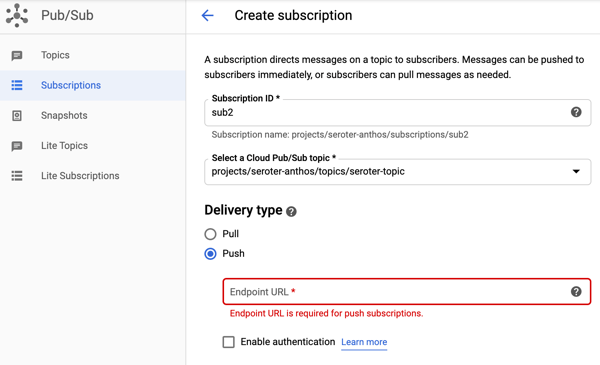
    I first used the Google Cloud Console to create a pull-based subscription for the topic. You can see a variety of other settings (with sensible defaults) around acknowledgement deadlines, message retention, and more.

    I then created a pair of .NET Core applications. One pushes messages to the topic, another pulls messages from the corresponding subscription. Google created NuGet packages for each of the major Cloud services—which is better than one mega-package that talks to all services—that you can see listed here on GitHub. Here’s the Pub/Sub package that added to both projects.

    The code for the (authenticated) publisher app is straightforward, and the API was easy to understand.

    using Google.Cloud.PubSub.V1;
    using Google.Protobuf;
    
    ...
    
     public string PublishMessages()
     {
       PublisherServiceApiClient publisher = PublisherServiceApiClient.Create();
                
       //create messages
       PubsubMessage message1 = new PubsubMessage {Data = ByteString.CopyFromUtf8("Julie")};
       PubsubMessage message2 = new PubsubMessage {Data = ByteString.CopyFromUtf8("Hazel")};
       PubsubMessage message3 = new PubsubMessage {Data = ByteString.CopyFromUtf8("Frank")};
    
       //load into a collection
       IEnumerable<PubsubMessage> messages = new PubsubMessage[] {
          message1,
          message2,
          message3
        };
                
       //publish messages
       PublishResponse response = publisher.Publish("projects/seroter-anthos/topics/seroter-topic", messages);
                
       return "success";
     }
    

    After I ran the publisher app, I switched to the web-based Console and saw that the subscription had three un-acknowledged messages. So, it worked.

    The subscribing app? Equally straightforward. Here, I asked for up to ten messages associated with the subscription, and once I processed then, I sent “acknowledgements” back to Pub/Sub. This removes the messages from the queue so that I don’t see them again.

    using Google.Cloud.PubSub.V1;
    using Google.Protobuf;
    
    ...
    
      public IEnumerable<String> ReadMessages()
      {
         List<string> names = new List<string>();
    
         SubscriberServiceApiClient subscriber = SubscriberServiceApiClient.Create();
         SubscriptionName subscriptionName = new SubscriptionName("seroter-anthos", "sub1");
    
         PullResponse response = subscriber.Pull(subscriptionName, true, 10);
         foreach(ReceivedMessage msg in response.ReceivedMessages) {
             names.Add(msg.Message.Data.ToStringUtf8());
         }
    
         if(response.ReceivedMessages.Count > 0) {
             //ack the message so we don't receive it again
             subscriber.Acknowledge(subscriptionName, response.ReceivedMessages.Select(m => m.AckId));
         }
    
         return names;
     }
    

    When I start up the subscriber app, it reads the three available messages in the queue. If I pull from the queue again, I get no results (as expected).

    As an aside, the Google Cloud Console is really outstanding for interacting with managed services. I built .NET Core apps to test out Pub/Sub, but I could have done everything within the Console itself. I can publish messages:

    And then retrieve those message, with an option to acknowledge them as well:

    Great stuff.

    But back to the point of this section, I can use Pub/Sub to create pull subscriptions and push subscriptions. We’ve been conditioned by cloud vendors to expect distinct services for each variation in functionality. One example is with messaging services, where you see unique services for queuing, event streaming, notifications, and more. Here with Pub/Sub, I’m getting a notification service and queuing service together. A “push” subscription doesn’t wait for the subscriber to request work; it pushes the message to the designated (optionally, authenticated) endpoint. You might provide the URL of an application webhook, an API, a function, or whatever should respond immediately to your message.

    I like this capability, and it simplifies your architecture.

    #3 – Supports message replay within an existing subscription and for new subscriptions

    One of the things I’ve found most attractive about event processing engines is the durability and replay-ability functionality. Unlike a traditional message queue, an event processor is based on a durable log where you can rewind and pull data from any point. That’s cool. Your event streaming engine isn’t a database or system of record, but a useful snapshot in time of an event stream. What if you could get the queuing semantics you want, with that durability you like from event streaming? Pub/Sub does that.

    This again harkens back to point #2, where Pub/Sub absorbs functionality from other specialized services. Let me show you what I found.

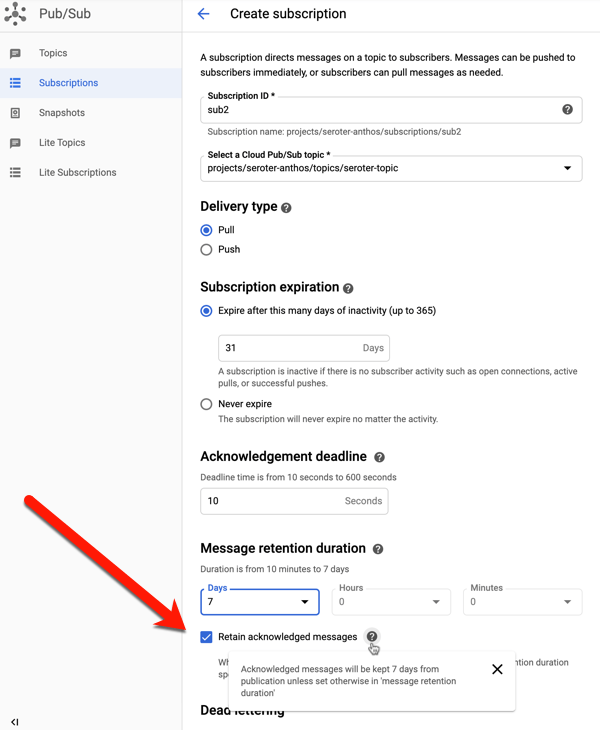
    When creating a subscription (or editing an existing one), you have the option to retain acknowledged messages. This keeps these messages around for whatever the duration is for the subscription (up to seven days).

    To try this out, I sent in four messages to the topic, with bodies of “test1”, “test2”, “test3”, and “test4.” I then viewed, and acknowledged, all of them.

    If I do another “pull” there are no more messages. This is standard queuing behavior. An empty queue is a happy queue. But what if something went wrong downstream? You’d typically have to go back upstream and resubmit the message. Because I saved acknowledged messages, I can use the “seek” functionality to replay!

    Hey now. That’s pretty wicked. When I pull from the subscription again, any message after the date/time specified shows up again.

    And I get unlimited bites at this apple. I can choose to replay again, and again, and again. You can imagine all sorts of scenarios where this sort of protection can come in handy.

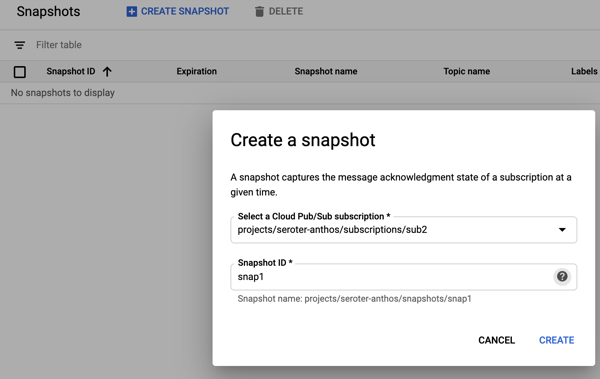
    Ok, but what about new subscribers? What about a system that comes online and wants a batch of messages that went through the system yesterday? This is where snapshots are powerful. They store the state of any unacknowledged messages in the subscription, and any new messages published after the snapshot was taken. To demonstrate this, I sent in three more messages, with bodies of “test 5”, “test6” and “test7.” Then I took a snapshot on the subscription.

    I read all the new messages from the subscription, and acknowledged them. Within this Pub/Sub subscription, I chose to “replay”, load the snapshot, and saw these messages again. That could be useful if I took a snapshot pre-deploy of code changes, something went wrong, and I wanted to process everything from that snapshot. But what if I want access to this past data from another subscription?

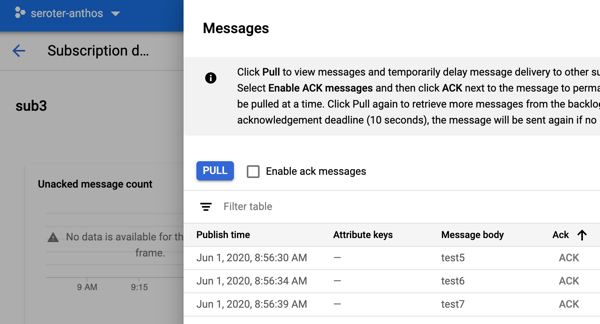
    I created a new subscription called “sub3.” This might represent a new system that just came online, or even a tap that wants to analyze the last four days of data. Initially, this subscription has no associated messages. That makes sense; it only sees messages that arrived after the subscription was created. From this additional subscription, I chose to “replay” and selected the existing snapshot.

    After that, I went to my subscription to view messages, and I saw the three messages from the other subscription’s snapshot.

    Wow, that’s powerful. New subscribers don’t always have to start from scratch thanks to this feature.

    It might be worth it for you to take an extended look at Google Cloud Pub/Sub. It’s got many of the features you expect from a scaled cloud service, with a few extra features that may delight you.

  • Creating an event-driven architecture out of existing, non-event-driven systems

    Creating an event-driven architecture out of existing, non-event-driven systems

    Function-as-a-service gets all the glory in the serverless world, but the eventing backplane is the unheralded star of modern architectures, serverless or otherwise. Don’t get me wrong, scale-to-zero compute is cool. But is your company really transforming because you’re using fewer VMs? I’d be surprised. No, it seems that big benefits comes from a reimagined architecture, often powered by (managed) software that emit and consume events. If you have this in place, creative developers can quickly build out systems by tapping into event streams. If you have a large organization, and business systems that many IT projects tap into, this sort of event-driven architecture can truly speed up delivery.

    But I doubt that most existing software at your company is powered by triggers and events. How can you start being more event-driven with all the systems you have in place now? In this post, I’ll look at three techniques I’ve used or seen.

    First up, what do you need at your disposal? What’s the critical tech if you want to event-enable your existing SaaS or on-premises software? How about:

    • Event bus/backbone. You need an intermediary to route events among systems. It might be on-premises or in the public cloud, in-memory or persistent, open source or commercial. The important thing is having a way to fan-out the information instead of only offering point-to-point linkages.
    • Connector library. How are you getting events to and from software systems? You may use HTTP APIs or some other protocol. What you want is a way to uniformly talk to most source/destination systems without having to learn the nuances of each system. A series of pre-built connectors play a big part.
    • Schema registry. Optional, but important. What do the events looks like? Can I discover the available events and how to tap into them?
    • Event-capable targets. Your downstream systems need to be able to absorb events. They might need a translation layer or buffer to do so.

    MOST importantly, you need developers/architects that understand asynchronous programming, stateful stream processing, and distributed systems. Buying the technology doesn’t matter if you don’t know how to best use it.

    Let’s look at how you might use these technologies and skills to event-ify your systems. In the comments, tell me what I’m missing!

    Option #1: Light up natively event-driven capabilities in the software

    Some software is already event-ready and waiting for you to turn it on! Congrats if you use a wide variety of SaaS systems like Salesforce (via outbound messaging), Oracle Cloud products (e.g. Commerce Cloud), GSuite (via push notifications), Office 365 (via graph API) and many more. Heck, even some cloud-based databases like Azure Cosmos DB offer a change feed you can snack on. It’s just a matter of using these things.

    On-premises software can work here as well. A decade ago, I worked at Amgen and we created an architecture where SAP events were broadcasted through a broker, versus countless individual systems trying to query SAP directly. SAP natively supported eventing then, and plenty of systems do now.

    For either case—SaaS systems or on-premises software—you have to decide where the events go. You can absolutely publish events to single-system web endpoints. But realistically, you want these events to go into an event backplane so that everyone (who’s allowed) can party on the event stream.

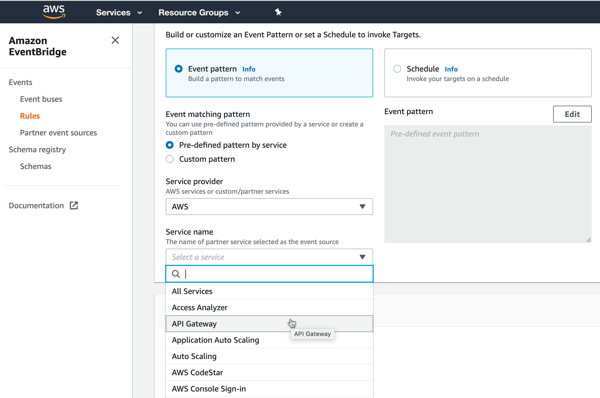
    AWS has a nice offering that helps here. Amazon EventBridge came out last year with a lot of fanfare. It’s a fully managed (serverless!) service for ingesting and routing events. EventBridge takes in events from dozens of AWS services, and (as of this writing) twenty-five partners. It has a nice schema registry as well, so you can quickly understand the events you have access to. The list of integrated SaaS offerings is a little light, but getting better. 

    Given their long history in the app integration space, Microsoft also has a good cloud story here. Their eventing subsystem, called Azure Event Grid, ingests events from Azure (or custom) sources, and offers sophisticated routing rules. Today, its built-in event sources are all Azure services. If you’re looking to receive events from a SaaS system, you bolt on Azure Logic Apps. This service has a deep array of connectors that talk to virtually every system you can think of. Many of these connectors—including SharePointSalesforceWorkdayMicrosoft Dynamics 365, and Smartsheet—support push-based triggers from the SaaS source. It’s fairly easy to create a Logic App that receives a trigger, and publishes to Azure Event Grid.

    And you can always use “traditional” service brokers like Microsoft’s BizTalk Server which offer connectors, and pub/sub routing on any infrastructure, on-premises or off.

    Option #2: Turn request-driven APIs into event streams

    What if your software doesn’t have triggers or webhooks built in? That doesn’t mean you’re out of luck. 

    Virtually all modern packaged (on-premises or SaaS) software offers APIs. Even many custom-built apps do. These APIs are mostly request-response based (versus push-based async, or request-stream) but we can work with this.

    One pattern? Have a scheduler call those request-response APIs and turn the results into broadcasted events. Is it wasteful? Yes, polling typically is. But, the wasted polling cycles are worth it if you want to create a more dynamic architecture.

    Microsoft Azure users have good options. Specifically, you can quickly set up an Azure Logic App that talks to most everything, and then drops the results to Azure EventGrid for broadcast to all interested parties. Logic Apps also supports debatching, so you can parse the polled results and create an outbound stream of individual events. Below, every minute I’m listing records from ServiceNow that I publish to EventGrid.

    Note that Amazon EventBridge also supports scheduled invocation of targets. Those targets include batch job queues, code pipelines, ECS tasks, Lambda functions, and more.

    Option #3: Hack the subsystems to generate events

    You’ll have cases where you don’t have APIs at all. Just give up? NEVER. 

    A last resort is poking into the underlying subsystems. That means generating events from file shares, FTP locations, queues, and databases. Now, be careful here. You need to REALLY know your software before doing this. If you create a change feed for the database that comes with your packaged software, you could end up with data integrity issues. So, I’d probably never do this unless it was a custom-built (or well-understood) system.

    How do public cloud platforms help? Amazon EventBridge primarily integrates with AWS services today. That means if your custom or packaged app runs in AWS, you can trigger events off the foundational pieces. You might trigger events off EC2 state changes, new objects added to S3 blob storage, deleted users in the identity management system, and more. Most of these are about the service lifecycle, versus about the data going through the service, but still useful.

    In Azure, the EventGrid service ingests events from lots of foundational Azure services. You can listen on many of the same types of things that Amazon EventBridge does. That includes blob storage, although nothing yet on virtual machines.

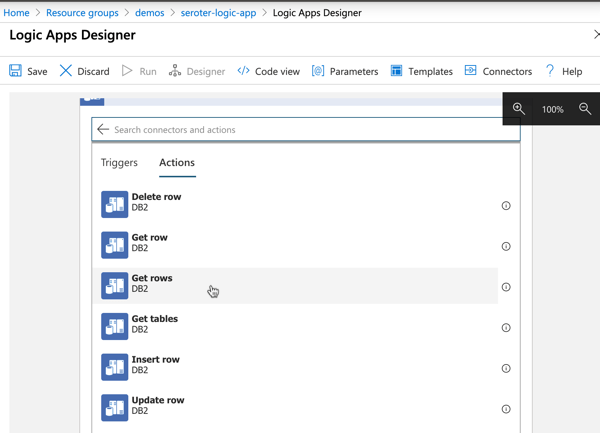
    Your best bet in Azure may be once again to use Logic Apps and turn subsystem queries into an outbound event stream. In this example, I’m monitoring IBM DB2 database changes, and publishing events. 

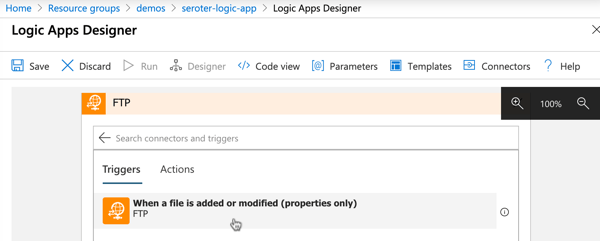
    I could do the same with triggers on FTP locations …

    … and file shares.

    In all those cases, it’s fairly straightforward to publish the queried items to Azure EventGrid for fan-out processing to trigger-based recipient systems

    Ideally, you have option #1 at your disposal. If not, you can selectively choose #2 or #3 to get more events flowing in your architecture. Are there other patterns and techniques you use to generate events out of existing systems?

  • These six integrations show that Microsoft is serious about Spring Boot support in Azure

    Microsoft doesn’t play favorites. Oh sure, they heavily promote their first party products. But after that, they typically take a big-tent, welcome-all-comers approach and rarely call out anything as “the best” or “our choice.” They do seem to have a soft spot for Spring, though. Who can blame them? You’ve got millions of Java/Spring developers out there, countless Spring-based workloads in the wild, and 1.6 million new projects created each month at start.spring.io. I’m crazy enough to think that whichever vendor attracts the most Spring apps will likely “win” the first phase of the public cloud wars.

    With over a dozen unique integrations between Spring projects and Azure services, the gang in Redmond has been busy. A handful stand out to me, although all of them make a developer’s life easier.

    #6 Azure Functions

    I like Azure Functions. There’s not a lot extra machinery—such as API gateways—you have to figure out to use it. The triggers and bindings model are powerful. And it supports lots of different programming languages.

    While many (most?) developers are polyglot and comfortable switching between languages, it’d make sense if you want to keep your coding patterns and tooling the same as you adopt a new runtime like Azure Functions. The Azure team worked with the Spring team to ensure that  developers could take advantage of Azure Functions, while still retaining their favorite parts of Spring. Specifically, they partnered on the adapter that wires up Azure’s framework into the user’s code, and testing of the end-to-end experience. The result? A thoughtful integration of Spring Cloud Functions and Azure Functions that gives you the best of both worlds. I’ve seen a handful of folks offer guidance, and tutorials. And Microsoft offers a great guide.

    Always pick the right language based on performance needs, scale demands, etc. Above all else, you may want to focus on developer productivity, and using the language/framework that’s best for your team. Your productivity (or lack thereof) is more costly than any compute infrastructure!

    #5 Azure Service Bus and Event Hubs

    I’m a messaging geek. Connecting systems together is an underrated, but critically valuable skill. I’ve written a lot about Spring Cloud Stream in the past. Specifically, I’ve shown you how to use it with Azure Event Hubs, and even the Kafka interface.

    Basically, you can now use Microsoft’s primary messaging platforms—Service Bus Queues, Service Bus Topics, Event Hubs—as the messaging backbone of a Spring Boot app. And you can do all that, without actually learning the unique programming models of each platform. The Spring Boot developer writes platform-agnostic code to publish messages to subscribe to messages, and the Spring Cloud Stream objects take care of the rest.

    Microsoft has guides for working with Service BusEvent Hubs, and Event Hubs Kafka API. When you’re using Azure messaging services, I’m hard pressed to think of any easier way to interact with them than Spring Boot.

    #4 Azure Cosmos DB

    Frankly, all the database investment’s by Microsoft’s Java/Spring team have been impressive. You can cleanly interact with their whole suite of relational databases with JDBC and JPA via Spring Data.

    I’m more intrigued by their Cosmos DB work. Cosmos DB is Microsoft’s global scale database service that serves up many different APIs. Want a SQL API? You got it. How about a MongoDB or Cassandra facade? Sure. Or maybe a graph API using Gremlin? It’s got that too.

    Spring developers can use Microsoft-created SDKs for any of it. There’s a whole guide for using the SQL API. Likewise, Microsoft created walkthroughs for Spring devs using CassandraMongo, or Gremlin APIs. They all seem to be fairly expressive and expose the core capabilities you want from a Cosmos DB instance. 

    #3 Azure Active Directory B2C

    Look, security stuff doesn’t get me super pumped. Of course it’s important. I just don’t enjoy coding for it. Microsoft’s making it easier, though. They’ve got a Spring Boot Starter just for Azure Key Vault, and clean integration with Azure Active Directory via Spring Security. I’m also looking forward to seeing managed identities in these developer SDKs.

    I like the support for Azure Active Directory B2C. This is a standalone Azure service that offer single sign-on using social or other 3rd party identities. Microsoft claims it can support millions of users, and billions of authentication requests. I like that Spring developers have such a scalable service to seamlessly weave into their apps. The walkthrough that Microsoft created is detailed, but straightforward. 

    My friend Asir also presented this on stage with me at SpringOne last year in Austin. Here’s the part of the video where he’s doing the identity magic:

    #2 Azure App Configuration

    When you’re modernizing an app, you might only be aiming for one or two factors. Can you gracefully restart the thing, and did you yank configuration out of code? Azure App Configuration is a new service that supports the latter.

    This service is resilient, and supports labeling, queryingencryption, and event listeners. And Spring was one of the first things they announced support for. Spring offers a robust configuration subsystem, and it looks like Azure App Configuration slides right in. Check out their guide to see how to tap into cloud-stored config values, whether your app itself is in the cloud, or not.

    #1 Azure Spring Cloud

    Now, I count about a dozen ways to run a Java app on Azure today. You’re not short of choices. Why add another? Microsoft saw demand for a Spring-centric runtime that caters to microservices using Spring Cloud. Azure Spring Cloud will reach General Availability soon, so I’m told, and offers features like config management, service discovery, blue/green deployments, integrated monitoring, and lots more. I’ve been playing with it for a while, and am impressed with what’s possible.

    These integrations help you stitch together some pretty cool Azure cloud services into a broader Spring Boot app. That makes sense, when you consider what Spring Boot lead Phil Webb said at SpringOne a couple years back:

    “A lot of people think that Spring is a dependency injection framework … Spring is more of an integration framework. It’s designed to take lots of different technologies that you might want to use and allow you to combine them in ways that feel nature.”

  • Let’s try out the new durable, replicated quorum queues in RabbitMQ

    Let’s try out the new durable, replicated quorum queues in RabbitMQ

    Coordination in distributed systems is hard. How do a series of networked processes share information and stay in sync with each other? Recently, the RabbitMQ team released a new type of queue that uses the Raft Consensus Algorithm to offer a durable, first-in-first-out queuing experience in your cluster. This is a nice fit for scenarios where you can’t afford data loss, and you also want the high availability offered by a clustered environment. Since RabbitMQ is wildly popular and used all over the place, I thought it’d be fun to dig into quorum queues, and give you an example that you can follow along with.

    What do you need on your machine to follow along? Make sure you have Docker Desktop, or some way to instantiate containers from a Docker Compose file. And you should have git installed. You COULD stop there, but I’m also building a small pair of apps (publisher, subscriber) in Spring Boot. To do that part, ensure you have the JDK installed, and an IDE (Eclipse or IntelliJ) or code editor (like VS Code with Java + Boot extensions) handy. That’s it.

    Before we start, a word about quorum queues. They shipped as part of a big RabbitMQ 3.8 release in the Fall of 2019. Quorum queues are the successor to mirrored queues, and improve on them in a handful of ways. By default, queues are located on a single node in a cluster. Obviously something that sits on a single node is at risk of downtime! So, we mitigate that risk by creating clusters. Mirrored queues have a master node, and mirrors across secondary nodes in the cluster for high availability. If a master fails, one of the mirrors gets promoted and processing continues. My new colleague Jack has a great post on how quorum queues “fix” some of the synchronization and storage challenges with mirrored queues. They’re a nice improvement, which is why I wanted to explore them a bit.

    Let’s get going. First, we need to get a RabbitMQ cluster up and running. Thanks to containers, this is easy. And thanks to the RabbitMQ team, it’s super easy. Just git clone the following repo:

    git clone https://github.com/rabbitmq/rabbitmq-prometheus
    

    In that repo are Docker Compose files. The one we care about is in the docker folder and called docker-compose-qq.yml. In here, you’ll see a network defined, and some volumes and services. This setup creates a three node RabbitMQ cluster. If you run this right now (docker-compose -f docker/docker-compose-qq.yml up) you’re kind of done (but don’t stop here!). The final service outlined in the Compose file (qq-moderate-load) creates some queues for you, and generates some load, as seen below in the RabbitMQ administration console.

    You can see above that the queue I selected is a “quorum” queue, and that there’s a leader of the queue and multiple online members. If I deleted that leader node, the messaging traffic would continue uninterrupted and a new leader would get “elected.”

    I don’t want everything done for me, so after cleaning up my environment (docker-compose -f docker/docker-compose-qq.yml down), I deleted the qq-moderate-load service definition from my Docker Compose file, and renamed it. Then I spun it up again, with the new file name:

    docker-compose -f docker/docker-compose-qq-2.yml up
    

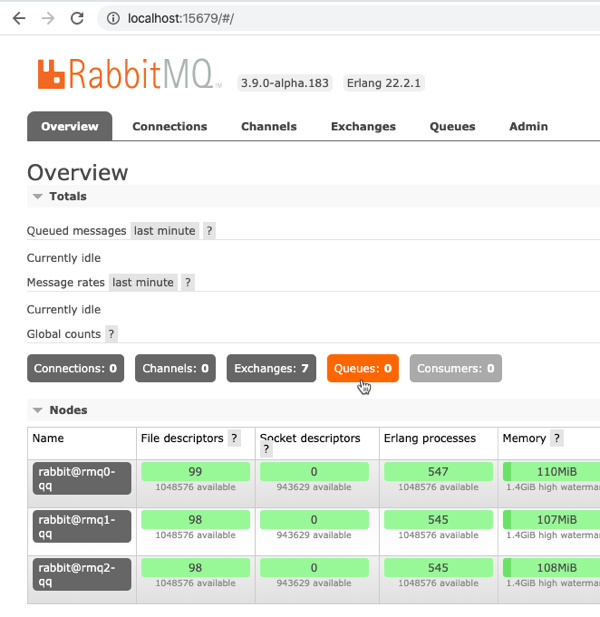
    We now have an “empty” RabbitMQ, with three nodes in the cluster, but no queues or exchanges.

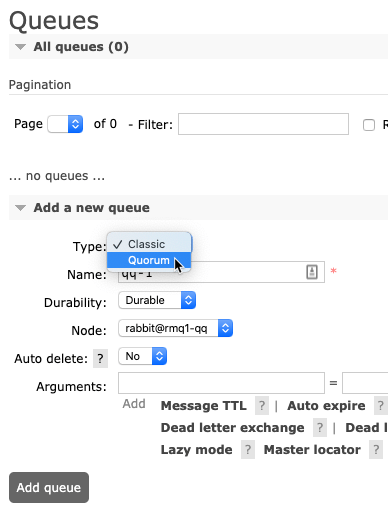
    Let’s create a quorum queue. On the “Queues” tab of this administration console, fill in a name for the new queue (I called mine qq-1), select quorum as the type, and pick a node to set as the leader. I picked rmq1-qq. Click the “Add queue” button.

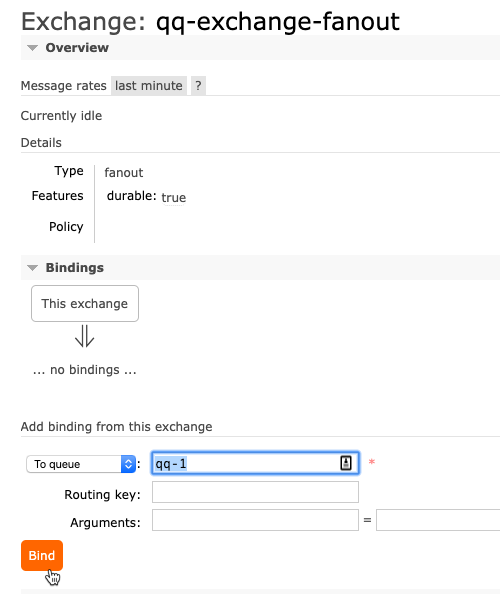
    Now we need an exchange, which is the publisher-facing interface. Create a fanout exchange named qq-exchange-fanout and then bind our queue to this exchange.

    Ok, that’s it for RabbitMQ. We have a highly available queue stood up with replication across three total nodes. Sweet. Now, we need an app to publish messages to the exchange.

    I went to start.spring.io to generate a Spring Boot project. You can talk to RabbitMQ from virtually any language, using any number of supported SDKs. This link gives you a Spring Boot project identical to mine.

    I included dependencies on Spring Cloud Stream and Spring for RabbitMQ. These packages inflate all the objects necessary to talk to RabbitMQ, without forcing my code to know anything about RabbitMQ itself.

    Two words to describe my code? Production Grade. Here’s all I needed to write to publish a message every 500ms.

    package com.seroter.demo;
    
    import org.springframework.boot.SpringApplication;
    import org.springframework.boot.autoconfigure.SpringBootApplication;
    import org.springframework.cloud.stream.annotation.EnableBinding;
    import org.springframework.cloud.stream.messaging.Source;
    import org.springframework.context.annotation.Bean;
    import org.springframework.integration.annotation.InboundChannelAdapter;
    import org.springframework.integration.core.MessageSource;
    import org.springframework.messaging.support.GenericMessage;
    import org.springframework.integration.annotation.Poller;
    
    @EnableBinding(Source.class)
    @SpringBootApplication
    public class RmqPublishQqApplication {
    
    	public static void main(String[] args) {
    		SpringApplication.run(RmqPublishQqApplication.class, args);
    	}
    	
    	private int counter = 0;
    	
    	@Bean
    	@InboundChannelAdapter(value = Source.OUTPUT, poller = @Poller(fixedDelay = "500", maxMessagesPerPoll = "1"))
    	public MessageSource<String> timerMessageSource() {
    		
    		return () -> {
    			counter++;
    			System.out.println("Spring Cloud Stream message number " + counter);
    			return new GenericMessage<>("Hello, number " + counter);
    		};
    	}
    }


    The @EnableBinding attribute and reference to the Source class marks this as streaming source, and I used Spring Integration’s InboundChannelAdapter to generate a message, with an incrementing integer, on a pre-defined interval.

    My configuration properties are straightforward. I list out all the cluster nodes (to enable failover if a node fails) and provide the name of the existing exchange. I could use Spring Cloud Stream to generate the exchange, but wanted to experiment with creating it ahead of time.

    spring.rabbitmq.addresses=localhost:5679,localhost:5680,localhost:5681
    
    spring.rabbitmq.username=guest
    spring.rabbitmq.password=guest
     
    spring.cloud.stream.bindings.output.destination=qq-exchange-fanout
    spring.cloud.stream.rabbit.bindings.output.producer.exchange-type=fanout
    

    Before starting up the publisher, let’s create the subscriber. Back in start.spring.io, create another app named rmq-subscribe-qq with the same dependencies as before. Click here for a link to download this project definition.

    The code for the subscriber is criminally simple. All it takes is the below code to pull a message from the queue and process it.

    package com.seroter.demo;
    
    import org.springframework.boot.SpringApplication;
    import org.springframework.boot.autoconfigure.SpringBootApplication;
    import org.springframework.cloud.stream.annotation.EnableBinding;
    import org.springframework.cloud.stream.annotation.StreamListener;
    import org.springframework.cloud.stream.messaging.Sink;
    
    @EnableBinding(Sink.class)
    @SpringBootApplication
    public class RmqSubscribeQqApplication {
    
    	public static void main(String[] args) {
    		SpringApplication.run(RmqSubscribeQqApplication.class, args);
    	}
    	
    	@StreamListener(target = Sink.INPUT)
    	public void pullMessages(String s) {
    		System.out.println("Spring Cloud Stream message received: " + s);
    	}
    }
    

    It’s also annotated with an @EnableBinding declaration and references the Sink class which gets this wired up as a message receiver. The @StreamListener annotation marks this method as the one that handles whatever gets pulled off the queue. Note that the new functional paradigm for Spring Cloud Stream negates the need for ANY streaming annotations, but I like the existing model for explaining what’s happening.

    The configuration for this project looks pretty similar to the publisher’s configuration. The only difference is that we’re setting the queue name (as “group”) and indicating that Spring Cloud Stream should NOT generate a queue, but use the existing one.

    spring.rabbitmq.addresses=localhost:5679,localhost:5680,localhost:5681
    
    spring.rabbitmq.username=guest
    spring.rabbitmq.password=guest
     
    spring.cloud.stream.bindings.input.destination=qq-exchange-fanout
    spring.cloud.stream.bindings.input.group=qq-1
    spring.cloud.stream.rabbit.bindings.input.consumer.queue-name-group-only=true
    

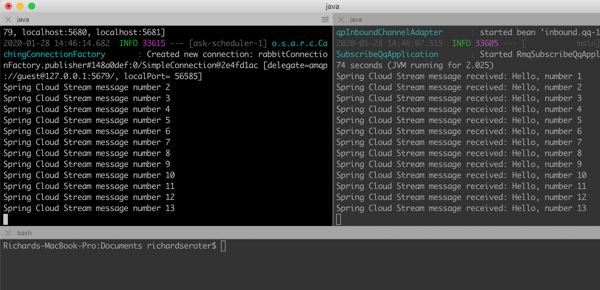
    We’re done! Let’s test it out. I opened up a few console windows, the first pointing to the publisher project, the second to the subscriber project, and a third that will shut down a RabbitMQ node when the time comes.

    To start up each Spring Boot project, enter the following command into each console:

    ./mvnw spring-boot:run
    

    Immediately, I see the publisher publishing, and the subscriber subscribing. The messages arrive in order from a quorum queue.

    In the RabbitMQ management console, I can see that we’re processing messages, and that rmq1-qq is the queue leader. Let’s shut down that node. From the other console (not the publisher or subscriber) switch the git folder that you downloaded at the beginning, and enter the following command to remove the RabbitMQ node from the cluster:

    docker-compose -f docker/docker-compose-qq-2.yml stop rmq1-qq

    As you can see, the node goes away, and there’s no pause in processing, and the Spring Boot app keeps happily sending and receiving data, in order.

    Back in the RabbitMQ administration console, note that there’s a new leader for the quorum queue (not rmq1-qq as we originally set up), and just two of the three cluster members are online. All of this “just happens” for you.

    For fun, I also started up the stopped node, and watched it quickly rejoin the cluster and start participating in the quorum queue again.

    A lot of your systems depend on your messaging middleware. It probably doesn’t get much praise, but everyone sure yells when it goes down! Because distributed systems are hard, keeping that infrastructure highly available with no data loss isn’t easy. I like things like RabbitMQ’s quorum queues, and you should keep playing with them. Check out the terrific documentation to go even deeper.

  • 2019 in Review: Watching, Reading, and Writing Highlights

    Be still and wait. This was the best advice I heard in 2019, and it took until the end of the year for me to realize it. Usually, when I itch for a change, I go all in, right away. I’m prone to thinking that “patience” is really just “indecision.” It’s not. The best things that happened this year were the things that didn’t happen when I wanted! I’m grateful for an eventful, productive, and joyful year where every situation worked out for the best.

    2019 was something else. My family grew, we upgraded homes, my team was amazing, my company was acquired by VMware, I spoke at a few events around the world, chaired a tech conference, kept up a podcast, created a couple new Pluralsight classes, continued writing for InfoQ.com, and was awarded a Microsoft MVP for the 12th straight time.

    For the last decade+, I’ve started each year by recapping the last one. I usually look back at things I wrote, and books I read. This year, I’ll also add “things I watched.”

    Things I Watched

    I don’t want a ton of “regular” TV—although I am addicted to Bob’s Burgers and really like the new FBI—and found myself streaming or downloading more things while traveling this year. These shows/seasons stood out to me:

    Crashing – Season 3 [HBO] Pete Holmes is one of my favorite stand-up comedians, and this show has some legit funny moments, but it’s also complex, dark, and real. This was a good season with a great ending.

    BoJack Horseman – Season 5 [Netflix] Again, a show with absurdist humor, but also a dark, sobering streak. I’m got to catch up on the latest season, but this one was solid.

    Orange is the New Black – Season 7 [Netflix] This show has had some ups and downs, but I’ve stuck with it because I really like the cast, and there are enough surprises to keep me hooked. This final season of the show was intense and satisfying.

    Bosch – Season 4 [Amazon Prime] Probably the best thing I watched this year? I love this show. I’ve read all the books the show is based on, but the actors and writers have given this its own tone. This was a super tense season, and I couldn’t stop watching.

    Schitt’s Creek – Seasons 1-4 [Netflix] Tremendous cast and my favorite overall show from 2019. Great writing, and some of the best characters on TV. Highly recommended.

    Jack Ryan – Season 1 [Amazon Prime] Wow, what a show. Throughly enjoyed the story and cast. Plenty of twists and turns that led me to binge watch this on one of my trips this year.

    Things I Wrote

    I kept up a reasonable writing rhythm on my own blog, as well as publication to the Pivotal blog and InfoQ.com site. Here were a few pieces I enjoyed writing the most:

    [Pivotal blog] Five part series on digital transformation. You know what you should never do? Write a blog post and in it, promise that you’ll write four more. SO MUCH PRESSURE. After the overview post, I looked at the paradox of choice, design thinking, data processing, and automated delivery. I’m proud of how it all ended up.

    [blog] Which of the 295,680 platform combinations will you create on Microsoft Azure? The point of this post wasn’t that Microsoft, or any cloud provider for that matter, has a lot of unique services. They do, but the point was that we are prone to thinking that we’re getting a complete solution from someone, but really getting some really cool components to stitch together.

    [Pivotal blog] Kubernetes is a platform for building platforms. Here’s what that means. This is probably my favorite piece I wrote this year. It required a healthy amount of research and peer review, and dug into something I see very few people talking about.

    [blog] Go “multi-cloud” while *still* using unique cloud services? I did it using Spring Boot and MongoDB APIs. There’s so many strawman arguments on Twitter when it comes to multi-cloud that it’s like a scarecrow convention. Most people I see using multiple clouds aren’t dumb or lazy. They have real reasons, including a well-founded lack of trust in putting all their tech in one vendor’s basket. This blog post looked at how to get the best of all worlds.

    [blog] Looking to continuously test and patch container images? I’ll show you one way. I’m not sure when I give up on being a hands on technology person. Maybe never? This was a demo I put together for my VMworld Barcelona talk, and like the final result.

    [blog] Building an Azure-powered Concourse pipeline for Kubernetes – Part 3: Deploying containers to Kubernetes. I waved the white flag and learned Kubernetes this year. One way I forced myself to do so was sign up to teach an all-day class with my friend Rocky. While leading up to that, I wrote up this 3-part series of posts on continuous delivery of containers.

    [blog] Want to yank configuration values from your .NET Core apps? Here’s how to store and access them in Azure and AWS. It’s fun to play with brand new tech, curse at it, and document your journey for others so they curse less. Here I tried out Microsoft’s new configuration storage service, and compared it to other options.

    [blog] First Look: Building Java microservices with the new Azure Spring Cloud. Sometimes it’s fun to be first. Pivotal worked with Microsoft on this offering, so on the day it was announced, I had a blog post ready to go. Keep an eye on this service in 2020; I think it’ll be big.

    [InfoQ] Swim Open Sources Platform That Challenges Conventional Wisdom in Distributed Computing. One reason I keep writing for InfoQ is that it helps me discover exciting new things. I don’t know if SWIM will be a thing long term, but their integrated story is unconventional in today’s “I’ll build it all myself” world.

    [InfoQ] Weaveworks Releases Ignite, AWS Firecracker-Powered Software for Running Containers as VMs. The other reason I keep writing for InfoQ is that I get to talk to interesting people and learn from them. Here, I engaged in an informative Q&A with Alexis and pulled out some useful tidbits about GitOps.

    [InfoQ] Cloudflare Releases Workers KV, a Serverless Key-Value Store at the Edge. Feels like edge computing has the potential to disrupt our current thinking about what a “cloud” is. I kept an eye on Cloudflare this year, and this edge database warranted a closer look.

    Things I Read

    I like to try and read a few books a month, but my pace was tested this year. Mainly because I chose to read a handful of enormous biographies that took a while to get through. I REGRET NOTHING. Among the 32 books I ended up finishing in 2019, these were my favorites:

    Churchill: Walking with Destiny by Andrew Roberts (@aroberts_andrew). This was the most “highlighted” book on my Kindle this year. I knew the caricature, but not the man himself. This was a remarkably detailed and insightful look into one of the giants of the 20th century, and maybe all of history. He made plenty of mistakes, and plenty of brilliant decisions. His prolific writing and painting were news to me. He’s a lesson in productivity.

    At Home: A Short History of Private Life by Bill Bryson. This could be my favorite read of 2019. Bryson walks around his old home, and tells the story of how each room played a part in the evolution of private life. It’s a fun, fascinating look at the history of kitchens, studies, bedrooms, living rooms, and more. I promise that after you read this book, you’ll be more interesting at parties.

    Messengers: Who We Listen To, Who We Don’t, and Why by Stephen Martin (@scienceofyes) and Joseph Marks (@Joemarks13). Why is it that good ideas get ignored and bad ideas embraced? Sometimes it depends on who the messenger is. I enjoyed this book that looked at eight traits that reliably predict if you’ll listen to the messenger: status, competence, attractiveness, dominance, warm, vulnerability, trustworthiness, and charisma.

    Six Days of War: June 1967 and the Making of the Modern Middle East by Michael Oren (@DrMichaelOren). What a story. I had only a fuzzy understanding of what led us to the Middle East we know today. This was a well-written, engaging book about one of the most consequential events of the 20th century.

    The Unicorn Project: A Novel about Developers, Digital Disruption, and Thriving in the Age of Data by Gene Kim (@RealGeneKim). The Phoenix Project is a must-read for anyone trying to modernize IT. Gene wrote that book from a top-down leadership perspective. In The Unicorn Project, he looks at the same situation, but from the bottom-up perspective. While written in novel form, the book is full of actionable advice on how to chip away at the decades of bureaucratic cruft that demoralizes IT and prevents forward progress.

    Talk Triggers: The Complete Guide to Creating Customers with Word of Mouth by Jay Baer (@jaybaer) and Daniel Lemin (@daniellemin). Does your business have a “talk trigger” that leads customers to voluntarily tell your story to others? I liked the ideas put forth by the authors, and the challenge to break out from the pack with an approach (NOT a marketing gimmick) that really resonates with customers.

    I Heart Logs: Event Data, Stream Processing, and Data Integration by Jay Kreps (@jaykreps). It can seem like Apache Kafka is the answer to everything nowadays. But go back to the beginning and read Jay’s great book on the value of the humble log. And how it facilitates continuous data processing in ways that preceding technologies struggled with.

    Kafka: The Definitive Guide: Real-Time Data and Stream Processing at Scale by Neha Narkhede (@nehanarkhede), Gwen Shapira (@gwenshap), and Todd Palino (@bonkoif). Apache Kafka is probably one of the five most impactful OSS projects of the last ten years, and you’d benefit from reading this book by the people who know it. Check it out for a great deep dive into how it works, how to use it, and how to operate it.

    The Players Ball: A Genius, a Con Man, and the Secret History of the Internet’s Rise by David Kushner (@davidkushner). Terrific story that you’ve probably never heard before, but have felt its impact. It’s a wild tale of the early days of the Web where the owner of sex.com—who also created match.com—had it stolen, and fought to get it back. It’s hard to believe this is a true story.

    Mortal Prey by John Sanford. I’ve read a dozen+ of the books in this series, and keep coming back for more. I’m a sucker for a crime story, and this is a great one. Good characters, well-paced plots.

    Your God is Too Safe: Rediscovering the Wonder of a God You Can’t Control by Mark Buchanan (@markaldham). A powerful challenge that I needed to hear last year. You can extrapolate the main point to many domains—is something you embrace (spirituality, social cause, etc) a hobby, or a belief? Is it something convenient to have when you want it, or something powerful you do without regard for the consequences? We should push ourselves to get off the fence!

    Escaping the Build Trap: How Effective Product Management Creates Real Value by Melissa Perri (@lissijean). I’m not a product manager any longer, but I still care deeply about building the right things. Melissa’s book is a must-read for people in any role, as the “build trap” (success measured by output instead of outcomes) infects an entire organization, not just those directly developing products. It’s not an easy change to make, but this book offers tangible guidance to making the transition.

    Project to Product: How to Survive and Thrive in the Age of Digital Disruption with the Flow Framework by Mik Kersten (@mik_kersten). This is such a valuable book for anyone trying to unleash their “stuck” I.T. organization. Mik does a terrific job explaining what’s not working given today’s realities, and how to unify an organization around the value streams that matter. The “flow framework” that he pioneered, and explains here, is a brilliant way of visualizing and tracking meaningful work.

    Range: Why Generalists Triumph in a Specialized World by David Epstein (@DavidEpstein). I felt “seen” when I read this. Admittedly, I’ve always felt like an oddball who wasn’t exceptional at one thing, but pretty good at a number of things. This book makes the case that breadth is great, and most of today’s challenges demand knowledge transfer between disciplines and big-picture perspective. If you’re a parent, read this to avoid over-specializing your child at the cost of their broader development. And if you’re starting or midway through a career, read this for inspiration on what to do next.

    John Newton: From Disgrace to Amazing Grace by Jonathan Aitken. Sure, everyone knows the song, but do you know the man? He had a remarkable life. He was the captain of a slave ship, later a pastor and prolific writer, and directly influenced the end of the slave trade.

    Blue Ocean Shift: Beyond Competing – Proven Steps to Inspire Confidence and Seize New Growth by W. Chan Kim and Renee Mauborgne. This is a book about surviving disruption, and thriving. It’s about breaking out of the red, bloody ocean of competition and finding a clear, blue ocean to dominate. I liked the guidance and techniques presented here. Great read.

    Leonardo da Vinci by Walter Isaacson (@WalterIsaacson). Huge biography, well worth the time commitment. Leonardo had range. Mostly self-taught, da Vinci studying a variety of topics, and preferred working through ideas to actually executing on them. That’s why he had so many unfinished projects! It’s amazing to think of his lasting impact on art, science, and engineering, and I was inspired by his insatiable curiosity.

    AI Superpowers: China, Silicon Valley, and the New World Order by Kai-Fu Lee (@kaifulee). Get past some of the hype on artificial intelligence, and read this grounded book on what’s happening RIGHT NOW. This book will make you much smarter on the history of AI research, and what AI even means. It also explains how China has a leg up on the rest of the world, and gives you practical scenarios where AI will have a big impact on our lives.

    Never Split the Difference: Negotiating As If Your Life Depended On It by Chris Voss (@VossNegotiation) and Tahl Raz (@tahlraz). I’m fascinated by the psychology of persuasion. Who better to learn negotiation from than an FBI’s international kidnapping negotiator? He promotes empathy over arguments, and while the book is full of tactics, it’s not about insincere manipulation. It’s about getting to a mutually beneficial state.

    Amazing Grace: William Wilberforce and the Heroic Campaign to End Slavery by Eric Metaxas (@ericmetaxas). It’s tragic that this generation doesn’t know or appreciate Wilberforce. The author says that Wilberforce could be the “greatest social reformer in the history of the world.” Why? His decades-long campaign to abolish slavery from Europe took bravery, conviction, and effort you rarely see today. Terrific story, well written.

    Unlearn: : Let Go of Past Success to Achieve Extraordinary Results by Barry O’Reilly (@barryoreilly). Barry says that “unlearning” is a system of letting go and adapting to the present state. He gives good examples, and offers actionable guidance for leaders and team members. This strikes me as a good book for a team to read together.

    The Soul of a New Machine by Tracy Kidder. Our computer industry is younger than we tend to realize. This is such a great book on the early days, featuring Data General’s quest to design and build a new minicomputer. You can feel the pressure and tension this team was under. Many of the topics in the book—disruption, software compatibility, experimentation, software testing, hiring and retention—are still crazy relevant today.

    Billion Dollar Whale: The Man Who Fooled Wall Street, Hollywood, and the World by Tom Wright (@TomWrightAsia) and Bradley Hope (@bradleyhope). Jho Low is a con man, but that sells him short. It’s hard not to admire his brazenness. He set up shell companies, siphoned money from government funds, and had access to more cash than almost any human alive. And he spent it. Low befriended celebrities and fooled auditors, until it all came crashing down just a few years ago.

    Multipliers: How the Best Leaders Make Everyone Smarter by Liz Wiseman (@LizWiseman). It’s taken me very long (too long?) to appreciate that good managers don’t just get out of the way, they make me better. Wiseman challenges us to release the untapped potential of our organizations, and people. She contrasts the behavior of leaders that diminish their teams, and those that multiply their impact. Lots of food for thought here, and it made a direct impact on me this year.

    Darwin’s Doubt: The Explosive Origin of Animal Life and the Case for Intelligent Design by Stephen Meyer (@StephenCMeyer). The vast majority of this fascinating, well-researched book is an exploration of the fossil record and a deep dive into Darwin’s theory, and how it holds up to the scientific research since then. Whether or not you agree with the conclusion that random mutation and natural selection alone can’t explain the diverse life that emerged on Earth over millions of years, it will give you a humbling appreciation for the biological fundamentals of life.

    Napoleon: A Life by Adam Zamoyski. This was another monster biography that took me months to finish. Worth it. I had superficial knowledge of Napoleon. From humble beginnings, his ambition and talent took him to military celebrity, and eventually, the Emperorship. This meticulously researched book was an engaging read, and educational on the time period itself, not just Bonaparte’s rise and fall.

    The Paradox of Choice: Why More Is Less by Barry Schwartz. I know I’ve used this term for year’s since it was part of other book’s I’ve read. But I wanted to go to the source. We hate having no choices, but are often paralyzed by having too many. This book explores the effects of choice on us, and why more is often less. It’s a valuable read, regardless of what job you have.

    I say it every year, but thank you for having me as part of your universe in 2019. You do have a lot of choices of what to read or watch, and I truly appreciate when you take time to turn that attention to something of mine. Here’s to a great 2020!

  • Messing around with Apache Kafka using the Confluent Cloud free trial

    Messing around with Apache Kafka using the Confluent Cloud free trial

    This week, Confluent announced that there’s now a free trial for their Confluent Cloud. If you’re unfamiliar with either, Confluent is the company founded by the creators of Apache Kafka, and Confluent Cloud is their managed Kafka offering that runs on every major public cloud. There are various ways to kind-of use Kafka in the public cloud (e.g. Amazon Managed Streaming for Apache Kafka, Azure Event Hubs with Kafka interface), but what Confluent offers is the single, best way to use the full suite of Apache Kafka capabilities as a managed service. It’s now free to try out, so I figured I’d take it for a spin.

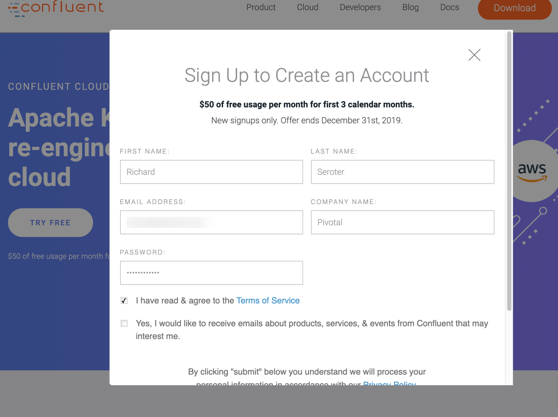
    First, I went to the Confluent Cloud site and clicked the “try free” button. I was prompted to create an account.

    I was asked for credit card info to account for overages above the free tier (and after the free credits expire in 3 months), which I provided. With that, I was in.

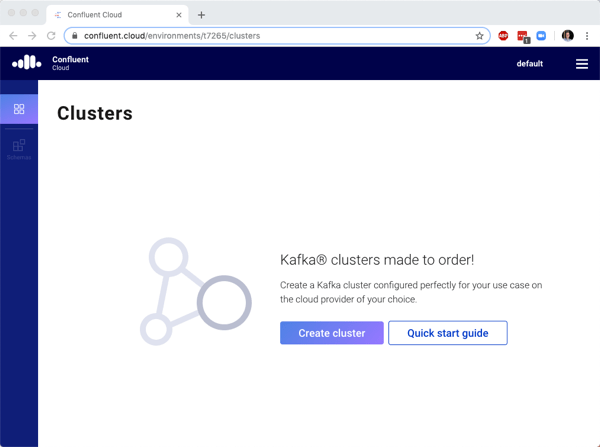
    First, I was prompted to create a cluster. I do what I’m told.

    Here, I was asked to provide a cluster name, and choose a public cloud provider. For each cloud, I was shown a set of available regions. Helpfully, the right side also showed me the prices, limits, billing cycle, and SLA. Transparency, FTW!
    While that was spinning up, I followed the instructions to install the Confluent Cloud CLI so that I could also geek-out at the command line. I like the the example CLI commands in the docs actually reflect the values of my environment (e.g. cluster name). Nice touch.

    Within maybe a minute, my Kafka cluster was running. That’s pretty awesome. I chose to create a new topic with 6 partitions. I’m able to choose up to 60 partitions for a topic, and define other settings like data retention period, max size on disk, and cleanup policy.

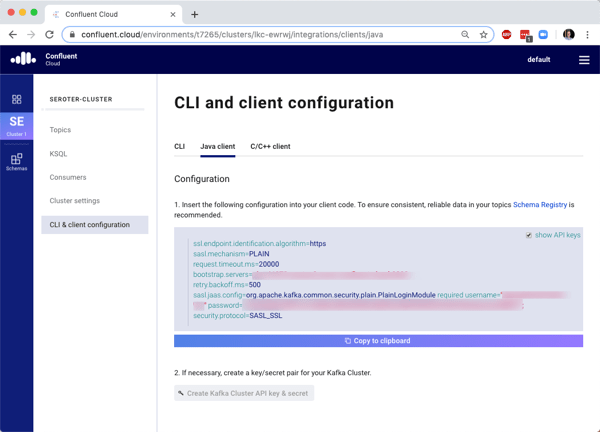
    Before building an app to publish data to Confluent Cloud, I needed an API key and secret. I could create this via the CLI, or the dashboard. I generated the key via the dashboard, saved it (since I can’t see it again after generating), and saw the example Java client configuration updated with those values. Handy, especially because I’m going to talk to Kafka via Spring Cloud Stream!

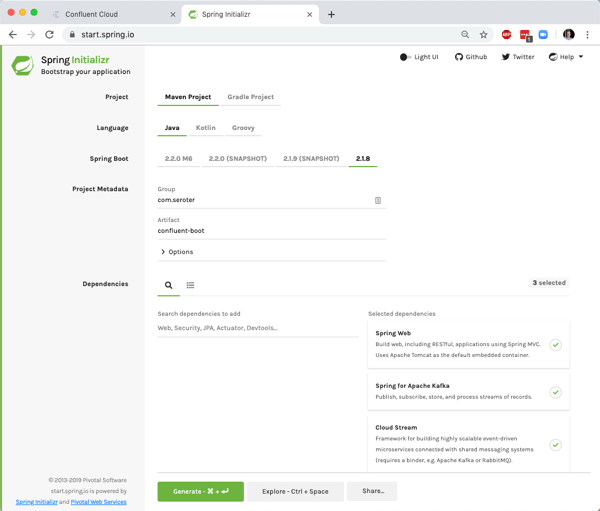
    Now I needed an app that would send messages to Apache Kafka in the Confluent Cloud. I chose Spring Boot because I make good decisions. Thanks to the Spring Cloud Stream project, it’s super-easy to interact with Apache Kafka without having to be an expert in the tech itself. I went to start.spring.io to generate a project. If you click this link, you can download an identical project configuration.

    I opened up this project and added the minimum code and configuration necessary to gab with Apache Kafka in Confluent Cloud. I wanted to be able to submit an HTTP request and see that message published out. That required one annotation to create a REST controller, and one annotation to indicate that this app is a source to the stream. I then have a “Source” variable is autowired, which means it’s inflated by Spring Boot at runtime. Finally, I have a single operation that responds to an HTTP post command and writes the payload to the message stream. That’s it!

    package com.seroter.confluentboot;
    
    import org.springframework.beans.factory.annotation.Autowired;
    import org.springframework.boot.SpringApplication;
    import org.springframework.boot.autoconfigure.SpringBootApplication;
    import org.springframework.cloud.stream.annotation.EnableBinding;
    import org.springframework.cloud.stream.messaging.Source;
    import org.springframework.messaging.support.GenericMessage;
    import org.springframework.web.bind.annotation.PostMapping;
    import org.springframework.web.bind.annotation.RequestBody;
    import org.springframework.web.bind.annotation.RestController;
    
    @EnableBinding(Source.class)
    @RestController
    @SpringBootApplication
    public class ConfluentBootApplication {
    
        public static void main(String[] args) {
          SpringApplication.run(ConfluentBootApplication.class, args);
        }
    	
        @Autowired
        private Source source;
     
        @PostMapping("/messages")
        public String postMsg(@RequestBody String msg) {
         this.source.output().send(new GenericMessage<>(msg));
         return "success";
        }
    }
    

    The final piece? The application configuration. In the application.properties file, I set the handful of parameters, mostly around the target cluster, topic name, and credentials.

    spring.cloud.stream.kafka.binder.brokers=pkc-41973.westus2.azure.confluent.cloud:9092
    spring.cloud.stream.bindings.output.destination=seroter-topic
     
    spring.cloud.stream.kafka.binder.configuration.sasl.jaas.config=org.apache.kafka.common.security.plain.PlainLoginModule required username="[KEY]" password="[SECRET]";
    spring.cloud.stream.kafka.binder.configuration.sasl.mechanism=PLAIN
    spring.cloud.stream.kafka.binder.configuration.security.protocol=SASL_SSL
    

    I started up the app, confirmed that it connected (via application logs), and opened Postman to issue an HTTP POST command.

    After switching back to the Confluent Cloud dashboard, I saw my messages pop up.

    You can probably repeat this whole demo in about 10 minutes. As you can imagine, there’s a LOT more you can do with Apache Kafka than what I showed you. If you want an environment to learn Apache Kafka in depth, it’s now a no-brainer to spin up a free account in Confluent Cloud. And if you want to use a legit managed Apache Kafka for production in any cloud, this seems like a good bet as well.

  • Wait, THAT runs on Pivotal Cloud Foundry? Part 3 – Background, batch, and scheduled jobs

    Wait, THAT runs on Pivotal Cloud Foundry? Part 3 – Background, batch, and scheduled jobs

    So far in this series of posts, we’ve seen that Pivotal Cloud Foundry (PCF) runs a lot more than just web applications. Not every app has a user-facing front-end component. Some of your systems run in the background or on a schedule and perform a variety of important tasks. In this post, I’ll take a look at how to deploy background workers, on-demand batch tasks, and scheduled jobs.

    This is the third in a five part series of posts:

    Deploying and running background workers

    Pivotal Cloud Foundry makes it easy to run workers that don’t have a routable address. These background jobs might listen to a database and respond to data changes, or respond to messages in a work queue. Let’s demonstrate the latter. 

    I built a .NET Core console app that’s responsible for pulling “loan” records from RabbitMQ and processing them. You can built these background jobs is any programming language supported by Cloud Foundry.

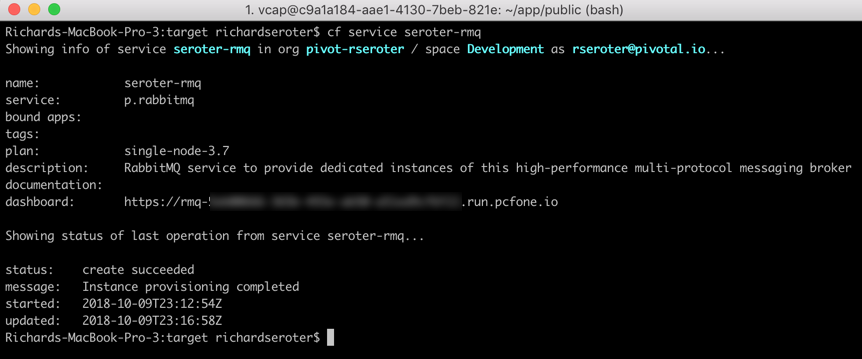
    What’s nice is that background jobs have access to all the useful PCF capabilities that web apps do. One such capability? Service Brokers! Devs love using Service Brokers to provision and access backing services. My background job needs access to RabbitMQ and I don’t want to hard-code any connection details. No big deal. I first spun up an on-demand RabbitMQ instance via the PCF Service Broker.

    My .NET Core app uses the Steeltoe Service Connector (and the RabbitMQ .NET Client) to load service broker connection info and talk to my instance.

    static void Main(string[] args){            
    //pull service broker configuration
    var builder = new ConfigurationBuilder()
    .AddEnvironmentVariables()
    .AddCloudFoundry();

    var configuration = builder.Build();
    //get our fully loaded service
    var services = new ServiceCollection();
    services.AddRabbitMQConnection(configuration);
    var provider = services.BuildServiceProvider();
    ConnectionFactory f = provider.GetService<ConnectionFactory>();

    //connect to RMQ
    using (var connection = f.CreateConnection())
    using (var channel = connection.CreateModel())
    {
    channel.QueueDeclare(queue: "loans", durable: true, exclusive: false, autoDelete: false, arguments: null);
    var consumer = new EventingBasicConsumer(channel);

    //fire up when a new message comes in
    consumer.Received += (model, ea) => {
    var body = ea.Body;
    var message = Encoding.UTF8.GetString(body);
    Console.WriteLine("[x] Received loan data: {0}", message);
    };
    channel.BasicConsume(queue: "loans", autoAck: true, consumer: consumer);
    Console.ReadLine();
    }
    }

    Apps deployed to Cloud Foundry are typically accompanied by a YAML manifest. You can provide the parameters on the CLI, but versioned, source-controlled manifests are a better way to go. For these background jobs, the manifests are simple. Note two key things: the no-route parameter is “true” so that we don’t get a route assigned, and the health-check-type is set to “process” so that the orchestrator monitors process availability and doesn’t try to ping a non-existent web endpoint. Also notice that I bound my app to the previously-created RabbitMQ service instance.

    ---  
    applications:
    - name: core-demo-background
    memory: 256M
    no-route: true
    health-check-type: process
    services:
    - seroter-rmq

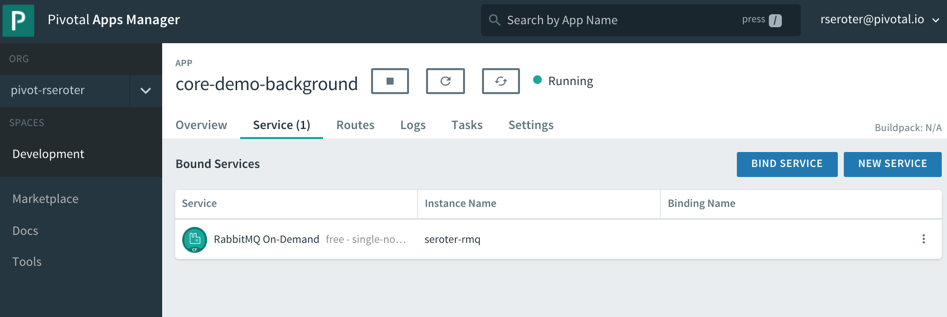
    After a quick cf push, my background app was running, and bound to the RabbitMQ instance.

    This job quietly sits and waits for work to do. What’s neat is this can also take advantage of PCF’s autoscale capability, and scale by monitoring RabbitMQ queue depth, for example. For now, one instance is plenty. I logged into RabbitMQ and sent in a couple sample “loan” messages.

    Sure enough, when I viewed the aggregated application logs for my background job, I saw the content of each read message printed out. 

    These sorts of workers are a useful part of most systems, and PCF offers a resilient, manageable place to run them.

    Deploying and running on-demand batch tasks

    How many useful, random scripts do your system administrators have sitting around? You know, the ones that create users, reset demo environments, or purge FTP shares. Instead of having those scripts buried on administrator desktops, you can run these one-off batch jobs in PCF.

    I created another .NET Core console application. This one pretends to sweep expired files from a shared folder. I deployed this application to PCF with a –no-start command since I want to trigger it on demand.

    cf push --no-start

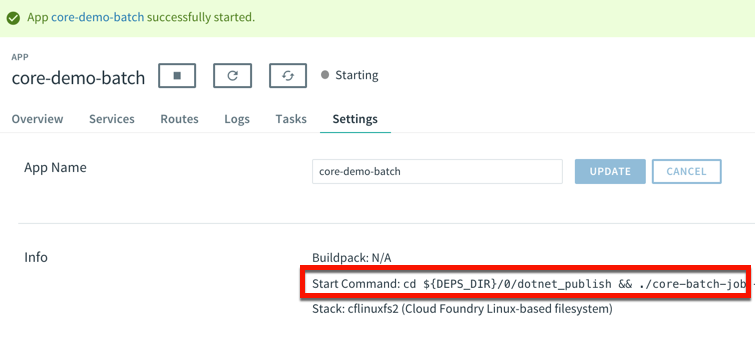
    Now, to trigger the job, I need to know the start command. This depends on how you deployed it. Since I used the .NET Core buildpack, I want to start up the app one time to discover how PCF starts up the app.

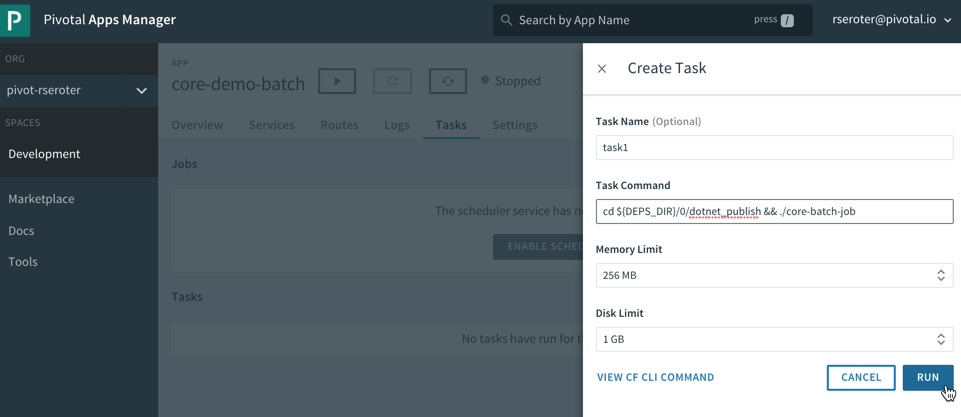
    That command showed me where the .NET Core executable lives in the container. I stopped the app again, and switched over the “Tasks” view in the PCF Apps Manager interface. I can do all these things via the CLI as well, but I’m a sucker for a nice UX. There’s a “run task” button that lets me define a one-off task definition.

    Here I gave the task a name, pasted the start command I found above, and that was it! When I hit, “run”, PCF instantiated a new container instance and shut down the container when the task was complete. And that’s what I saw. There was a log entry indicating a successful job run, and the application logs showed the output of the task. Nice!

    This is a great option for one-off jobs and scripts. Consolidate them in PCF, and get all the availability and auditing you need.

    Deploying and running scheduled jobs

    Finally, some of those one-off jobs may not be as one-off as you thought! Instead of asking your admin to trigger a task once a day to purge expired files, how about you schedule the job to run on a schedule? 

    PCF also offers a scheduling component to trigger tasks (or API calls!) on a recurring basis. On the same “tasks” tab of the PCF Apps Manager UX, there’s a “jobs” section for scheduled tasks. Besides giving the job a name and a command (the same as the task command above), you enter a Cron expression for the schedule itself. The expression is in a MIN HOUR DAY-OF-MONTH MONTH DAY-OF-WEEK format. For example “15 * ? * * *” means you should run the job every 15 minutes, and “30 10 * * 5” means you should run the job at 10:30am every Friday. My job below is set to run every minute.

    We’re all building lots of web apps nowadays, but you have lots of need for event-driven or scheduled background work. PCF may surprise you as an entirely suitable platform for those workloads.

  • My new Pluralsight course—Cloud-native Architecture: The Big Picture—is now available!

    I’ll be honest with you, I don’t know much about horses. I mean, I know some things and can answer basic questions from my kids. But I’m mostly winging it and relying on what I remember from watching Seabiscuit. Sometimes you need just enough knowledge to be dangerous. With that in mind, do you really know what “cloud-native” is all about? You should, and if you want the foundational ideas, my new on-demand Pluralsight class is just for you.

    Clocking in at a tight 51 minutes, my course “Cloud-native Architecture: The Big Picture” introduces you to the principles, patterns, and technologies related to cloud-native software. The first module digs into why cloud-native practices matter, how to define cloud-native, what “good” looks like, and more.

    The second module calls out cloud-native patterns around application architecture, application deployment, application infrastructure, and teams. The third and final module explains the technologies that help you realize those cloud-native patterns.

    This was fun to put together, and I’ve purposely made the course brief so that you could quickly get the key points. This was my 18th Pluralsight course, and there’s no reason to stop now. Let me know what topic you’d like to see next!