Category: General Architecture

  • Evaluation Criteria for SaaS/Cloud Platform Vendors

    My company has been evaluating (and in some cases, selecting) SaaS offerings and one of the projects that I’m currently on has us considering such an option as well.  So, I started considering the technology-specific evaluation criteria (e.g. not hosting provider’s financial viability) that I would use to determine our organizational fit to a particular cloud/SaaS/ASP vendor.  I’m lumping cloud/SaaS/ASP into a bucket of anyone who offers me an off-premises application.  When I finished a first pass of the evaluation, my list looked a whole lot like my criteria for standard on-premises apps, with a few obvious omissions and modifications.

    First off, what are the things that I should have an understanding of, but am assuming that I have little control over and that  the service provider will simply “do for me” (take responsibility for)?

    Category

    Considerations / Questions

    Scalability
    Availability
    • How do you maintain high uptime for both domestic and international users?
    Manageability
    • What (user and programmatic) interfaces do I have to manage the application?
    • How can on-premises administrators mash up your client-facing management tools with their own?
    Hardware/Software
    • What is the underlying technology of the cloud platform or specific instance details for the ASP provider?
    Storage
    • What are the storage limits and how do I scale up to more space?
    Network configuration and modeling
    • How is the network optimized with regards to connectivity, capacity, load balancing, encryption and quality of service?
    • What is the firewall landscape and how does that impact how we interact with you?
    Disaster recovery
    • What is the DR procedure and what is the expected RPO and RTO?
    Data retention
    • Are there specific retention policies for data or does it stay in the active transaction repository forever?
    Concurrency
    • How are transactions managed and resource contention handled?
    Patch management
    • What is the policy for updating the underlying platform and how are release notes shared?
    Security
    • How do you handle data protection and compliance with international data privacy laws and regulations?
    • How is data securely captured, stored, and accessed in a restricted fashion?
    • Are there local data centers where country/region specific content can reside?
    User Interfaces
    • Are there mobile interfaces available?

    So far, I’m not a believer that the cloud is simply a place to stash an application/capability and that I need not worry about interacting with anything in that provider’s sandbox.  I still see a number of integration points between the cloud app and the infrastructure residing on premises.  Until EVERYTHING is in the cloud (and I have to deal with cloud-to-cloud integration), I still need to deal with on-premises applications. This next list addresses the key aspects that will determine if the provider can fit into our organization and its existing on-site investments (in people and systems).

    Category

    Considerations / Questions

    Security
    • How do I federate our existing identity store with yours?
    • What is the process for notifying you of a change in employment status (hire/fire)?
    • Are we able to share entitlements in a central way so that we can own the full provisioning of users?
    Backwards compatibility of changes
    • What is the typical impact of a back end change on your public API?
    • Do you allow direct access to application databases and if so, how are your environment updates made backwards compatible?
    • Which “dimensions of change” (i.e. functional changes, platform changes, environment changes) will impact any on-premises processes, mashups, or systems that we have depending on your application?
    Information sharing patterns
    • What is your standard information sharing interface?  FTP?  HTTP?
    • How is master data shared in each direction?
    • How is reference data shared in each direction?
    • Do you have both batch (bulk) and real-time (messaging) interfaces?
    • How is initial data load handled?
    • How would you propose handling enterprise data definitions that we use within our organizations?  Adapters with transformation on your side or our side?
    • How is information shared between our organizations securely?  What are your standard techniques?
    • For real-time data sharing, do you guarantee once-only, reliable delivery?
    Access to analytics and reporting
    • How do we access your reporting interface?
    • How is ad-hoc reporting achieved?
    • Do we get access to the raw data in order extract a subset and pull it in house for analysis?
    User interface customization
    • What are the options for customizing the user interface?
    • Does this require code or configuration?  By whom?
    Globalization /  localization
    • How do you handle the wide range of character sets, languages, text orientations and units of measure prevalent in an international organization?
    Exploiting on-premises capabilities
    • Can this application make use of any existing on-premises infrastructure capabilities such as email, identity, web conferencing, analytics, telephony, etc?
    Exception management
    • What are the options for application/security/process exception notification and procedures?
    Metadata ownership
    Locked in components
    • What aspects of your solution are proprietary and “locked in” and can only be part of an application in your cloud platform?
    Developer toolkit
    • What is the developer experience for our team when interfacing with your cloud platform and services?  Are there SDKs, libraries and code samples?
    Enhancement cost
    • What types of changes to the application incur a cost to me (e.g. changing a UI through configuration, building new reports, establishing new API interfaces)?

    This is a work in progress.  There are colleagues of mine doing more thorough investigations into our overall cloud strategy, but I figured that I’d take this list out of OneNote and expose it to the light of day.  Feel free to point out glaring mistakes or omissions.

    As an aside, the two links I included in the lists above point to the Dev Central blog from F5.  I’ll tell you what, this has really become one of my “must read” blogs for technology concepts and infrastructure thoughts.  Highly recommended regardless of whether or not you use their products.  It’s thoughtfully written and well reasoned.

    Technorati Tags: ,

  • What Technologies Makes Up an SOA?

    My boss’s boss asked if our architecture team could put together a list of what technologies and concepts typically comprise a service oriented architecture, so I compiled a collection of items and organized them by category.  I then evaluated whether we had such a technology in house, and if so, did we actively use it.  While you don’t care about those latter criteria, I thought I’d share (and ask your opinion of) my technology list.

    Is this fairly complete?  Is anything missing or mischaracterized?

    Category Technology Description Toolset Examples
    Standards XML Markup language for defining the encoding of structured data sets Application platforms, database platforms, COTS packages
    SOAP Protocol specification for exchanging XML data over networks Application platforms, COTS packages
    WSDL XML language for describing web service contracts Application platforms, COTS packages that expose WSDL, IDE tools such as XmlSpy for hand-crafting WSDL documents
    WS* Set of web service standards of varying maturity that address message routing, security, attachment encoding, transactions and more. COTS packages such as SAP, application platforms such as Microsoft WCF
    RESTful Services Architectural style with a focus on resource orientation and interacting with the state of that resource through traditional HTTP verbs .NET Framework 3.5+
    Design Service Modeler Graphical tools for modeling SOA solutions WebSphere Business Modeler, Mashup Tools
    Data Enterprise Entity Definitions Computable representations of shared entities that may span multiple source systems XSD, DDL
    Reference Data Architecture Three components made up of: (a) Operation Data Stores for logical entity definitions that act as “real time data warehouse” consisting of both real-time and batch updated data (b) Data marts for data subset analysis, and (c ) Data Warehouse for enterprise data storage and analysis Oracle, Teradata, SQL Server
    Enterprise Information Integration (EII) Virtual integration of disparate data sources Composite
    Data Service Interface Generation Application for generating interfaces (SOAP/batch) on existing data repositories BizTalk Server 09, .NET Framework, Composite
    Enterprise Service Bus Reliable message routing, transformation, queuing and delivery across disparate technologies BizTalk Server 09, Tibco, Sonic
    Application Adapters Connectivity to cross-platform systems via configuration and/or abstract interfaces BizTalk Server 09, BizTalk Adapter Pack (Siebel, SAP, Oracle)
    ETL Application Bulk data extraction, cleansing and migration between repositories.  Frequently needed for consolidating data in the ODS Informatica, SSIS
    Infrastructure Application Platforms Libraries for building SOA solutions .NET Framework, Java EE
    XML Gateway (Accelerators) Focuses on SOA security and performance issues; typically a hardware appliance WebSphere DataPower; Layer 7
    Complex Event Processing Engine Concept where distinct application or system events are correlated with the goal of discovering critical business information in real time Microsoft StreamInsight, Tibco, Oracle CEP
    Single Sign On Single set of authenticated credentials can be converted to system-specific credentials without user intervention Siteminder
    Data Quality Services Used to cleanse data and validate data quality DataFlux
    Load Balancing Hardware or software solution which sits in front of physical web servers and is responsible for distributing load F5; SOA Service Manager
    Web Hosting Platforms Environment to making web services available to consumers Microsoft IIS, Oracle WebLogic
    Process Integration BPM Server Tooling that supports the modeling, simulation, execution, monitoring and optimizations of business processes BizTalk Server 09Lombardi
    Business Rules Engine Software system for maintaining business rules outside of compiled code Microsoft BRE,           Oracle
    Orchestration Services Arrangement of services into an executable business process often designed through a graphical model BizTalk Server 09
    Business Activity Monitoring Aggregation of activities, events and data that provides insight into organization and its business processes BizTalk Server 09
    Service Management XML Service Management (XSM) A platform independent system for administering, mediating and monitoring services SOA Service Manager
    Repository Metadata repository for service definitions SOA Service Manager
    UDDI-compliant Registry Interface for runtime infrastructure to discover and bind to service endpoints SOA Service Manager
    Runtime Policies Attach attributes to service (or operation) that dictates how the service request is secured and processed SOA Service Manager
    SLA Enforcement Define acceptable web service availability with customizable rules consisting of alert code, metric to monitor and an interval SOA Service Manager
    Access Control Contracts Limit usage of service based on distinct number of allowable attempts, time of day window, or based on caller identity SOA Service Manager
    Service Lifecycle Management Stage, status, approvals, dependency tracking, audit trail

    SOA Service Manager

    Security Authorization Verify user identity through LDAP integration, SAML tokens, x.509 certificates Active Directory, Sun ONE LDAP, SOA Service Manager
    Authentication User/group/role at service or operation level SOA Service Manager
    Identity Management Central storage of user profile

    Any feedback is appreciated!

    Technorati Tags:

  • Interview Series: Four Questions With … Jesus Rodriguez

    I took a hiatus last month with the interview, but we’re back now.  We are continuing my series of interviews with CSD thought leaders and this month we are having a little chat with Jesus Rodriguez.  Jesus is a Microsoft MVP, blogger, Oracle ACE, chief architect at Tellago, and a prolific speaker.  If you follow Jesus’ blog, then you know that he always seems to be ahead of the curve with technology and can be counted on for thoughtful insight. 

    Let’s see how he handles the wackiness of Seroter’s Four Questions.

    Q: You recently published a remarkably extensive paper on BAM.  Did you learn anything new during the creation of this paper, and what do you think about the future of BAM from Microsoft?

    A:  Writing an extensive paper is always a different experience. I am sure you are familiar with that feeling given that these days you are really busy authoring a book. A particular characteristic of our BAM whitepaper is the diversity of the target audience. For instance, while there are sections that are targeting the typical BizTalk audience, others are more intended to a developer that is really deep with WCF-WF and yet others sections are completely centered on Business Intelligence topics. I think I learned a lot in terms of how to structure content that targets a largely diverse audience without confusing everybody. I am not sure we accomplish that goal but we certainly tried 😉

    I think BAM is one of the most appealing technologies of the BizTalk Server family. In my opinion, in the next releases, we should expect BAM to evolve beyond being a BizTalk-centric technology to become a mainstream infrastructure for tracking and representing near real time business information. Certainly the WCF-WF BAM interceptors in BizTalk R2 were a step on that direction but there are a lot of other things that need to be done. Specifically, BAM should gravitate towards a more integrated model with the different Microsoft’s Business Intelligence technologies such as the upcoming Gemini. Also, having interoperable and consistent APIs is a key requirement to extend the use of BAM to non Microsoft technologies. That’s why the last chapter of our paper proposes a BAM RESTful API that I believe could be one of the channels for enhancing the interoperability of BAM solutions.

    Q: You spoke at SOA World late last year and talked about WS* and REST in the enterprise.    What sorts of enterprise applications/scenarios are strong candidates for REST services as opposed to WS*/SOAP services and why?

    A: Theoretically, everything that can be modeled as a resource-oriented operation is a great candidate for a RESTful model. In that category we can include scenarios like exposing data from databases or line of business systems. Now, practically speaking, I would use a RESTful model over a SOAP/WS-* alternative for almost every SOA scenario in particular those that require high levels of scalability, performance and interoperability. WS-* still has a strong play for implementing capabilities such as security, specifically for trust and federation scenarios, but even there I think we are going to see RESTful alternatives that leverages standards like OpenID, OAuth and SAML in the upcoming months. Other WS-* protocols such as WS-Discovery are still very relevant for smart device interfaces.

    In the upcoming years, we should expect to see a stronger adoption of REST especially after the release the JSR 311 (http://jcp.org/en/jsr/detail?id=311 ) which is going to be fully embraced by some of the top J2EE vendors such as Sun, IBM and Oracle.

    Q: What is an example of a “connected system” technology (e.g. BizTalk/WCF/WF) where a provided GUI or configuration abstraction shields developers from learning a technology concept that might actually prove beneficial?

    A:  There are good examples of configuration abstractions in these three technologies (BizTalk, WCF and WF). Given the diversity of its feature set, WCF hides a lot of things behind its configuration that could be very useful on some situations. For instance, each time we configure a specific binding on a service endpoint we are indicating the WCF runtime the configuration of ten or twelve components such as encoders, filters, formatters or inspectors that are required in order to process a message. Knowing those components and how to customize them allows developers to optimize the behavior of the WCF runtime to specific scenarios.

    Q [stupid question]: Many of us have just traveled to Seattle for the Microsoft MVP conference.  This year they highly encouraged us to grab a roommate instead of residing in separate rooms.  I’ve been told that one way to avoid conference roommates is to announce during registration some undesirable characteristic that makes you an lousy roommate choice.  For instance, I could say that I have a split personality and that my alter ego is a nocturnal, sexually-confused 15th century sea pirate with a shocking disregard for the personal space of others.  Bam, single room.  Give us a (hopefully fictitious) characteristic that could guarantee you a room all to yourself.

    A:  My imaginary friend is a great Opera singer 🙂 We normally practice signing duets after midnight and sometimes we spend all night rehearsing one or two songs. We are really looking have our MVP roommate as our audience and, who knows, maybe we can even try a three-voice song.

    Seriously now, given work reasons I had to cancel my attendance to the MVP summit but I am sure you guys (BizTalk MVP gang) had a great time and drove your respective roommates crazy 😉

    As always, I had fun with this one.  Hopefully Jesus can say the same.

    Technorati Tags: , ,

  • Service Security Guide on MSDN

    The Improving Web Services Security: Scenarios and Implementation Guidance for WCF project on CodePlex now has its results in an online browsable from within the MSDN site.    I linked to this project last year, but it’s great that everything has been made available on MSDN as well.

    Even if you aren’t using WCF, this set of deliverables has some very insightful components.  For example, the Security Fundamentals for Web Services chapter barely even mentions WCF but rather focuses on defining services, overarching security principles, as well as a set of security patterns that address topics such as authentication, data confidentiality and message validation.

    Chapter 2, Threats and Countermeasures for Web Services, is also technology-neutral and identifies a set of security threats, vulnerabilities, and countermeasures.

    Of course it is a WCF guide, so expect to find a wealth of information about WCF security options and trade-offs as well as 20+ “how to” walkthroughs that range from hosting services, to impersonation to using certificate-based authentication.

    Finally, if you’re not a “read tons of pages about security” kind of fella, then at least peruse the WCF Security Checklist (which can provide a good development checkpoint prior to service release), the summary of WCF Security Practices at a Glance (which provides a clean list of categories and related articles) and the very important Q&A section that contains dozens of realistic questions with straightforward answers.

    Great job on this.  Thanks J.D. and team.

    Technorati Tags: ,

  • Tips for Successful Software Vendor Evaluations

    In the past six months, I’ve had the pleasure (penalty?) of participating in software vendor evaluations for two distinct projects.  In each case, we looked at three vendors over the course of consecutive days and evaluated them against a series of business scenarios to see which software package was a best fit for our environment.   I learned a lot between those two sessions, and thought I’d share my best tips for participating in such sessions.

    • DO know the business cases ahead of time.  In my earlier vendor evaluation I didn’t know the core business or their use cases particularly well so it was difficult to engage in every business discussion.  Prior to this most recent session, I have spent months sitting in a war room with the business stakeholders refining requirements and hashing out goals for the project.  By deeply knowing what the software had to accomplish, I was able to actively participate in the discussion AND, ask technical questions that had significant relevant context behind them.
    • DO NOT wait to ask common technology questions until the day of the demonstration.  You should make sure to get base technical questions answered before the evaluation session.  We have a strong software vendor evaluation toolkit that we send to the vendors as part of an RFP.  This gets basic questions like “what is your platform built on”, “explain your DR strategy” and “describe your information integration patterns” out of the way.  If you’re looking for ideas when building such a questionnaire, check out the EPIC offering from the SEI. By establishing a foundation of technical background on a vendor, I can better refine business-relevant technical questions and not waste time asking if their product is Java or .NET based.
    • DO prepare a thorough list of technical questions for the session itself.  I defined a list of 2 dozen questions that weren’t in our initial software evaluation toolkit and were specifically relevant to our project.  While I did maintain a running list of new questions that I thought of during the actual demo, it was very beneficial to construct a stock list of questions for each vendor.  Some examples of these questions included:
      • How would I configure / code a punchout to an external service or repository in order to enrich a data entity or perform a data lookup?
      • How do I configure an outbound real time event to a SOAP listener outside the system?
      • Are customizations made via database procedures, custom code, etc and how are each propagated between environments (dev/test/prod)?  What are configurations and what are customizations?
      • How are exceptions captured, displayed and actionable on workflows, rules and business operations?
      • What support does the application have for a federated identity model?
      • How do you load master data from external systems while sharing master data with others?
    • DO strategically use instant messenger to communicate amongst team members.  While the majority of business participants filled out paper scoresheets in order to discourage distraction, a few of us remained on our laptops.  While this could have been an excuse to mess around, one key benefit was the ability to quickly (and stealthily) communicate between one another and find out if someone missed something, had a question to verify before asking, or simply keep ourselves aware of time restraints.
    • DO have a WebEx (aka web conference) set up so that you can (a) observe greater details on a laptop instead of on a projector far away, and (b) be able to take screenshots of the application presented.  The taking of screenshots was the biggest way I stay engaged throughout 4 straight days of presentations and demos.  And the best part was, when all was said and done, I had a captured record of what I saw.  When we met later to discuss each presentation, I could quickly review what was presented and differentiate each vendor.
    • DO agree on a scoring mechanism ahead of time.  If you want to be militant and say that you only give a non-zero score when you see an ACTUAL demonstration of a feature (vs. “oh we can do that, but didn’t build it in”) then everyone must agree on that strategy.  Either way, create a common ranking scale and discuss what sorts of things should fall into each.
    • DO set aside a specific time during the evaluation day for technical discussion.  The majority of the day should be focused on business requirements and objectives.  In our case, we blocked off the last 1.5 hours of each day for targeted technical discussion.  This made the flow of the day much smoother and less prone to tangents.
    • DO NOT get bogged down in deep technical discussion because the goal of this type of session is to determine compatibility, not to necessary model and design the entire solution.  This distracts you from getting to the other big-picture questions you need to get answered.
    • DO be forthright and demanding.  I’ve been on the other side of this while working from Microsoft, and my current employer was great at not beating around the bush.  If you don’t see something you expected, or think you might have missed something, stop the presentation and get your question resolved.  The vendor is there for your benefit, not the other way around.
    • DO be explicit in what you want to see from the vendor.  It helps them and helps you.  In our case, we provided detailed requirements and use case scripts that we expected the vendor to follow.  This allowed us to clearly set expectations and gave our vendors the best chance to show us what we’d like to see.
    • DO NOT provide too much time between when you deliver such scripts / use cases and when you expect them to be presented.  By only allowing a short time for the vendor to digest what we wanted and actually deliver it, we forced them to work with out-of-the-box features and did not give them a chance to completely customize their application in a way we never would.

    Overall, I actually enjoy these evaluations.  It gives me a chance to observe how smart software developers solve diverse business projects.  And, I get free lunches each day, so that’s a plus too.

    Technorati Tags:

  • Should an ODS Have a Query-By-Service Interface?

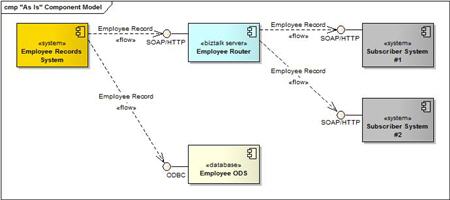
    My company has an increasingly mature Operational Data Store (ODS) strategy where agreed-upon enterprise entities are added to shared repositories and accessible across the organization.  These repositories are typically populated via batch loads from the source system.  The ODS is used to keep systems which are dependent on the source system from bombarding the source with bulk data load processing requests.  Independent of our ODS landscape, we have BizTalk Server doing fan-outs of real-time data from source systems to subscribers who can handle real-time data events.  My smart architect buddy Ian is proposing a change to our model, and I thought I’d see what you all think.

    So this is a summary of what our landscape looks like today:

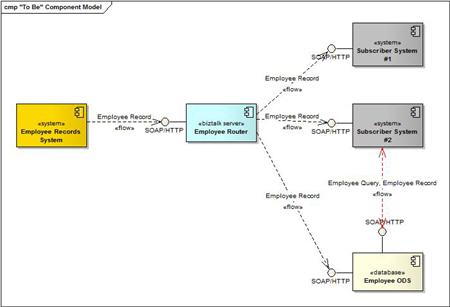
    Notice that in this case, our ESB (BizTalk Server) is populated independently of our ODS.  What Ian wants us to do is populate all of our ODSs from our ESB (thus making it just another real-time subscriber), and then throw a “get” interface on the ODS for request/reply operations which would have previously gone against the source system (see below).  Below notice that the second subscriber of data receives real-time feeds from BizTalk, but also can query the ODS for data as well.

    I guess I’ve typically thought of an ODS as being for batch interactions only, and not something that should be queried via request/response operations.  If I need real-time data, I’d always go to the source itself. However, there are lots of benefits to this proposed model:

    • Decouple clients from source system
    • Remove any downstream  impact on source system maintenance schedules
    • Don’t require additional load, interfaces or adapters on source system (although most enterprise systems should be able to handle the incremental load of request/response queries).
    • All the returned entities are already in a flattened, enterprise format as opposed to how they are represented in the source system

    Now, before declaring that we never go to source systems and always hit an ODS (which would be insane), here are some considerations we’ve thought about:

    • This should only be for shared enterprise entities that are distributed around the organization.
    • There is only a “get by ID” operation on the ODS vs. any sort of “update” or “delete” operations.  Clearly having any sort of “change” operations would be nuts and cause a data consistency nightmare.
    • The availability/reliability of the platform hosting the ODS must meet or exceed that of the source system.
    • We must be assured that the source system can publish a real-time event/data message.  No “quasi-real-time” where updates are pushed out every hour.
    • This model should not be used for entities where we need to be 110% sure that the data is current (e.g. financial data, extremely volatile data).

    Now, there still may be a reliance by clients on the source system if the shared entity doesn’t contain every property required by the client.  And in a truly event-driven model, maybe the non-ODS subscribers should only get event notifications and be expected to ping the ODS (which receives the full data message) if they want more data than what exists in the event message.  But other than that, are there other things I’ve missed or considerations I should weigh more heavily one way or the other?  Share with me.

    Technorati Tags: , ,

  • RSSBus V2 Released

    A few months back I wrote a series of articles on RSSBus that used an early release of their software.  Yesterday they formally released version 2.0 of their product and have included some pretty interesting features.

    You’ve got the new SOAP connector, new scripting keywords, Intellisense within Visual Studio.NET 2008, updated User Guide, and lots more.  One of the coolest things is that they have a demo of the RSSBus server running on Windows Azure.  I need to play around with that and see exactly what can be accomplished there.

    The folks behind this are some of the smarter technologists I know, so you’re in good hands if you invest some time and energy into a solution based on RSSBus.

    Technorati Tags: ,

  • Application Architecture "Pocket Guides" From Microsoft

    Was trolling CodePlex today and noticed that those Patterns and Practices cats just released a neat little set of short architecture guides that cover a few specific architectural areas including the Agile architecture method, web application architecturemobile architecture, rich Internet application (RIA) architecturerich client architecture, and finally, service architecture.

    The service guide is a fairly useful little document that spells out a few important things.  It covers different considerations for SOA services, data services and workflow services.  I like the sections which cover items such as considerations for each design area (e.g. exception management, message endpoints, authentication, etc), as well as the considerations for each service layer.  There are brief descriptions of common patterns, and a handy checklist for evaluating your service architecture. 

    Overall, a pleasant read.  May not be breaking new ground for some of you, but if anything, this set of guides should encourage you to read about a particular architecture topic you aren’t that familiar with.

    Technorati Tags:

  • I, For One, Welcome our New Cloud Overlords

    I’m trying really hard to not pay attention to PDC today, but, damn them and their interesting announcements!  The “Cloud OS” turned out to be Azure.  Good stuff there.  “BizTalk Services” are dead, long live .NET Services.    Neat that you have both Java and Ruby SDKs for .NET Services.

    Also, we got a full release of the Microsoft Federation Gateway (whitepaper here) and a preview of the Microsoft Service Connector (announcement here).  For companies tackling B2B scenarios with a myriad of partners, these technologies may offer a simplified route.

    Ok, back to real work.  Stop distracting me with your sexy cloud products.

    Technorati Tags: ,

  • That’s "MR" Skeptical Blogger to You!

    A couple weeks back I answered some interview questions regarding my impressions of Microsoft’s Oslo.  One of my answers found its way into an article you can read on ComputerWorld entitled Microsoft eyes Oslo as game-changer for application development.   It’s a good article with some interesting perspective.  You’ll find my quote on page three.  I wouldn’t say that I’m skeptical of the intentions of Oslo, but I AM just curious to see how they pull it off.  So, maybe I’m skeptical of their implementation!  The point I was trying to make is that expansive models aren’t easy to either design or maintain, and attempts that I’ve seen so far to synchronize the model with the implementation have been lacking.  We’ll see if the Oslo repository and “M” language are actually game changers.  Here’s hoping.

    I’m not making it to PDC this year, but since I live close by, I hope to pop in on some extracurricular events.