Category: General Architecture

  • SIMPLER Way of Hosting the WCF 4.0 Routing Service in IIS7

    A few months back I was screwing around with the WCF Routing Service and trying something besides the “Hello World” demos that always used self-hosted versions of this new .NET 4.0 WCF capability. In my earlier post, I showed how to get the Routing Service hosted in IIS.  However, I did it in a round-about way since that was only way I could get it working.  Well, I have since learned how to do this the EASY way, and figured that I’d share that. As a quick refresher, the WCF Routing Service is a new feature that provides a very simple front end service broker which accepts inbound messages and distributes them to particular endpoints based on specific filter criteria.  It leverages your standard content-based routing pattern, and is not a pub/sub mechanism.  Rather, it should be used when you want to send an inbound message to one of many possible destination endpoints. I’ll walk through a full solution scenario here.  We start with a standard WCF contract that will be shared across the services sitting behind the Router service.  Now you don’t HAVE to use the same contract for your services, but if not, you’ll need to transform the content into the format expected by each downstream service, or, simply accept untyped content into the service.  Your choice.  For this scenario, I’m using the Routing Service to accept ticket orders, and based on the type of event that the ticket applies to, routes it to the right ticket reservation system.  My common contract looks like this:

    [ServiceContract]
        public interface ITicket
        {
            [OperationContract]
            string BuyTicket(TicketOrder order);
        }
    
        [DataContract]
        public class TicketOrder
        {
            [DataMember]
            public string EventId { get; set; }
            [DataMember]
            public string EventType { get; set; }
            [DataMember]
            public int CustomerId { get; set; }
            [DataMember]
            public string PaymentMethod { get; set; }
            [DataMember]
            public int Quantity { get; set; }
            [DataMember]
            public decimal Discount { get; set; }
        }
    

    I then added two WCF Service web projects to my solution.  They each reference the library holding the previously defined contract, and implement the logic associated with their particular ticket type.  Nothing earth-rattling here:

    public string BuyTicket(TicketOrder order)
        {
            return "Sports - " + System.Guid.NewGuid().ToString();
        }
    

    I did not touch the web.config files of either service and am leveraging the WCF 4.0 capability to have simplified configuration. This means that if you don’t add anything to your web.config, some default behaviors and bindings are used. I then deployed each service to my IIS 7 environment and tested each one using the handy WCF Test Client tool.  As I would hope for, calling my service yields the expected result: 2010.3.9router01 Ok, so now I have two distinct services which add orders for a particular type of event.  Now, I want to expose a single external endpoint by which systems can place orders.  I don’t want my service consumers to have to know my back end order processing system URLs, and would rather they have a single abstract endpoint which acts as a broker and routes messages around to their appropriate target. So, I created a new WCF Service web application.  At this point, just for reference I have four projects in my solution. 2010.3.9router02 Alrighty then.  First off, I removed the interface and service implementation files that automatically get added as part of this project type.  We don’t need them.  We are going to reference the existing service type (Routing Service) provided by WCF 4.0.  Next, I went into the .svc file and changed the directive to point to the FULLY QUALIFIED path of the Routing Service.  I didn’t capitalize those words in the last sentence just because I wanted to be annoying, but rather, because this is what threw me off when I first tried this back in December.

    <%@ ServiceHost Language="C#" Debug="true" Service="System.ServiceModel.Routing.RoutingService,System.ServiceModel.Routing, version=4.0.0.0, Culture=neutral,PublicKeyToken=31bf3856ad364e35"  %>
    

    Now all that’s left is the web.config file.  The configuration file needs a reference to our service, a particular behavior, and the Router specific settings. I first added my client endpoints:


    Then I added the new “routing” configuration section.  Here I created a namespace alias and then set each Xpath filter based on the “EventType” node in the inbound message.  Finally, I linked the filter to the appropriate endpoint that will be called based on a matched filter.


    After that, I added a new WCF behavior which leverages the “routing” behavior and points to our new filter table.


    Finally, I’ve got my service entry which uses the above behavior and defines which contract we wish to use.  In my case, I have request/reply operations, so I leveraged the corresponding contract in the Routing service.


    After deploying the routing service project to IIS, we’re ready to test.  What’s the easiest way to test this bad boy?  Well, we can take our previous WCF Test Client entry, and edit it’s WCF configuration.  This way, we get the strong typing on the data entry, but ACTUALLY point to the Routing service URL. 2010.3.9router03 After the change is made, we can view the Configuration file associated with the WCF Test Client and see that our endpoint now refers to the Routing service. 2010.3.9router04 Coolio.  Now, we can test.  So I invoked the BuyTickets operation and first entered a “Sports” type ticket. 2010.3.9router05 Then, ALL I did was switch the EventType from “Sports” to “Concert” and the Routing service should now call the service which fronts the concert reservation service. 2010.3.9router06 There you have it.  What’s nice here, is that if I added a new type of ticket to order, I could simply add a new back end service, update my Routing service filter table, and my service consumers don’t have to make a single change.  Ah, the power of loose coupling. You all put up with these types of posts from me even though I almost never share my source code.  Well, your patience has paid off.  You can grab the full source of the project here.  Knock yourselves out. Share

  • StreamInsight Musings

    I’ve been spending a fair amount of free time recently looking much deeper into Microsoft StreamInsight which is the complex event processing engine including in SQL Server 2008 R2.  I figured that I’d share a few thoughts on it.

    First off, as expected with such a new product, there is a dearth of available information.  There’s some information out there, but as you’d expect, there are plenty of topics where you’d love to see significantly more depth.  You’ve got the standard spots to read up on it:

    The provided documentation isn’t bad, and the samples are useful for trying to figure things out, but man, you still really have to commit a good amount of time to grasping how it all works.

    The low-latency/high-volume aspect is touted heavily in these types of platforms, but I actually see a lot of benefit in just having the standing queries.  As one writer on StreamInsight put it, unlike database-driven applications where you throw queries at data, in CEP solutions, you throw data at queries.  Even if you don’t have 100,000 transactions per second to process, you could benefit by passing moderate volumes of data through strategic queries in order to find useful correlations or activities that you wish to immediately act upon.

    Using LINQ for queries is nice, but for me, I had to keep remembering that I was dealing with a stream of data and not a static data set.  You must establish a “window” if you want to execute aggregations or joins against a particular snapshot of data.  It makes total sense given that you’re dealing with streams of data, but for some reason, it took me a few cycles to retain that.  Despite the fact that you’re using LINQ on the streams, you have to think of StreamInsight more like BizTalk (transient data flying through a bus) instead of a standard application where LINQ would be used to query at-rest data.

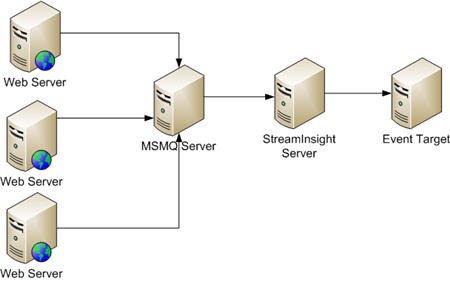
    The samples provided in StreamInsight are ok, and the PDC examples provide a good set of complimentary bits.  However, I was disappointed that there were no “push” adapter scenarios demonstrated.  That is, virtually every demonstration I’ve seen shows how a document is sucked into StreamInsight and the events are processed.  Some examples show a poller, but I haven’t seen any cases of a device/website/application pushing data directly into the StreamInsight engine.  So, I built a MSMQ adapter to try it out.  In the scenario I built, I generate web-click and event log data and populate a set of MSMQ queues.  My StreamInsight MSMQ adapter then responds to data hitting the queue and runs it through the engine.  Works pretty well.

    2010.02.12Streaminsight01

    It’s not too tough to build an adapter, BUT, I bet it’s hard to build a good one.  I am positive that mine is fine for demos but would elicit laughter from the StreamInsight team.  Either way, I hope that the final release of StreamInsight contains more demonstrations of the types of scenarios that they heavily tout as key use cases.

    Lastly, I’ll look forward to seeing what tooling pops up around StreamInsight.  While it consists of an “engine”, the whole things feels much more like a toolkit than a product.  You have to write a lot of plumbing code on adapters and I’d love to see more visual tooling on administering servers and adding new queries to running servers.

    Lots of rambling thoughts, but I find complex event processing to be a fascinating area and something that very well may be a significant topic in IT departments this year and next.  There are some great, mature tools already in the CEP marketplace, but you have to assume that when Microsoft gets involved, the hype around a technology goes up a notch.  If you’re a BizTalk person, the concepts behind StreamInsight aren’t too difficult to grasp, and you would do well to add this to your technology repertoire.

    Share

  • Interview Series: Four Questions With … Thiago Almeida

    Welcome to the 17th interview in my thrilling and mind-bending series of chats with thought leaders in the “connected technology” space.  With the 2010 Microsoft MVP Summit around the corner, I thought it’d be useful to get some perspectives from a virginal MVP who is about to attend their first Summit.  So, we’re talking to Thiago Almeida who is a BIzTalk Server MVP, interesting blogger, solutions architect at Datacom New Zealand, and the leader of the Auckland Connected Systems User Group

    While I’m not surprised that I’ve been able to find 17 victims of my interviewing style, I AM a bit surprised that my “stupid question” is always a bit easier to come up with that the 3 “real” questions.  I guess that tells you all you need to know about me.  On with the show.

    Q: In a few weeks, you’ll be attending your first MVP Summit.  What sessions or experiences are you most looking forward to?

    A: The sessions are all very interesting – the ones I’m most excited about are those where we give input on and learn more about future product versions. When the product beta is released and not under NDA anymore we are then ready to spread the word and help the community.

    For the MVPs that can’t make it this year most of the sessions can be downloaded later – I watched the BizTalk sessions from last year’s Summit after becoming an MVP.  With that in mind what I am really most looking forward to is putting faces to and forming a closer bond with the product team and other attending BizTalk and CSD MVPs like yourself and previous ‘Four Questions’ Interviewees. To me that will be the most invaluable part of the summit.

    Q: I’ve come to appreciate how integration developers/architects need to understand so many peripheral technologies and concepts in order to do their job well.  For instance, a BizTalk person has to be comfortable with databases, web servers, core operating system features, line-of-business systems, communication channel technologies, file formats, as well as advanced design patterns.  These are things that a front-end web developer, SharePoint developer or DBA may never need exposure to.  Of all the technologies/principles that an “integration guy” has to embrace, which do you think are the two most crucial to have a great depth in?

    A: As you have said an integrations professional touches on several different technologies even after a short number of projects, especially if you are an independent contractor or work for a services company. On one project you might be developing BizTalk solutions that coordinate the interaction between a couple of hundred clients sending messages to BizTalk via multiple methods (FTP, HTTP, email, WCF), a SQL Server database and a website. The next project you would have to implement several WCF services hosted in Windows Activation Services (or even better, on Windows Server AppFabric) that expose data from an SAP system by using the SAP adapter in the BizTalk Adapter Pack 2.0. Just between these two projects, besides basic BizTalk and .NET development skills, you would have to know about FTP and HTTP connectivity and configuration, POP3 and SMTP, creating and hosting WCF services, SQL Server development, calling SAP BAPIs… In reality there isn’t a way to prepare for everything that all integration projects will throw at you, most of it you gather with experience (and some late nights). To me that is the beauty and the challenge of this field, you are always being exposed to new technologies, besides having to keep up to date with advancements in technologies you’re already familiar with.

    The answer to your question would have to be divided it into levels of BizTalk experience:

    • Junior Integrations Developer – The two most crucial technologies on top of basic BizTalk development knowledge would be good .NET and XML skills as well as SQL Server database development.
    • Intermediate Developer – On top of what the junior developer knows the intermediate developer needs understanding of networking and advanced BizTalk adapters – TCP/IP, HTTP, FTP, SMTP, firewalls, proxy servers, network issue resolution, etc., as well as being able to decide and recommend when BizTalk is or isn’t the best tool for the job.
    • Senior Developer/Solutions Architect – It is crucial at this level to have in depth knowledge of integration and SOA solutions design options, patterns and best practices, as well as infrastructure knowledge (servers, virtualization, networking). Other important skills at this level are the ability to manage, lead and mentor teams of developers and take ownership of large and complex integrations projects.

    Q: Part of the reason we technologists get paid so much money is because we can make hard decisions.  And because we’re uncommonly good looking.  Describe for us a recent case when you were faced with two (or more) reasonable design choices to solve a particular problem, and how you decided upon one.

    A: In almost every integrations project we are faced with several options to solve the same problem. Do we use BizTalk Server or is SSIS more fitting? Do we code directly with ADO.NET or do we use the SQL Adapter? Do we build it from scratch in .NET or will the advantages in BizTalk overcome licensing costs?

    On my most recent project our company will build a website that needs to interact with an Oracle database back-end. The customer also wants visibility and tracking of what is going on between the website and the database. The simplest solution would be to have a data layer on the website code that uses ODP.NET to directly connect to Oracle, and use a logging framework like log4net or the one in the Enterprise Library for .NET Framework.

    The client has a new BizTalk Server 2009 environment so what I proposed was that we build a service layer hosted on the BizTalk environment composed of both BizTalk and WCF services. BizTalk would be used for long running processes that need orchestrating between several calls , generate flat files, or connect to other back-end systems; and the WCF services would run on the same BizTalk servers, but be used for synchronous high performing calls to Oracle (simple select, insert, delete statements for example).

    For logging and monitoring of the whole process BAM activities and views will be created, and be populated both from the BizTalk solutions and the WCF services. The Oracle adapter in the BizTalk Adapter Pack 2.0 will also be taken advantage of since it can be called both from BizTalk Server projects and directly from WCF services or other .NET code. With this solution future projects can take advantage of the services created here.

    Now I have to review the proposal with other architects on my team and then with the client – must refer to this post. Also, this is where good looking BizTalk architects might get the advantage, we’ll see how I go.

    Q [stupid question]: As a new MVP, you’ll probably be subjected to some sort of hazing or abuse ritual by the BizTalk product team.  This could include being forced to wear a sundress on Friday, getting a “Real architects BAM” tattoo in a visible location, or being forced to build a BizTalk 2002 solution while sitting in a tub of grouchy scorpions.  What type of hazing would you absolutely refuse to participate in, and why?

    A: There isn’t much I wouldn’t at least try going through, although I’m not too fond of Fear Factor style food. I can think of a couple of challenges that would be very difficult though: 1. Eat a ‘Quadruple Bypass Burger’ from the Heart Attack Grill in Arizona while having to work out the licensing costs for dev/systest/UAT/Prod/DR load balanced highly available, SQL clustered and Hyper-V virtualized BizTalk environments in New Zealand dollars. I could even try facing the burger but the licensing is just beyond me. 2. Ski jumping at the 2010 Vancouver Winter Olympics, happening at the same time as the MVP Summit, and having to get my head around some of Charles Young or Paolo Salvatori’s blog posts before I hit the ground. With the ski jump I would still stand a chance.

    Well done, Thiago.  Looking forward to hanging out with you and the rest of the MVPs during the Summit.  Just remember, if anything goes wrong, we always blame Yossi or Badran (depends who’s available).

    Share

  • Considerations When Retrying Failed Messages in BizTalk or the ESB Toolkit

    I was doing some research lately into a publish/subscribe scenario and it made me think of a “gotcha” that folks may not think about when building this type of messaging solution.

    Specifically, what are the implications of resubmitted a failed transmission to a particular subscriber in a publish/subscribe scenario?  For demonstration purposes, let’s say I’ve got a schema defining a purchase request for a stock.

    2010.01.18pubsub01

    Now let’s say that this is NOT an idempotent message and the subscriber only expects a single delivery.  If I happen to send the above message twice, then 400 shares would get bought.  So, we need a guaranteed-once delivery.  Let’s also assume that we have multiple subscribers of this data who all do different things.  In this demonstration, I have a single receive port/location which picks up this message, and two send ports which both subscribe on the message type and transmit the data to different locations.

    2010.01.18pubsub02

    As you’d expect, if I drop a single file in, I get two files out.  Now what if the first send port fails for whatever reason?  If I change the endpoint address to something invalid, the first port will fail, and the second will proceed as normal.

    2010.01.18pubsub03

    You can see that this suspension is directly associated with a particular send port, so resuming this failed message (after correcting the invalid endpoint address) should ONLY target the failed send port, and not put the message in a position to ALSO be processed by the previously-successful send port.  This is verified in the scenario above.

    So all is good.  BUT what happens if you leverage an external system to facilitate the repair and resubmit of failed messages?  This could be a SharePoint solution, custom application or the ESB Toolkit.  Let’s use the ESB Toolkit here.  I went into each send port and checked the Enable routing for failed messages box.  This will result in port failures being published back to the bus where the ESB Toolkit “catch all” exception send port will pick it up.

    2010.01.18pubsub04

    Before testing this out, make sure you have an HTTP receive location set up.  We’ll be using this to send message back from the ESB portal to BizTalk for reprocessing.  I hadn’t set up an HTTP receive location yet on my IIS 7 box and found the instructions here (I used an HTTP receive location instead of the ESB on-ramps because I saw the same ESB Toolkit bug mentioned here).

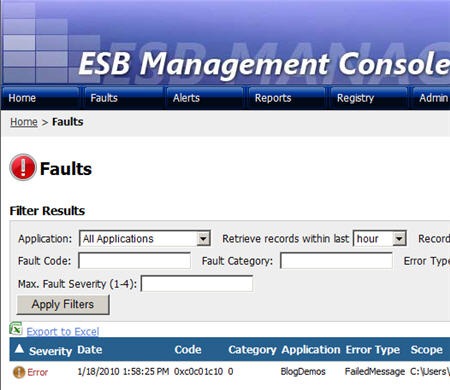
    So once again, I changed a send port’s address to something invalid and published a message to BizTalk.  One message succeeded, one failed and there were no suspended messages because I had the failed message routing turned on.  When I visit my ESB Toolkit Management Portal I can see the failed message in all its glory.

    2010.01.18pubsub05

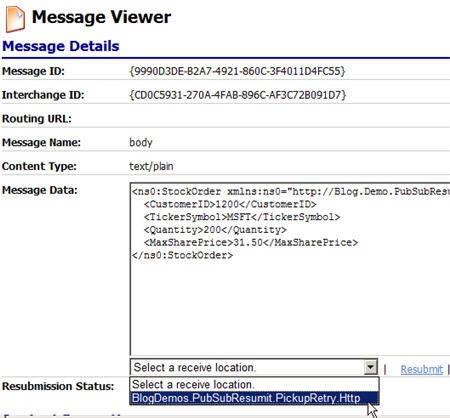
    Clicking on the error drills into the details. From here I can view the message, click Edit and choose to resubmit it back to BizTalk.

    2010.01.18pubsub06

    This message comes back into BizTalk with no previous context or destination target.  Rather, it’s as if I’m dropping this message into BizTalk for the first time.  This means that ALL subscribers (in my scenario here) will get the message again and cause unintended side effects.

    This is a case you may not think of when working primarily in point-to-point solutions.  How do you get around it?  A few ways I can think of:

    • Build your messages and services to be idempotent.  Who cares if a message comes once or ten times?  Ideally there is a single identifier in each message that can indicate a message is a duplicate, or, the message itself is formatted in a way which is immune to retries.  For instance, instead of the message saying to buy 200 shares, we could have fields with a “before amount” of 800 and “after amount” of 1000.
    • Transform messages at the send port to destination specific formats.  If each send port transforms the message to a destination format, then we could repair and resubmit it and only send ports looking for either the canonical format OR the destination format would pick it up.
    • Have indicators in the message to indicate targets/retries and filter those out of send ports.  We could add routing instructions to a message that specified a target system and have filters in send ports so only ports listening for that target pick up a message.  The ESB Toolkit lets us edit the message itself before resubmitting it, so we could have a field called “target” and manually populate which send port the message should aim for.

    So there you go.  When working solely within BizTalk for messaging exceptions, the fact of using pub/sub or not shouldn’t matter.  But, if you leverage error handling orchestrations or completely external exception management systems, you need to take into account the side effects of resubmitted messages that could reach multiple subscribers.

    Share

  • Interview Series: Four Questions With … Michael Stephenson

    Happy New Year to you all!  This is the 16th interview in my series of chats with thought leaders in the “connected systems” space.  This month we have the pleasure of harassing Michael Stephenson who is a BizTalk MVP, active blogger, independent consultant, user group chairman, and secret lover of large American breakfasts.

    Q: You head up the UK SOA/BPM User Group (and I’m looking forward to my invitation to speak there).  What are the topics that generate the most interest, and what future topics do you think are most relevant to your audience?

    A: Firstly, yes we would love you to speak, and ill drop you an email so we can discuss this 🙂

    The user group actually formed about 18 months ago when two groups of people got together.  There was the original BizTalk User Group and some people who were looking at a potential user group based around SOA.  The people involved were really looking at this from a Microsoft angle so we ended up with the UK SOA/BPM User Group (aka SBUG).  The idea behind the user group is that we would look at things from an architecture and developer perspective and be interested in the technologies which make up the Microsoft BPM suite (including ISV partners) and the concepts and ideas which go with solutions based on SOA and BPM principles. 

    We wanted to have a number of themes going on and to follow some of the new technologies coming out which organizations would be looking at.  Some of the most common technology topics we have had previously have included BizTalk, Dublin, Geneva and cloud.  We have also tried to have some ISV sessions too.  My idea around the ISV sessions is that most people tend to see ISV’s present high level topics at big industry events where you see pretty slides and quite simple demonstrations but with the user group we want to give people the change to get a deeper understanding of ISV offerings so they know how various products are positioned and what they offer.  Some examples we have coming up on this front are in January where Global 360 will be doing a case study around Nationwide Building Society in the UK and AgilePoint will be doing a web cast about SAP.  Hopefully members get a change to see what these products do, and to network and ask tough questions without it being a sales based arena.

    Last year one of our most popular sessions was when Darren Jefford joined us to do a follow up to a session he presented at the SOA/BPM Road show about on-premise integration to the cloud.  I’m hoping that Darren might be able to join us again this year to do another follow up to a session he did recently about a BizTalk implementation with really high performance characteristics.  Hopefully the dates will workout well for this.

    We have about 4 in person meetings per year at the moment, and a number of online web casts.  I think we have got things about right in terms of technology sessions, and I expect that in the following year we will combine potentially BizTalk 2009 R2, and AppFabric real world scenarios, more cloud/Azure, and I’d really like to involve some SharePoint stuff too.  I think one of the weaker areas is around the concepts and ideas of SOA or BPM.  I’d love to get some people involved who would like to speak about these things but at present I haven’t really made the right contacts to find appropriate speakers.  Hopefully this year we will make some inroads on this.  (Any offers please contact me).

    A couple of interesting topics in relation to the user group are probably SQL Server, Oslo and Windows Workflow.  To start with Windows Workflow is one of those core technologies which you would expect the technology side of our user group to be pretty interested in, but in reality there has never been that much appetite for sessions based around WF and there hasn’t really been that many interesting sessions around it.  You often see things like here is how to do a work flow that does a specific thing, but I haven’t really seen many cool business solutions or implementations which have used WF directly.  I think the stuff we have covered previously has really been around products which leverage workflow.  I think this will continue but I expect as AppFabric and a solid hosting solution for WF becomes available there may be future scenarios where we might do case studies of real business problems solved effectively using WF and Dublin.

    Oslo is an interesting one for our user group.  Initially there was strong interest in this topic and Robert Hogg from Black Marble did an excellent session right at the start of our user group about what Oslo was and how he could see it progressing.  Admittedly I haven’t been following Oslo that much recently but I think it is something I will need to get feedback from our members to see how we would like to continue following its development.  Initially it was pitched as something which would definitely be of interest to the kind of people who would be interested in SBUG but since it has been swallowed up by the “SQL Server takes over the world” initiative, we probably need to just see how this develops, certainly the core ideas of Oslo still seem to be there.  SQL Server also has a few other features now such as StreamInsight which are probably also of interest to SBUG members.

    I think one of the challenges for SBUG in the next year is about the scope of the user group.  The number of technologies which are likely to be of interest to our members has grown and we would like to get some non technology sessions involved also, so the challenge is how we manage this to ensure that there is a strong enough common interest to keep involved, yet the scope should be wide enough to offer variety and new ideas.

    If you would like to know more about SBUG please check out our new website on: http://uksoabpm.org.

    Q: You’ve written a lot on your blog about testing and management of BizTalk solutions.  In your experience, what are the biggest mistakes people make when testing system integration solutions and how do those mistakes impact the solution later on?

    A: When it comes to BizTalk (or most technology) solutions there are often many ways to solve a problem and produce a solution that will do a job for your customer to one degree or another.  A bad solution can often still kind of work.  However when it comes to development and testing processes it doesn’t matter how good your code/solution is if the process you use is poor, you will often fail or make your customer very angry and spend a lot of their money.  I’ve also felt that there has been plenty of room for blogging content to help people with this.  Some of my thoughts on common mistakes are:

    Not Automating Testing

    This can be the first step to making your life so much less stressful.  On the current project I’m involved with we have a large number of separate BizTalk applications each with quite different requirements.  The fact that all of these are quite extensively tested with BizUnit means that we have quite low maintenance costs associated with these solutions.  Anytime we need to make changes we always have a high level of confidence that things will work well. 

    I think on this project during its life cycle the defects associated with our team have usually been <5% related to coding errors.  The majority are actually because external UAT or System test teams have written tests incorrectly, problems with other systems which get highlighted by BizTalk or a poor requirement. 

    Good automated testing means you can be really proactive when it comes to dealing with change and people will have confidence in the quality of things you produce.

    Not Stubbing Out Dependencies

    I see this quite often when you have multiple teams working on a large development project.  Often the work produced by these teams will require services from other applications or a service bus.  So many times I’ve seen the scenario where the developer on Team A downs tools because their code wont work because the developer on Team B is making changes to the code which runs on his machine.  In the short term this can cause delays to a project, and in the longer term a maintenance nightmare.  When you work on a BizTalk project you often have this challenge and usually stubbing out these dependencies becomes second nature.  Sometimes its the teams who don’t have to deal with integration regularly who aren’t used to this mindset. 

    This can be easily mitigated if you get into the contract first mind set and its easy to create a stub of most systems that use a standards based interface such as web services.  I’d recommend checking out Mockingbird as one tool which can help you here.  Actually to plug SBUG again we did a session about Mockingbird a few months ago which is available for download: http://uksoabpm.org/OnlineMiniMeetings.aspx

    Not considering data flow across systems

    One common bad practice I see when someone has automated testing is that they really just check the process flow but don’t really consider the content of messages as they flow across systems.  I once saw a scenario where a process passed messages through BizTalk and into an internal LOB system.  The development team had implemented some tests which did pretty good job at testing the process, but the end to end system testing was performed by an external testing team.  This team basically loaded approximately 50k messages per day for months through the system into the LOB application and made a large assumption that because there were no errors recorded by the LOB application everything was fine.

    It turned out that a number of the data fields were handled incorrectly by the LOB application and this just wasn’t spotted.

    The lessons here were mainly that sometimes testing is performed by specialist testing teams and you should try develop a relationship between your development and test teams so you know what everyone is doing.  Secondly executing millions of messages is no where near as effective as understanding the real data scenarios and testing those.

    Poor/No/Late Performance Testing

    This is one of the biggest risks of any project and we all know its bad.  Its not uncommon for factors beyond our control to limit our ability to do adequate performance testing.  In BizTalk world we often have the challenge that test environments do not really look like a production environment due to the different scaling options taken. 

    If you find yourself in this situation probably the best thing you can do is to firstly ensure the risk is logged and that people are aware of the risk.  If your project has accepted the risk and doesn’t plan to do anything about it, the next thing is to agree as a team how you will handle this.  Agree a process of how you will ensure to maximize the resources you do have to adequately performance test your solution.  Maybe this is to run some automated tests using BizUnit and LoadGen on a daily basis, maybe its to ensure you are doing some profiling etc.  If you agree your process and stick to it then you have mitigated the risk as much as possible.

    A couple of additional side thoughts here are that a good investment in the monitoring side of your solution can really help.  If you can see that part of your solution isn’t performing too well in a small test environment don’t just disregard this because the environment is not production like, analyze the characteristics of the performance and understand if you can make optimizations.  The final thought here is that when looking at end to end performance you also need to consider the systems you will integrate with.  In most scenarios latency or throughput limitations of an application you integrate with will become a problem before any additional overhead added by BizTalk.

    Q: When architecting BizTalk solutions, you often make the tradeoff between something that is either (a) quite complex, decoupled and easier to scale and change, or (b) something a bit more rigid but simpler to build, deploy and maintain.  How do you find the right balance between those extremes and deliver a project on time and architected the “right” way for the customer?

    A: By their nature integration projects can be really varied, and even seasoned veterans will come across scenarios which they haven’t seen before or a problem with many ways to solve it.  I think its very helpful if you can be open-minded and able to step back and look at the problem from a number of angles, consider the solution from the perspective of all of your stakeholders.  This should help you to evaluate the various options.  Also one of my favorite things to do is to bounce the idea of some friends.  You often see this on various news groups or email forums.  I think sometimes people are afraid to do this, but you know, no one knows everything and people on these forums generally like to help each other out so its a very valuable resource to be able to bounce your thoughts off colleagues (especially if your project is small).

    More specifically about Richard’s question I guess there is probably two camps on this, the first is “Keep it simple stupid”, and as a general rule if you do what you are required to do, do it well and do it cheaply then usually everyone will be happy.  The problem with this comes when you can see there are things past the initial requirements which you should consider now or the longer term cost will be significantly higher.  The one place you don’t want to go is where you end up lost in a world of your own complexity.  I can think of a few occasions where I have seen solutions where the design had been taken to the complex extreme.  While designing or coding, if you can teach yourself to regularly take a step away from your work and ask yourself “What is it that I’m trying to do” or to explain things to a colleague you will be surprised how many times you can save yourself a lot of headaches later.

    I think one of the real strengths of BizTalk as a product is that it lets you have a lot of this flexibility without too much work compared to non BizTalk based approaches.  I think in the current economic climate it is more difficult to convince a customer about the more complex decoupled approaches when they cant clearly and immediately see benefits from it.  Most organizations are interested in cost and often the simpler solution is perceived to be the cheapest.  The reality is that because BizTalk has things like the pub/sub model, BRE, ESB Guidance, etc it means you can deal with complexity and decoupling and scaling without it actually getting too complex.  To give you a recent and simple example of this, one of my customers wanted to have a quick and simple way of publishing some events to a B2B partner from a LOB application.  Without going into too much detail this was really easy to do, but the fact that it was based on BizTalk meant the decoupling offered by subscriptions allowed us to reuse this process three more times to publish events to different business partners in different formats over different protocols.  This was something the customer hadn’t even thought about initially.

    I think on this question there is also the risk factor to consider, when you go for the more complex solution the perceived risk of things going wrong is higher which tends to turn some people away from the approach, however this is where we go back to the earlier question about testing and development processes.  If you can be confident in delivering something which is of high quality then you can be more confident in delivering something which is more complex.

    Q [stupid question]: As we finish up the holiday season, I get my yearly reminder that I am utterly and completely incompetent at wrapping gifts.  I usually end these nightmarish sessions completely hairless and missing a pint of blood.  What is an example of something you can do, but are terrible at, and how can you correct this personal flaw?

    A: I feel your pain on the gift wrapping front (literally).  I guess anyone who has read this far will appreciate one of my flaws is that I can go on a bit, hope some of it was interesting enough!

    I think the things that I like to think I can do, but in reality I’d have to admit I am terrible at are Cooking and DIY.  Both are easily corrected by getting other people to do them, but saying as this will be the first interview of the new year I guess its fitting that I should make a new years resolution so I’ll plan to do something about one of them.  Maybe take a cooking class.

    Oh did I mention another flaw is that I’m not too good at keeping new years resolutions.

    Thanks to Mike for taking the time to entertain us and provide some great insights.

    Share

  • Using UML vs. ADL (Arbitrary Diagramming Language)

    At my company, we highly encourage our architects and developers to communicate their design models through UML.  We have a standard set of diagrams that we regularly use to convey aspects of a given solution, including:

    • Component diagrams for system dependency, functional decomposition and data flow
    • Use case diagrams for business and system scenarios
    • Sequence diagrams for a timing perspective on system interactions
    • Deployment diagrams for both logical and physical representations of the hardware/software landscape

    We all know that the job of architect pretty much consists of “ask lots of annoying questions” and “draw boxes and lines.”  The downside with being so UML-centric is that UML can accidentally become the default way to draw boxes and lines that represent all sorts of things.  My boss has encouraged us to be observant for when a particular graphical representation should take a more “marketecture” approach (i.e. fancy boxes and lines in PowerPoint or Visio) vs. formal modeling in UML or BPMN.  She labeled the PowerPoint/Visio approach as using the Arbitrary Diagramming Language (ADL) method.  Seems about right.

    What’s an example of this?  I’ll give you two.  I recently had to put together a reference architecture for a project I’m working on.  My first inclination was to throw together a functional decomposition diagram (component diagram) of all the relevant functional pieces.  However, this was very early in the project lifecycle, and I knew that this diagram would be consistently referred to in both business and technical meetings.  So instead of going nuts on a UML diagram that would be utterly confusing, and potentially hacked up to represent certain ideas, I went with a PowerPoint model that has been in regular use for 5 months now.

    In another case, I’m trying to represent deployment options (incremental phased approach vs. all-at-once) for a global system.  I began this effort thinking about component diagrams, deployment diagrams, swim lanes and mashing some things together.  Again though, I’d probably have to bastardize UML and overload agreed-upon constructs in order to convey my point.  So, I went again to trusty PowerPoint and modeled out the options in a more business-friendly way.  I could create my own terminology/model without feeling guilty for screwing up standard UML.

    This way, I could convey a sequence of deployment phases (through a set of slides), which parties were involved, and the necessary interim interfaces without butchering UML.

    So when to use each modeling style?  I’d like your thoughts as well, but for me, I switch to an ADL / marketecture model when:

    • Doing early project stage diagrams to convey concepts presented to broad audiences (e.g. logical architectures, deployment diagrams, proposed data flow between systems/organizations)
    • I realize that I need to cannibalize, bastardize, overload or otherwise distort UML notation to convey a point (e.g. user experience flow, etc)

    I fire up a UML tool for modeling when:

    • I’m building lasting representations of how a system will be built and providing an accurate blueprint to the development team
    • Conveying solution aspects to solely technical teams through presentations or design documents
    • I can take a particular solution aspect and clearly convey the point via one or many complimentary UML model perspectives.

    The hard part is not stuffing so much into a single visual model as to render it useless.  There’s no shame in requiring two (or more) different perspectives on a problem.

    So there you go. Is Visio/PowerPoint/other-boxes-and-lines-tool-of-choice your first place to go when you have to diagram something for your project team or management?  Or do you try and shape and morph traditional diagramming notations to fit your needs?

  • Interview Series: Four Questions With … Lars Wilhelmsen

    Welcome to the 14th edition of my interview series with thought leaders in the “connected technology” space.  This month, we are chatting with Lars Wilhelmsen, development lead for his employer KrediNor (Norway), blogger, and Connected Systems MVP.  In case you don’t know, Connected Systems is the younger, sexier sister of the BizTalk MVP, but we still like those cats.  Let’s see how Lars holds up to my questions below.

    Q: You recently started a new job where you have the opportunity to use a host of the “Connected System” technologies within your architecture.  When looking across the Microsoft application platform stack, how do you begin to align which capabilities belong in which bucket, and lay out a logical architecture that will make sense for you in the long term?

    A: I’m Development Lead. Not a Lead Developer, Solution Architect or Develop  Manager, but a mix of all those three, plus that I put on a variety of other “hats” during a normal day at work. I work close with both the Enterprise Architect and the development team. The dev team consists of “normal” developers, a project manager, a functional architect, an information architect, an tester, a designer and a “man-in-the-middle” whose only task is to “break down” the design into XAML.

    We’re on a multi-year mission to turn the business around to meet new legislative challenges & new markets. The current IT system is largely centered around a mainframe-based system, that (at least as we like to think today, in 2009) has too many responsibilities. We seek to use “Components of the Shelf” where we can, but we’ve identified a good set of subsystems that needs to be built from scratch. The strategy defined by the top-level management states that we should seek to use primarily Microsoft technology to implement our new IT platform, but we’re definitely trying to be pragmatic about it. Right now, a lot of the ALT.NET projects gains a lot of usage and support, so even though Microsoft brushes up bits like Entity Framework and Workflow Foundation, we haven’t ruled out the possibility to use non-Microsoft components where we need to. A concrete example is in a new Silverlight –based application we’re developing right now; we evaluated some third party control suites, and in the end we landed on RadControls from Telerik.

    Back to the question, I think over time, we will see a lot of the current offerings from Microsoft, either it targets developers, IT Pro’s or the rest of the company in general (Accounting, CRM etc. systems) implemented in our organization, if we find the ROI acceptable. Some of the technologies used by the current development projects include; Silverlight 3, WCF, SQL Server 2008 (DB, SSIS, SSAS) and BizTalk. As we move forward, we will definitely be looking into the next-generation Windows Application Server / IIS 7.5 / “Dublin”, as well as WCF/WF 4.0 (one of the tasks we’ve defined in the near future is a light-weight service bus), and codename “Velocity”.

    So,the capabilities we’ve applied so far (and planned) in our enterprise architecture is a mix of both thoroughly tested and bleeding edge technology.

    Q: WCF offers a wide range of transport bindings that developers can leverage.  What are you criteria for choosing an appropriate binding, and which ones do you think are the most over-used and under-used?

    A: Well, I normally follow a simple set of “Rules of thumbs”;

    • Inter-process: NetNamedPipeBinding
    • Homogenous intranet communication: NetTcpBinding
    • Heterogeneous intranet communication: WSHttpBinding BasicHttpBinding
    • Extranet/Internet communication: WSHttpBinding or BasicHttpBinding

    Now, one of the nice thing with WCF is that is possible to expose the same service with multiple endpoints, enabling multi-binding support that is often needed to get all types of consumers to work. But, not all types of binding are orthogonal; the design is often leaky (and the service contract often need to reflect some design issues), like when you need to design a queued service that you’d eventually want to expose with an NetMsmqBinding-enabled endpoint.

    Often it boils down to how much effort you’re willing to put in the initial design, and as we all (hopefully) know by now; architectures evolves and new requirements emerge daily.

    My first advice to teams that tries to adapt WCF as a technology and service-orientation, is to follow KISS – Keep It Simple, Stupid. There’s often room to improve things later, but if you do it the other way around, you’ll end up with unfinished projects that will be closed down by management.

    When it comes to what bindings that are most over- and under-used, it depends. I’ve seen someone that has exposed everything with BasicHttpBinding and no security, in places where they clearly should have at least turned on some kind of encryption and signing.

    I’ve also seen highly optimized custom bindings based on WSHttpBinding, with every small little knob adjusted. These services tends to be very hard to consume from other platforms and technologies.

    But, the root cause of many problems related to WCF services is not bindings; it is poorly designed services (e.g. service, message, data and fault contracts). Ideally, people should probably do contract-first (WSDL/XSD), but being pragmatic I tend to advice people to design their WCF contracts right (if in fact, they’re using WCF). One of the worst thing I see, is service operations that accepts more than one input parameter. People should follow the “At most one message in – at most one message out” pattern. From a versioning perspective, multiple input arguments are the #1 show stopper. If people use message & data contracts correctly and implements the IExtensibleDataObject, it is much easier in the future to actually version the services.

    Q: It looks like you’ll be coming to Los Angeles for the Microsoft Professional Developers Conference this year.  Which topics are you most keen to hear about and what information do you hope to return to Norway with?

    A: It shouldn’t come as a surprise, but as a Connected Systems MVP, I’m most excited about the technologies from that department (Well, they’ve merged now with the Data Platform people, but I still refer to that part of MSFT as Connected Systems Div.). WCF/WF 4.0 will definitely get a large part of my attention, as well as Codename “Dublin” and Codename “Oslo”. I will also try to watch the ADFSv2 [Formerly known as Codename “Geneva”] sessions. Apart from that, I hope to use a lot of time talking to other people. MSFTies, MVPs and other people. To “fill up” the schedule, I will probably try to attend some of the (for me) more exoteric sessions about Axum, Rx framework, parallelization etc.

    Workflow 3.0/3.5 was (in my book) a more or less a complete failure, and I’m excited that it seems like Microsoft has taken the hint from the market again. Hopefully WF 4.0, or WF 3.0 as it really should be called (Microsoft product seems to reach maturity first at version 3.0), will hopefully be a useful technology that we’ll be able to utilize in some of our projects. Some processes are state machines, some places do we need to call out in parallel to multiple services – and be able to compensate if something goes wrong, and other places do we need a rule engine.

    Another thing we’d like to investigate more thorough, is the possibility to implement claims-based security in many of our services, so (for example) can federate with our large partners. This will enable “self service” of their own users that access our Line of Business applications via the Internet.

    A more long term goal (of mine, so far) is definitely to use the different part of codename “Oslo” – the modeling capabilities, the repository and MGrammar – to create custom DSLs in our business. We try to be early adopters of a lot of the new Microsoft technologies, but we’re not about to try to push things into production without a “Go-Live” license.

    Q [stupid question]: This past year you received your first Microsoft MVP designation for your work in Connected Systems.  There are a surprising number of technologies that have MVPs, but they could always use a few more such as a Notepad MVP, Vista Start Menu MVP or Microsoft Word “About Box” MVP.  Give me a few obscure/silly MVP possibilities that Microsoft could add to the fold.

    A: Well, I’ve seen a lot of middle-aged++ people during my career that could easily fit into a “Solitaire MVP” category 🙂 Fun aside, I’m a bit curious why Microsoft have Zune & XBox MVP titles. Last time I checked, the P was for “Professional” I can hardly imagine anyone who gets paid for listening to their Zune or playing on their XBox. Now, I don’t mean  to offend the Zune & XBox MVPs, because I know they’re brilliant at what they do, but Microsoft should probably have a different badge to award people that are great at leisure activities, that’s all.

    Thanks Lars for a good chat.

  • Tidbits from Amazon.com AWS Cloud Briefing

    Yesterday I attended the first of a set of roving sessions from Amazon.com to explain their cloud offering, Amazon Web Services (AWS).  I’ve been tinkering with their stuff for a while now, but I was amped to hear a bit more from the horse’s mouth.  I went with a couple colleagues and greatly enjoyed the horrific drive to/from Beverly Hills.

    The half-day session was keynoted by Amazon.com CTO Dr. Werner Vogels.  He explained how Amazon’s cloud offering came to be, and how it helped them do their jobs better.  He made a number of good points during his talk:

    • We have to think of reality scale vs. an academic or theoretical model of how an application scales.  That is, design scalability for real life and your real components and don’t get caught up in academic debates on how a system SHOULD scale.
    • He baked a key aspect of SOA down to “the description of a service is enough to consume it.”  That’s a neat way to think about services.  No libraries required, just standard protocols and a definition file.
    • If your IT team has to become experts in base functions like high performance computing in order to solve a business problem, then you’re not doing IT right and you’re wasting time.  We need to leverage the core competencies (and offerings) of others.
    • Amazon.com noticed that when it takes a long time (even 6 hours) to provision new servers, then people are more hesitant to release the resource when they were done with it.  This leads to all sorts of waste and inefficiency, and this behavior can be eliminated by an on-demand, pay-as-you-go cloud model.
    • Amazon.com breaks down the application into core features and services to the point that each page leverages up to 300 distinct services.  I can’t comprehend that without the aid of alcohol.
    • We need to talk to our major software vendors about cloud-driven licensing.  Not the vendor’s cloud computing solution, but how I can license their software in a cloud environment where I may temporarily stand up servers.  Should I pay a full CPU license for a database if I’m only using it during cloud-bursting scenarios or for short-lived production apps, or should I have a rental license available to me?

    Werner gave a number of good case study mentions ranging from startups to established, mature organizations.  Everything from eHarmony.com using the parallel processing of Amazon MapReduce to do “profile matching” in the cloud, to a company like SAP putting source code in the cloud in the evenings and having regresssion tests run against it.  I was amused by the eHarmony.com example only because I would hate to be the registered member who finally made the company say “look, we simply need 1400 simultaneously running computers to find this gargoyle a decent female companion.” 

    Representatives from Skifta, eHarmony.com, Reddit, and Geodelic were all on hand to explain how they used the Amazon cloud and what they learned while leveraging it.  Good lessons around working around unavoidable latency, distributing data, and sizing on demand.

    The session closed with talks from Mike Culver and Steve Riley of AWS.  Mike talked about architectural considerations (e.g. design for failure, force loose coupling, design for elasticity, put security everywhere, consider the best storage option) while Steve (a former Microsoftie) talked about security considerations.  My boss astutely noticed that most (all?) of Mike’s points should pertain to ANY good architecture, not necessarily just cloud.  Steve talked a fair amount about the AWS Virtual Private Cloud which is a pretty slick way to use the Amazon cloud, but put these machines within the boundaries (IP, domain, management) of your own network.

    All in all, great use of time.  We thought of additional use cases for my own company including proof-of-concept environments, providing temporary web servers for new product launches, or trying to process our mounds of drug research data more efficiently.

    If you get the chance to attend the upcoming New York or London sessions, I highly recommend it.

    Share

  • SQL Azure Setup Screenshots

    Finally got my SQL Azure invite code, and started poking around and figured I’d capture a few screenshots for folks who haven’t gotten in there yet.

    Once I plugged in my invitation code, I saw a new “project” listed in the console.

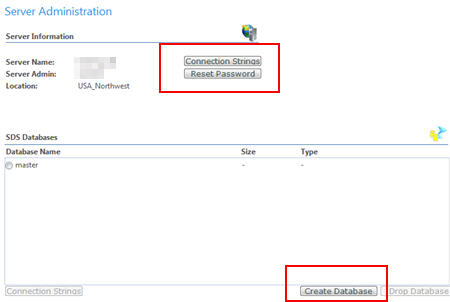
    If I choose to “Manage” my project, I see my administrator name, zone, and server.  I’ve highlighted options to create a new database and view connection strings.

    Given that I absolutely never remember connection string formats (and always ping http://www.connectionstrings.com for a reminder), it’s cool that they’ve provided me customized connection strings.  I think it’s pretty sweet that my standard ADO.NET code can be switched to point to the SQL Azure instance by only swapping the connection string.

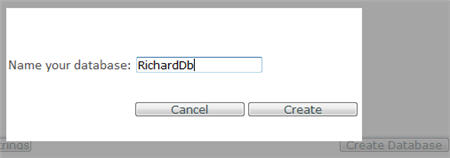
    Now I can create a new database, shown here.

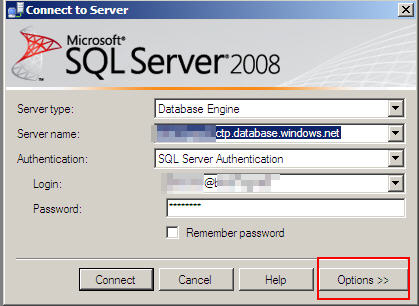
    This is as far as the web portal takes me.  To create tables (and do most everything else), I connect through my desktop SQL Server Management Studio.  After canceling the standard server connection window, I chose to do a “New Query” and entered in the fully qualified name of my server, SQL Server username (in the format user@server), and switched to the “Options” tab to set the initial database as “RichardDb”.

    Now I can write a quick SQL statement to create a table in my new database.  Note that I had to add the clustered index since SQL Azure doesn’t do heap tables.

    Now that I have a table, I can do an insert, and then a query to prove that my data is there.

    Neato.  Really easy transition for someone who has only worked with on-premise, relational databases.

    For more, check out the Intro to SQL Azure here, and the MSDN portal for SQL Azure here.  Wade Wegner created a tool to migrate your on-premise database to the cloud.  Check that out.

    Lots of interesting ways to store data in the cloud, especially in the Azure world.  You can be relational (SQL Azure), transient (Windows Azure Queue), high performing (Windows Azure Table) or chunky (Windows Azure Blob).  You’ll find similar offerings across other cloud vendors as well. Amazon.com, for instance, provides ways to store/access data in a high performing manner (Amazon SimpleDB), transient (Amazon Simple Queue Service), or chunky (Amazon S3).

    Fun times to be in technology.

    Share

  • Interview Series: Four Questions With … Jeff Sanders

    I continue my monthly chat with a different “connected technology” leader by sitting down with Jeff Sanders.  Jeff works for my alma mater, Avanade, as a manager/architect.  He’s the co-author of the recently released Pro BAM in BizTalk Server 2009 book and regularly works with a wide range of different technologies.  He also has the audacity to challenge Ewan Fairweather for the title of “longest answers given to Richard’s questions.”

    Q: You recently authored a great book on BAM which went to a level of depth that no previous book had. Are there specific things you learned about BAM while writing the book? How would you suggest that BAM get greater mindshare among both BizTalk and .NET architects?

    A: First, thanks and glad you found it to be useful. I must say, during the course of writing it, there were numerous concerns that all authors go through (is this too technical/not technical enough, are the examples practical, is it easy to follow, etc.). But because BAM has the limited adoption it does, there were additional concerns surrounding the diversity of real-world scenarios, better vs. best practices, and technical validation of some of the docs. As far as real-world experience goes, the shops that have implemented BAM have learned a lot in doing so, and are typically not that willing to share with the rest of the world their learning experiences. With technical validity, one of the more frustrating things in really diving into the nuances of subjects like the architecture of the WF interceptor, is that there is little if anything written about it (and therefore no points for reference). The documentation, well, one could say that it could be subject to reconsideration or so. I, regretfully, have a list of the various mistakes and issues I found in the MSDN docs for BAM. Perhaps it’s one of the major reasons BAM has the adoption it does. I think one of the other major issues is the tooling. There’s a utility (the TPE) for building what are, in essence, interceptor config files for BizTalk orchestrations. But if you want to build interceptor config files for WCF or WF, you have to manually code them. I think that’s a major oversight. It’s one of the things I’ve been working on in my spare time, and plan to post some free utilities and plug-ins to Visual Studio to a web site I’ve just set up, http://www.AllSystemsSO.com. I do thank, though, those who have written about BAM, like Jesus Rodriguez, for penning articles that kept BAM on the radar. Unfortunately there hasn’t been a single volume of information on BAM to date.

    Specific things I learned about BAM – well, with .NET Reflector, I was able to pull apart the WF interceptor. If you take it apart, and examine how tracking profiles are implemented in the WF interceptor, how they map to BizTalk tracking points, and the common concepts (like persistence), it’s a really fascinating story. And if you read the book where I’m explaining it (chapter 9), you may be able to note a sense of wonder. It’s clear that the same team in CSD that wrote BizTalk wrote WF, and that many of the same constructs are shared between the two. But even more interesting are that certain irritations of the BizTalk developer, like the ability to manually set a persistence point and the pluggable persistence service, made their way into WF, but never back into BizTalk. It gave me pause, and made me think when Devs have asked of Microsoft “When will BizTalk’s orchestration engine support WF?” and Microsoft’s answer has been “It won’t, it will continue to use XLANGs,” perhaps a better question (and what they meant) was “when will BizTalk and XLANGs support all the additional features of WF.”

    As for gaining greater mindshare, I wrote one of the chapters specifically along the lines of how BAM fits in your business. The goal of that chapter, and largely the book, was to defeat the notion that BAM is purely BizTalk-specific. It’s not. It’s connected systems-focused. It just so happens that it’s bundled with BizTalk. Yes, it’s been able to ride BizTalk’s coattails and, as such, be offered as free. But it’s a double-edged sword, as being packaged with BizTalk has really relegated BAM to BizTalk-only projects. I think if people had to pay for all the capabilities that BAM offers in a WCF and WF monitoring tool, it would clearly retail for $30k-50k.

    If BAM is to gain greater mindshare, .NET and connected systems developers need to make it a tool of their arsenal, and not just BizTalk devs. VPs and Business Analysts need to realize that BAM isn’t a technology, but a practice. Architects need to have an end-to-end process management strategy in mind, including BI, BAM, Reporting, StreamInsight, and other Performance Monitoring tools.

    RFID is a great vehicle for BAM to gain greater mindshare, but I think with Microsoft StreamInsight (because it’s being built by the SQL team), you’re going to see the unification of Business Activity Monitoring and Business Event Monitoring under the same umbrella. Personally, I’d really like to see the ESB Portal and Microsoft Services Engine all rolled up into a BAM suite of technologies alongside StreamInsight and RFID, and then segmented off of BizTalk (maybe that’s where “Dublin” is going?). I’d also like to see a Microsoft Monitoring Framework across apps and server products, but well, I don’t know how likely that is to happen. You have Tracing, Debugging, the Enterprise Framework, Systems Center, Logging Servers, Event Viewer, and PerfMon for systems. You have BAM, PerformancePoint, SSRS, Excel and Custom Apps for Enterprise (Business) Performance Monitoring. It’d be nice to see a common framework for KPIs, Measured Objectives, Activities, Events, Views, Portals, Dashboards, Scorecards, etc.

    Q: You fill a role of lead/manager in your current job. Do you plan delivery of small BizTalk projects differently than large ones? That is, do you use different artifacts, methodology, team structure, etc. based on the scale of a BizTalk project? Is there a methodology that you have found very successful in delivering BizTalk projects on schedule?

    A: Just to be clear, BizTalk isn’t the only technology I work on. I’ve actually been doing A LOT of SharePoint work in the last several years as it’s exploded, and a lot of other MS technologies, which was a big impetus for the “Integrating BAM with ____” section of the book.

    So to that end, scaling the delivery of any project, regardless of technology, is key to its success. A lot of the variables of execution directly correlate to the variables of the engagement. At Avanade, we have a very mature methodology named Avanade Connected Methods (ACM) that provides a six-phase approach to all projects. The artifacts for each of those phases, and ultimately the deliverables, can then be scaled based upon timeline, resources, costs, and other constraints. It’s a really great model. As far as team structure, before any deal gets approved, it has to have an associated staffing model behind it that not only matches the skill sets of the individual tasks, but also of the project as a whole. There’s always that X factor, as well, of finding a team that not only normalizes rather quickly but also performs.

    Is there a methodology that I’ve found to be successful in delivering projects on schedule? Yes. Effective communication. Set expectations up front, and keep managing them along the way. If you smell smoke, notify the client before there’s a fire. If you foresee obstacles in the path of your developers, knock them down and remove them so that they can walk your trail (e.g. no one likes paperwork, so do what you can to minimize administrivia so that developers have time to actually develop). If a task seems too big and too daunting, it usually is. Decomposition into smaller pieces and therefore smaller, more manageable deliverables is your friend – use it. No one wants to wait 9 months to get a system delivered. At a restaurant, if it took 4 hours to cook your meal, by the end, you would have lost your appetite. Keep the food coming out of the kitchen and the portions the right size, and you’ll keep your project sponsors hungry for the next course.

    I think certain elements of these suggestions align with various industry-specific methodologies (Scrum focuses on regular, frequent communication; Agile focuses on less paperwork and more regular development time and interaction with the customer, etc.). But I don’t hold fast to any one of the industry methodologies. Each project is different.

    Q: As a key contributor to the BizTalk R2 exam creation, you created questions used to gauge the knowledge of BizTalk developers. How do you craft questions (in both exams or job interviews) that test actual hands-on knowledge vs. book knowledge only?

    A: I wholeheartedly believe that every Architect, whether BizTalk in focus or not, should participate in certification writing. Just one. There is such a great deal of work and focus on process as well as refinement. It pains me a great deal whenever I hear of cheating, or when I hear comments such as “certifications are useless.” As cliché as it may sound, a certification is just a destination. The real value is in the journey there. Some of the smartest, most talented people I’ve had the pleasure to work with don’t have a single certification. I’ve also met developers with several sets of letters after their names who eat the fish, but really haven’t taught themselves how to fish just yet.

    That being said, to me, Microsoft, under the leadership of Gerry O’Brien, has taken the right steps by instituting the PRO-level exams for Microsoft technologies. Where Technology Specialist exams (MCTS) are more academic and conceptual in nature (“What is the method of this technology that solves the problem?”), the PRO-level exams are more applied and experiential in nature (“What is the best technology to solve the problem given that you know the strengths and limitations of each?”). Unfortunately, the BizTalk R2 exam was only a TS exam, and no PRO exam was ever green-lit.

    As a result, the R2 exam ended up having somewhat of a mixture of both. The way the process works, a syllabus is created on various BizTalk subject areas, and a number of questions is allotted to each area. Certification writers then compose the questions based upon different aspects of the area.

    When I write questions for an interview, I’m not so much interested in your experience (although that is important), but moreso your thought process in arriving to your answer. So you know what a Schema, a Map, a Pipeline, and an Orchestration do. You have memorized all of the functoids by group. You can list, in order, all of the WCF adapters and which bindings they support. That’s great and really admirable. But when was the last time your boss or your client asked you to do any of that? A real-world generic scenario is that you’ve got a large message coming into your Receive Port. BizTalk is running out of memory in processing it. What are some things you could do to remedy the situation? If you have done any schema work, you’d be able to tell me you could adjust the MaxOccurs attribute of the parent node. If you’ve done any pipeline work you’d be able to tell me that you’re able to de-batch messages in a pipeline as well into multiple single messages. If you’ve done Orchestrations, you know how a loop shape can iterate an XML document and publish the messages separately to the MessageBox and then subscribe using a different orchestration, or simply using a Call Shape to keep memory consumption low. If you’ve ever set up hosts, you know that the receive, processing, tracking, and sending of messages should be separate and distinct. Someone who does well in an interview with me demonstrates their strength by working through these different areas, explains that there are different things you could do, and therefore shows his or her strength and experience with the technology. I don’t think anyone can learn every aspect or feature of a product or technology any more. But with the right mindset, “problems” and “issues” just become small “challenges.”

    Certification questions are a different breed, though. There are very strict rules as to how a question must be written:

    • Does the item test how a task is being performed in the real-world scenario?
    • Does the item contain text that is not necessary for a candidate to arrive at the correct answer?
    • Are the correct answer choices 100% correct?
    • Are the distracters 100% incorrect?
    • Are the distracters non-fictitious, compelling, and possible to perform?
    • Are the correct answers obvious to an unqualified candidate?
    • Are the distracters obvious to an unqualified candidate?
    • Does the code in the item stem and answer choices compile?
    • Does the item map to the areas specified for testing?
    • Does this item test what 80% of developers run into 80% of the time?

    It’s really tough to write the questions, and honestly, you end up making little or nothing for all the time that goes in. No one is expected to score a perfect score, but again, the score is moreso a representation of how far into that journey you have traveled.

    Q [stupid question]: It seems that the easiest way to goose blog traffic is to declare that something “is dead.” We’ve heard recently that “SOA is Dead”, “RSS is Dead”, “Michael Jackson is Dead”, “Relational Databases are Dead” and so on. What could you claim (and pretend to defend) is dead in order to get the technical community up in arms?

    A: Wow, great question. The thing is, the inevitable answer deals in absolutes, and frankly, with technology, I find that absolutes are increasingly harder to nail down.

    Perhaps the easiest claim to make, and one that may be supported by observations in the industry as of late, is that “Innovation on BizTalk is Dead.” We haven’t seen any new improvements really added to the core engine. Most of the development, from what I understand, is not done by the CSD team in Redmond. Most of the constituent elements and concepts have been decomposed into their own offerings within the .NET framework. BizTalk, in the context of “Dublin,” is being marketed as an “Integration Server” and touted only for its adapters. SharePoint development and the developer community has exploded where BizTalk development has contracted. And any new BizTalk product features are really “one-off” endeavors, like the ESB Toolkit or RFID mobile.

    But like I said, I have a really hard time with that notion.

    I’ve just finished performing some training (I’m an MCT) on SharePoint development and Commerce Server 2009. And while Commerce Server 2009 is still largely a COM/COM+ based product where .NET development then runs back through an Interop layer in order to support the legacy codebase, I gotta say, the fact that Commerce Server is being positioned with SharePoint is a really smart move. It’s something I’m seeing that’s breathing a lot of fresh air into Commerce Server adoptions because with shops that have a SharePoint Internet offering, and a need for eCommerce, the two marry quite nicely.

    I think Innovation on BizTalk just needs some new life breathed into it. And I think there are a number of technologies on the horizon that offer that potential. Microsoft StreamInsight (“Project Orinoco”) has the potential to really take Activity and Event Monitoring to the next level by moving to ultra-low latency mode, and allowing for the inference of events. How cool would it be that you don’t have to create your BAM Activities, but instead, BAM infers the type of activity based upon correlating events: “It appears that someone has published a 50% off coupon code to your web site. Your profit margin in the BRE is set to a minimum of 30%. Based on this, I’m disabling the code.” The underpinnings to support this scenario are there with BAM, but it’s really up to the BAM Developer to identify the various exceptions that could potentially occur. CEP promotes the concept of inference of events.

    The M modeling language for DSL, WCF and WF 4.0, Project Velocity, and a lot of other technologies could be either worked into BizTalk or bolted on. But then again, the cost of adding and/or re-writing with these technologies has to be weighed.

    I’d like to see BAM in the Cloud, monitoring performance of business processes as it jumps outside the firewall, intra- and inter- data centers, and perhaps back in the firewall. Tell me who did what to my Activity or Event, where I’m losing money in interfacing inside my suppliers systems, who is eating up all my processing cycles in data centers, etc. I really look forward to the day when providing BAM metrics is standard to an SLA negotiation.

    I’m optimistic that there are plenty of areas for further innovation on BizTalk and connected systems, so I’m not calling the Coroner just yet.

    Thanks Jeff.  If any readers have any “is dead” topics they wish to debate, feel free.

    Technorati Tags:

    Share