Category: BizTalk

  • "SOA Patterns with BizTalk Server 2009" Released

    This morning my publisher turned a few knobs and pressed a complex series of buttons and officially released my first book, SOA Patterns with BizTalk Server 2009.  It’s available for purchase right now from Packt’s web site and should cascade down to other booksellers like Amazon.com within a week.

    You can find the complete table of contents here, as well as a free, partial sample chapter on the new WCF SQL Server adapter.  What looks like a full, PDF version of that sample chapter (as well as the book’s intro and acknowledgements) can be found here.

    I had three general goals when I started this process almost a year ago:

    • Cover topics and angles on BizTalk Server that had not been broadly discussed before
    • Write the book in a conversational tone that is more like my blog and less like an instruction manual
    • Build all examples using real-life scenarios and artifacts and avoid the ubiquitous “Project1”, “TestSchema2” stuff.

    In the end, I think I accomplished all three. 

    First, I included a few things that I’ve never seen done before, such as WCF duplex binding using the out-of-the-box BizTalk adapters, quasi complex event processing with BizTalk, detailed ESB Guidance 2.0 walkthroughs, and the general application of SOA principles to all aspects of BizTalk solutions.  Hopefully you’ll find dozens of items that are completely new to you.

    Secondly, I don’t truly enjoy technical books that just tell me to “click here, click there, copy this code” so that by the end of the chapter, I have no idea what I just accomplished.  Instead, I tried to follow my blog format where I address a topic, show the key steps and reveal the completed solution.  I provide all the code samples anyway, so if you need to dig into every single detail, you can find it.

    Finally, I decided up front to use actual business use cases for the samples in each chapter of the book.  It just doesn’t take THAT much effort, and I hope that it makes the concepts more real than if I had shown a bunch of schemas with elements called “Field1” and “Field42.”

    So there you go.  It was lots of fun to write this, and I hope a few of you pick up the book and enjoy reading it.   My tech reviewers did a great job keeping me honest, so you shouldn’t find too many glaring conceptual flaws or misplaced expletives.   If you do have any feedback on it, don’t hesitate to drop me a line. 

    UPDATE: The book is now available in the US on Amazon.com and is steadily creeping up in sales rank. Thanks everyone!

    Technorati Tags: ,

  • BizTalk 2009 Hyper-V Guide Released

    My buddy Ewan’s newest paper on BizTalk and Hyper-V was released a few days ago.  I had the opportunity to provide some feedback on the early drafts, and while it’s nice that he mentions me in the acknowledgements, I’m mad at him for outing my not-so-secret employer 🙂  I am now actively searching for secrets of Ewan’s that I can publish to a broad audience.  The racier the better.

    Anyway, it’s a good paper.  Don’t let the 135 pages fool you.  It’s not like it takes that much text to explain HOW to deploy BizTalk on Hyper-V.  If it did, then Microsoft failed miserably at making something understandable.  Rather, all this content focuses on the best practices, upfront considerations, and the results of a comprehensive set of tests run by the Microsoft team.  They’ve added a set of checklists that you can use which let you jump straight to the parts that help you deploy and configure BizTalk in the virtual environment.

    So who is this for?  While the paper boldly claims that this is for “All IT Professionals who work with BizTalk Server”, I’d say that this paper is quite useful to those responsible for estimating costs of new environments (consultants, internal IT orgs), those installing such environments, and system owners responsible for keeping the environment healthy and appropriately sized.

    Even if you aren’t using Hyper-V (we aren’t, for example), there is useful information here when trying to figure out the performance cost of virtualization on BizTalk environments and tips for improving that performance.

    Technorati Tags:

  • BizTalk and WCF Finds a New Home at Microsoft

    Saw on eWeek this morning that there has been some movement of Microsoft product teams.  Buried near the end of this article we find out that the Connected Systems Division (home of BizTalk, WCF, Oslo, etc) is combined with the Data and Storage Platform (SQL Server) team.  The entire new team is called “Business Platform Division.”

    Probably not a bad move given the inherent relationship between the two sets of technologies.  This probably helps BizTalk’s long term prospects because (a) Ted Kummert, who leads the new team, is a long time friend of BizTalk and (b) long term we may see a very tight integration (bundling?) between the products.

    Technorati Tags:

  • Interview Series: Four Questions With … Ewan Fairweather

    In this month’s interview with a CSD thought leader, we chat with Ewan Fairweather who works for Microsoft on the BizTalk Customer Advisory Team (previously known by their hip moniker “BizTalk Rangers”) and has authored or contributed to numerous BizTalk whitepapers including:

    Ewan is really THE guy when it comes to BizTalk performance considerations, and has delivered an EPIC set of answers to “Four Questions.”  Also note that because Ewan is a delightful Englishman, I demand that you read his answers using the thickest North England accent you can muster.

    Q: Whether someone has just purchased BizTalk Server, or is migrating an existing environment, appropriate solution sizing is critical.   What are the key questions you ask customers (or consider yourself) when determining how best to right size a BizTalk farm (OS, hardware, database, etc)?

    A: I’ll start with the numbers that I use and then go through the thought process I use to scope the size of environment I need when I run performance labs.  The number of messages that you can process on a BizTalk Group depends on a lot of factors (machine characteristics, adapters, etc.).  Therefore the best way to size a BizTalk solution remains to do a POC. However if this is not possible, here are the numbers that I can and do use to make sure I am in the right ballpark.  These numbers are derived from our internal test results. The BizTalk machines were Dual Proc Dual Core, 4 GB memory and SQL was Dual Proc Quad Core with 8 GB of memory:

    Single Server Messaging Performance

    1. A simple small messaging  scenario can achieve 715 messages a second (WSHTTP WCF One Way Messaging Scenario using 2KB messages and passthru pipelines)
    2. Optimizing the transport takes it to ~850 messages a second. Utilizing NetTCP provided us with an approx  ~18% gain.

    The scale factor that I use is approximately 1.5 per BizTalk Server. So in this scenario going to 2 servers I would expect ~1000-1200 messages per second. At a certain point adding additional BizTalk Servers is going to cause the MessageBox SQL Server to become a bottleneck. To alleviate this Multiple MessageBox’s can then be added. In practice going past 4 or 5 MessageBox’s the returns begin to diminish.

    Stage of the Project

    The first thing I need to determine is the stage of the project.  If I am coming in at the beginning of the project, I will always seek to understand the customers business problem first, as it is only once I know this that I can ascertain their requirements. Once I understand a customer’s requirements the first question, I ask myself is “is BizTalk the right solution for this customers problem”.  BizTalk is a fantastic product but is not a universal panacea for all problems.  I strongly believe that positioning the right technology to solve the problem a customer has is my number one job, even if this means not using BizTalk.  A common question I am hearing (along with every other BizTalk person) is “when should I use BizTalk over Dublin and vice versa”.  Now answering that would be a full article in itself so rather than attempt it here I will refer to Charles Young’s very good article on the topic here.  I also use the numbers mentioned above to determine whether there system requirements are realistic.

    Assuming that BizTalk is the right solution and will fulfill their requirements I then need to understand the key characteristics of the system, specifically I’m interested in the following:

    1.  Message flow through the system. 

    Now I know that there are often many tens of message flows through a system. For the majority of systems I’ve worked,  a much smaller subset of these tends to account for a large proportion of the load and hence have the most impact of perceived performance of the system.  I’ve found that identifying these and focusing on them is key.  For example, I recently worked with an customer in Europe to test their BizTalk system which was handling the back-end processing for their new Internet Bank.  In this case, over 80% of all requests were for the “Summary of Accounts view” (providing a consolidated view of all bank accounts).  In this scenario users are unlikely to wait a long time when they first log into the online bank therefore optimizing this and any directly message flows should be the key priority.    Once I’ve identified these flows, I’m primarily interested in the features of BizTalk that are being used.  Is messaging used heavily? Orchestration? Business Rules Engine? Is tracking required, either out of the box or BAM? I’m also trying to understand what external system are involved and how many calls are made from Orchestration.  Each of these features has some performance “cost” associated with it, my job as a Ranger is to work with the customer to ensure they get the functionality that they need at the minimum possible cost in terms of performance . In most cases I will put together a Visio diagram of the main message flows and clarify that these are correct with all the Developers of the system.

    2.  Size/Format/Distribution of the messages

    Message size and format is very important regarding BizTalk performance.  Processing binary files is expensive in terms of performance because often the message body cannot be compressed in the same way that XML can.   It is important to determine how big the messages will be and their distribution.  This is particularly important for large batches of messages that in many systems occur once a week.  I’ve seen many customers present me with extremely complex spreadsheets illustrating each and every single message type that will be processed in the system.  I think it is important to abstract to the appropriate level of detail otherwise dealing with and reproducing this in a lab becomes an impossible task. I typically ask customers to put together a table as per below with the constraint that it must be simple enough to fit on a single PowerPoint slide.

    Response Type

    Size

    % of Traffic

    Small 8413 bytes 20%
    Medium 16998 bytes 60%
    Large 52128 bytes 20%

    3.  Production Traffic Can This be Replayed

    Ideally in any performance testing or scoping scenario, I want to be able to replay actual data that will be processed in production.  Especially when the Rules Engine is used this is important to validate correct functionality.  Testing with a small subset of test data is better than nothing, but it is my experience that using production data will identify issues in system design before they get to production which is good for everybody.

    4.  Performance Goals

    Clear quantifiable goals are a must for anyone serious about BizTalk! Without these there is no quantifiable way to  judge the effectiveness of the system.  In short, performance goals are essential part of project success criteria. Good goals should state any constraints and should cover throughput and latency and any other relevant factors as well as how you will measure them. I’ve included an example below:

         Orchestration scenario

             Throughput :250,000 calls within 8 hours

                                ~9 messages/sec sustainable

              Latency:    < 3 seconds for  99% of all response messages

    5.  Type of Environment

    How many applications are present on the system – is this BizTalk group going to be processing a single application or is it going to be a centralized environment?

    Q: You’ve done a great job capturing BizTalk performance tuning metrics and providing benchmarks for the results.   The sheer volume of options can seem intimidating, so give me only four modifications you would want all BizTalk owners to make in their environment.

    A: I decided to cheat a bit on this answer and break my four modifications into areas: hardware, sql config, BizTalk config and monitoring.

    1.  Invest in the right hardware – gigabit networking, fast storage (SAN or 15K local SQL disks), modern fast processing machines.

    2.  Optimize SQL Server configuration for BizTalk. Including:

    • Data and log file separation
    • Create separate Temp DB data files (1 per processor) and use Trace flag 1118 as a startup parameter (this alone gave me 10% in a recent performance lab). 
    • Set autogrowth for the BizTalk databases

    3.  Tune BizTalk Host Settings.  Here are the main ones I look for:

    • CLR worker threads – to increase the number of processing threads
    • For latency reduce the MaxReceive interval.  Be careful with this one – make sure that the polling interval is not set to a value lower than the execution time for any of your BTS_Deque stored procedures (there is one of these SPROCS per BizTalk host).  If this happens then BizTalk will overwhelm SQL by creating more connections in order to poll in time.
    • Adjust the BizTalk config file max connection property if you are using HTTP

    4.  Invest in a monitoring solution and continuously configure this as you learn about the system.

    Q: Besides tuning hardware and deploying new infrastructure, there are ways that developers can directly impact (positively or negatively) the performance of their application through design choices they make.  What are some considerations that developers  should take into account with regards to performance when designing and building their applications?

    A: The most important thing I think that developers can do is help drive a performance culture on their project.  In my opinion performance should be viewed as an essential quality attribute for any BizTalk project throughout its lifecycle. It is much more than a two week lab which is performed at the end of a project, or even worse not at all.   I think it is important to point out that many BizTalk applications are mission critical and downtime cannot be tolerated; in many cases, downtime of the solution can affect the liquidity of the company.  In my experience a proper performance engineering approach is not taken on many BizTalk projects.  Everyone is responsible for performance. Unfortunately, in many cases I have seen developers not realize until it is too late that the lack of consideration for performance from the beginning  resulted in decisions early in the lifecycle which really affected the potential performance of the system.  I would advise any developer who is considering using BizTalk to consider performance right from the beginning and to test continuously (not just two weeks before go-live).  If something that affects performance creeps into the build and is not detected for more than two weeks, it is likely that removing it will require a lot of engineering.  In many cases I see that developers do not want to invest in these assets due to the perceived “cost” of them.  I would use the word investment instead, for me investing in automated performance tests and metrics are assets that will save me a huge amount of time later on and help ensure the success of the project.

    In terms of the application itself, ultimately bear in mind that everything that you add to an application will slow down the pure BizTalk engine.  Consider performance in everything that you do: e.g. within pipelines and Orchestrations minimize the use of XML document; instead use a streaming approach and XLANGMessage.  I would advise developers to invest in test assets which will enable them to continuously run performance tests and benchmarks .  I use BizUnit for my end to end functional testing.  I’ve found that using this in combination with the Visual Studio 2008 Load Test tools enables me to perform both automated functional testing and performance testing. Without a good baseline it is very difficult to determine whether a check-in has degraded or improved performance. BizTalk requires powerful hardware, therefore I would advise developers to invest in production quality machines at the beginning of a lifecycle. This will enable them to continuously run performance comparisons throughput the project.

    The final thing that I’d like to see developers do is to train their operations/infrastructure team in BizTalk and how their application uses it.  Most infrastructure teams understand what SQL, Exchange and Active Directory does.  This helps them define their support processes and procedures.  In many cases infrastructure teams have no prior experience of BizTalk – so they treat and support it as a black box. By training them in the architecture of BizTalk Server, you will enable them to effectively tune and maintain the environment once it goes into production and also minimize the amount of support incidents which need to be escalated to the development team.  I know that this is something that you yourself have done Richard within your organization.

    Q [stupid question]: Working at Microsoft, you have a level of credibility where folks believe the advice and information that you provide them.   This means that you could deliver them fake “facts” and they’d never know.  A few examples include:

    • “Little known fact, if you add the registry key “Woodgate4” to HKLM\SOFTWARE\Microsoft\BizTalk Server\3.0,  Microsoft actually provides you three additional orchestration shapes.”
    • “There are actually 13 editions of BizTalk Server 2009  including Home Premium and Web Edition.”

    Ok, you get the point.  Give me a “fake fact” about technology that you could sell with a straight face.

    A: If you hold down CTRL-SHIFT-P on startup, Windows Vista will load a custom version of Pac Man where your goal is to eat the evil Linux Ghosts.

    You won’t find all this information elsewhere, folks, so thanks to Ewan for taking the time to share such real world experiences.

    Technorati Tags:

  • System Integration with Nintex Workflow for SharePoint 2007 (Part III)

    [Series Overview: Part IPart II / Part III]

    In my first post of this series I looked at what Nintex workflow for SharePoint is.  The second post looked at its web service integration capabilities.  In this final post, we dig into the native BizTalk integration provided by the product.

    Let’s start out with the use case scenario.  Let’s say that I’ve got a new consultant on board and want to publish this employee’s information to the ESB and get back employee identifiers provisioned by downstream system.  So our SharePoint 2007 custom data list stores attributes that we’ll capture up front (e.g. vendor name, consultant name, start date) and has placeholders for values (e.g. employee ID, seating location, corporate laptop name) defined by our various onboarding applications.

    What we want is a workflow that can fire off once a new consultant is loaded into the SharePoint list.  This workflow shouldn’t be required to coordinate the various user provisioning systems, but rather, should communicate with our ESB (BizTalk Server 2006 R2) through a single interface.   In the previous post I showed how web services could be executed by a Nintex workflow.  While that is nice, I want a set of asynchronous interfaces where we can send a message to BizTalk and get something back whenever the user provisioning process is completed.

    My workflow starts out with the “Send/Receive BizTalk” activity that sends a message to BizTalk and is followed by a “Set Field Value” activity which flips the record’s status from “Pending” to “In Progress.”

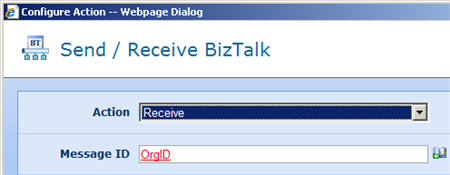
    So what does this BizTalk activity look like?  First, we designate whether this is a “Send”, “Receive” or “Send/Receive” action.  The “Send/Receive” is used for synchronous transactions while the other two are the choices for asynchronous transmission.  Next we specify a “Message ID” which acts as the unique identifier for the message (e.g. correlation).   By default, this activity uses a GUID alongside the ID of the list row, but I changed mine to just be the organization ID (which I realize is not going to be unique to each transaction.  Sue me.).  Note that you can inject any value from the list or workflow variable into this “Message ID” identifier field.

    The next section of the configuration pane is the “BizTalk Web Service Endpoint Settings” which we don’t have yet.  That will come later, and is blank for now.  Following that section is the place where we define the data we wish to send to BizTalk.  There are two choices: (a) send the file being acted upon (in the case that this workflow runs from a document library), or (b) choose list properties that contain the relevant message payload information.


    Notice the “Export to XSD” link.  This link causes your previous list property selections to be loaded into an XSD file for BizTalk to consume.  So, this becomes your inbound message contract.  What about the response contract?   We configure this by adding another “Send/Receive BizTalk” activity to our workflow.  Because our provisioning action may take awhile, I used an asynchronous publication to BizTalk and now need a way to get the response back in.  The data received back from BizTalk must be stored in workflow variables (as opposed to taking the whole response document and putting it somewhere).  My workflow variables look like this:

    Now let’s configure the response.  This time, my “Action” is set to “Receive” from BizTalk and I used the same “MessageID” as the “Send” activity.

    This shape also has its “BizTalk Web Service Endpoint Settings” left blank, but unlike the previous activity where we’ll fill this in later, this activity’s value always remains blank.  This is because the Nintex folks provide a single HTTP channel back into their workflow engine from BizTalk.

    Finally, we choose which available workflow variables we wish to populate with response data from BizTalk Server.

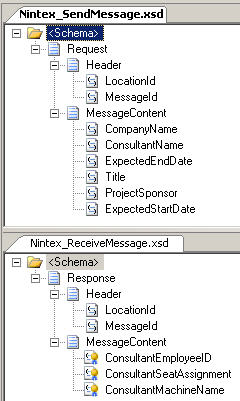
    Just like before, we can export this information out to an XSD.  I’ve gone ahead and exported both the request message (from list values) and response message (put back into workflow variables) and added them to a new BizTalk project in Visual Studio.NET.

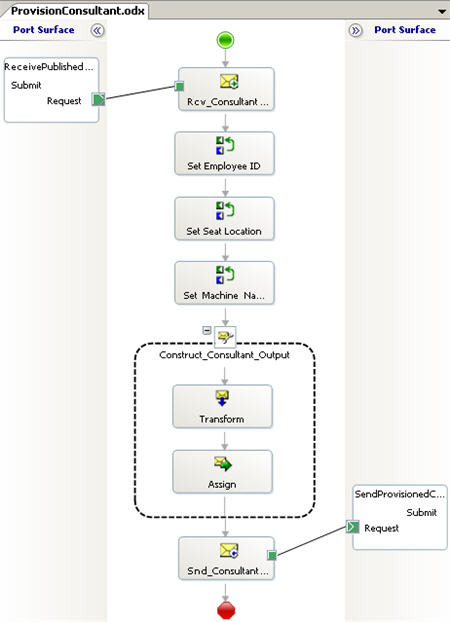
    Both the request and response message have a header added which includes routing information needed by Nintex to correlation inbound and outbound messages.  In my sample orchestration which coordinates employee provisioning activities, I receive a message in via a one-way port, call a few operations to generate an employee ID, set the office location and establish the laptop machine name, and finally send the message back out via a one-way port.

    After building and deploying this orchestration, I need to define the means by which Nintex sends a message into BizTalk.  As I mentioned in the previous post, Nintex does not currently support WCF, so you have to use the BizTalk Web Services Publishing Wizard to produce an ASMX service endpoint.  Once the wizard is complete, you have a valid service endpoint and a receive location that can be bound to the orchestration’s receive port.    What we need to manually create is the send port which sends our response message back to the running workflow.  The HTTP endpoint set up by Nintex is found at:

    http://<sharepoint server>/_layouts/nintexworkflow/BizTalkHandler.ashx

    Once that send port is bound to our orchestration, we’re ready to roll.  Now we can return to our SharePoint workflow and update the existing “Send to BizTalk” activity with the valid service connection details.

    Finally, I included a bunch of “Set field value” activities in the workflow which take the values from the workflow variables (set by the BizTalk response) and put them into the list values for the item.

    All that’s left to do is publish, and then trigger the workflow on our existing list item.  Sure enough, after launching the workflow, my item has its status set to “In Progress” and a couple of browser refreshes later, it displays the values returned by my BizTalk orchestration.

    Summary

    All in all, this was pretty easy to do.  It’s convenient that I can send either list data or entire documents into BizTalk, and it helps greatly that the tool produces valid XSD files (except there seems to be a bug where datetime fields in SharePoint lists don’t properly map to their XSD counterparts).  I’d choose the BizTalk integration vs. traditional web service integration when I want asynchronous interactions with my service or ESB.

    It’s a good toolset overall.  Definitely take a look.

    Technorati Tags: ,

  • System Integration with Nintex Workflow for SharePoint 2007 (Part I)

    [Series Overview: Part IPart II / Part III]

    If your organization uses MOSS 2007, hopefully you’ve taken a look at what the folks at Nintex have to offer.  My company recently deployed their workflow solution, and I thought I’d take a look at how to execute system integration scenarios as part of a Nintex Workflow.

    In this first post, I’ll take a short look at the general product toolset.  The second post will show off web services integration, and the final post will highlight their native BizTalk Server integration.

    First off, what is Nintex Workflow?  It’s a solution hosted within the SharePoint environment that allows you to graphically construct robust workflow solutions that play off of SharePoint lists and libraries.  While you can build workflows in SharePoint using either WF or SharePoint Designer, the former is purely a developer task and the latter really exposes a linear, wizard driven design model.  Where Nintex fits in is right in the middle: you get the business-friendly user experience alongside a rich set of workflow activities (including any custom ones you build in WF).

    Design Experience

    Once the Nintex module is installed and enabled in your SharePoint farm, then any list or library has a set of new options in the “Settings” menu.

    If I choose to create a new workflow, then I am given the option to select a pre-defined template which has a default flow laid out for me.
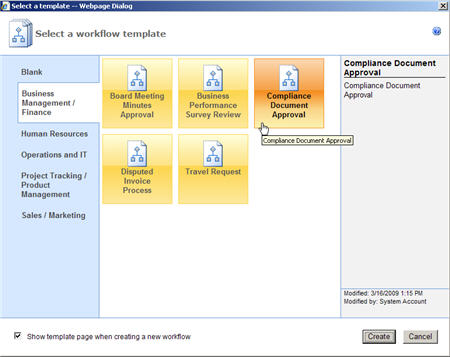
    Once a template or blank workflow is chosen, I have a plethora of “Workflow Actions” available to sketch out my process.  For example, the Integration category has options such as “Call web service”, “Execute SQL”, “Query LDAP”, “Send/Receive BizTalk” and “Call Workflow.”

    There are nine categories of workflow activities in all, including:

    • Integration
    • Libraries and lists (e.g. “Check out item”, “Create list”, “Set field value”)
    • Logic and flow (e.g. “For each”, “Run parallel action”, “State machine”)
    • Operations (e.g. “Build dynamic string”, “Wait for an item to update”)
    •  Provisioning (e.g. “Add User to AD Group”, “Provision user on Exchange”)
    • Publishing (e.g. “Copy to SharePoint”)
    • SharePoint Profiles (e.g. “Query user profile”)
    • Sites and Workspaces (e.g. “Create a site”)
    • User Interactions (e.g. “Request approval”, “Send a notification”, “Task reminder”)

    Note that you can turn off any individual action you wish if the capability exposed is too risky for your particular organization.

    Using these activity shapes, I can draw out a simple process made up of decisions, notifications and approvals.

    Each activity can be configured (and re-labeled for later readability) per its function.  When an activity requires data to act upon (as most do), those values can often either be retrieved from (a) a hard coded value, (b) a workflow-specific variable, or (c) content from any list on the site.  For the “Request approval” activity, I have all sorts of options for choosing where to get the approver list from, which means of approval to require (all, single, first, vote) and where to store the assigned tasks.  What’s also cool is the “Lazy Approval” setting in Nintex which allows you to respond to a notification email with a single word or phrase to indicate your response.  In the image below, notice that I used a value from the list (in red text) as part of my task name.

    The configuration experience is pretty similar for each activity.  For the most part, I’ve found it to be fairly intuitive although I’ll admit to actually having to open the Help file a few times.

    Runtime Experience

    You can choose what the start up option should be for the workflow.
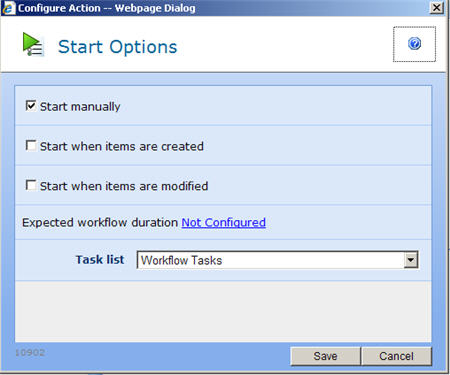
    Then, from the “Actions” menu, you can publish the workflow and make it available for use.  Pretty darn easy.

    Then, when you add/change data in the list or library, the workflow is either automatically or manually triggered.  Just like with any SharePoint workflow, you have a column added to the list which keeps you up to date on the status of the workflow (which you can drill into).  Whatever task list is associated with the workflow is also populated with tasks assigned to individual users or groups.

    Users can also add the “My Workflow Tasks” web part to a page which will show only the tasks for the active user.
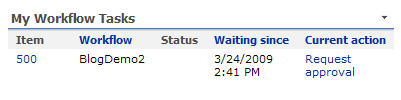
    Users can also browse into the running workflow and graphically see what’s been completed so far, how long each step took, and what comes next.

    Analysis Experience

    Just like the previous image, we can drill into a completed workflow and analyze how it ran and the duration of a given step.

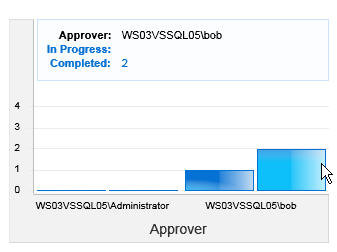
    As for reporting, the product comes with plenty of canned reports on a per-site or all-site basis that address topics such as: Approver Performance Statistics, Workflows in Progress, Workflow Performance and much more.

    You can display these reports either graphically or tabularly as a web part.  For the graphical reports, you can choose line, bar or pie chart.  The charts actually rely on Microsoft Silverlight (for the 2-D representation) and are pretty snazzy and configurable.
    Summary

    This was a very simple, but hopefully adequate, walkthrough to show you around the software.  This technology has lots to offer and integrates nicely with the Microsoft stack of products (including Live Communication Server).   Note that nothing I did here required a lick of programming or even a particularly technology-centric background.  And because the design surface is hosted within the SharePoint environment itself, you get a very rapid, accessible means for building and deploying functional workflows.

    If you have a SharePoint sandbox, consider downloading the free trial and playing around.

    In the next post, I’ll show you how to do some simple system integration via web service calls from a workflow.

    Technorati Tags: ,

  • My Book "SOA Patterns with BizTalk Server 2009" is Up for Pre-order

    Well look at that.  I just happen to check my publisher’s website today and noticed that they put my book description online and made it available for pre-order.

    The book, entitled SOA Patterns with BizTalk Server 2009, is due out by May 2009 (hopefully sooner).  I’m still in the process of editing the book and responding to technical review comments, but we’re nearing completion of that phase.  I have three fantastic technical reviewers (Charles Young, Zach Bonham, Ewan Fairweather) who have added a ton of great comments that I’m almost done wading through and addressing.

    This publisher (Packt Publishing) specializes in short, targeted technical books that address specific topics.   I tried to be “short” but still went over my suggested page count by nearly double.  Oh well, hopefully that’s better for the readers. 

    The high level chapter summaries are …

    • Chapter 1 – Building BizTalk Server 2009 Solutions – A brief walkthrough of creating a new BizTalk project from scratch
    • Chapter 2 – Windows Communication Foundation Primer – An overview of WCF with examples of developing, hosting, and consuming WCF services
    • Chapter 3 – Using WCF Services in BizTalk Server 2009 – An explanation of the marriage between BizTalk and WCF and how to both expose and consume WCF services within BizTalk Server
    • Chapter 4 – Planning Service Oriented BizTalk Solutions – A discussion of the core aspects of SOA, the types of services one can construct, available message exchange patterns, and how service-oriented principles apply to BizTalk solutions
    • Chapter 5 – Schema and Endpoint Patterns – How to build effective schemas and endpoints depending on the type of service constructed
    • Chapter 6 – Asynchronous Communication Patterns – A look at options for asynchronous communication and how to exploit this pattern in BizTalk solutions
    • Chapter 7 – Orchestration Patterns – We analyze the role of orchestration in service solutions and see how to build loosely coupled workflow processes
    • Chapter 8 – Versioning Patterns – We see here how to effectively version our SOA solutions and cleanly introduce updates to our BizTalk components
    • Chapter 9 – New SOA Capabilities in BizTalk Server 2009 – A first look at the latest additions to the BizTalk product. This includes the new UDDI v3 registry, WCF SQL Server Adapter, and ESB Guidance 2.0

    So there you go.  Once the book actually hits the shelves, I’ll make another mention of it on the blog.

    Technorati Tags: , ,

  • Presentations from 2009 Microsoft SOA/BPM Conference Available Online

    Hadn’t noticed this before, but found the complete collection of videos and presentations from this year’s SOA & BPM Conference.  I didn’t make it up to Redmond for this, so it’ll be nice to peruse the content which covers topics such as:

    • Customer case studies
    • Designing services for “Dublin”
    • Using BAM for Service and SLA monitoring
    • Supporting WS*, REST and POX simultaneously with WCF
    • SOA patterns from the field
    • Lap around “Oslo”

    Check it out.

    Technorati Tags: , ,

  • New "WCF Adapter FAQ" Whitepaper From Microsoft

    The folks over at the BizTalk Adapter Development blog pointed out their new paper which answers a number of questions about the WCF adapters for BizTalk Server 2006 R2.

    This collection of FAQs address topics such as:

    • Deciding which WCF adapter to use
    • When to use the two custom adapters
    • How do messages flow in from WCF adapters and flow back out
    • How to preserve the entire inbound message arriving via a WCF adapter
    • Accessing WCF message properties within a BizTalk solution
    • Decision criteria when choosing the WCF LOB Adapter SDK vs. the old BizTalk Adapter Framework
    • How BizTalk uses the WCF adapters
    • The difference between WCF behaviors and BizTalk pipelines

    There are plenty more besides these.  If you are doing WCF development alongside your BizTalk solution and need to integrate the two, you really should check this out.  The document is well written and nicely explains the concepts.

    Technorati Tags: ,

  • What I Learned at the 2009 Microsoft MVP Summit

    Just returned from the Summit, and had a really great time meeting colleagues and seeing interesting content.  Without breaking any NDAs, I thought I’d share some thoughts on what I saw this past week.

    • The CSD/BizTalk MVP group remains a smart bunch of guys with a diverse set of backgrounds.  I shared a hotel room with Yossi Dahan, and was thrilled to spend time with the likes of Mick Badran, Michael Stephenson, Saravana Kumar, Stephen Thomas, Leonid Ganeline, Ben Cline, Jon Fancey, Kevin Smith, Alan Smith, Mikael Håkansson, Jon Flanders, Matt Meleski, Tim Rayburn, Kent Weare, Bill Chestnut and many others.  The practical experiences these guys have with customers should be milked dry by the product teams.
    • I finally spent some time on Azure (thanks to Steve Marx’s session) from a development platform perspective (i.e. not .NET Services) and I am quite impressed by the developer experience.  This seems to be something Microsoft will really bang on when trying to differentiate its offering from those of others in the “cloud computing” space.
    • The Summit was also the first time I’ve REALLY looked at “M” since last year’s Summit, and I think it has potential to be useful.  I made this observation in a previous blog post, and plan to actively mess around with “M” for both data solutions and to emit actionable content.  The interesting thing is, the lengthiest work doesn’t seem to be writing the textual DSL as much as constructing the parser to do something with the output.  That is, in the examples referenced in the link above, “M” models are used to create orchestrations and BizTalk build processes, respectively.  Once the “M” part is done, both Yossi and Dana had to write the parser which took the MGraph and cycled through the objects to generate the final output (i.e., ODX file and executable deployment script).  Not a bad thing, just something that’s seemingly glossed over.
    • We had a “BizTalk Next” brainstorming session, and I was happy to see some big ticket items on the minds of the BizTalk architecture team.  After sitting on the same runtime engine for 5 years, and mostly surface-level changes during the past 2 releases, it seems like “put up or shut up” time for these guys.  And they seem to be working hard to be in the former category.
    • Ewan Fairweather led a strong session on BizTalk performance with a special focus on the impact of virtualizing BizTalk solutions in Hyper-V.  Ewan authored the BizTalk Server R2 Hyper-V Guide and BizTalk Server Performance Guide.  The results of Ewan’s recent exploits with his giant server farm will be making their way into public documentation shortly.  A few takeaways (which I was assured aren’t NDA!): (a) performance of “inline sends” vs. “logical ports” within orchestrations is nearly 4x faster with regards to throughput, (b) the performance impact of virtualization on BizTalk solutions is fairly negligible and (c) making a few well-known platform tweaks can nearly double performance.  Look for more approachable guidance in the near future (vs. massive, detailed whitepapers) as the team realizes that with such a developer-centric product as BizTalk, you need to remember that you aren’t always talking to your standard system administrators.

    As for non-content related observations …

    • Tim Rayburn can sing a mean Black Hole Sun, as experienced during one of the social parties of the week.
    • Those two white guys who sang California Love?  Not so much.
    • Mick Badran is a wild man, and a helluva great guy.  However, I worry that any “guys night out” with him always ends with something like “… and that’s how we ended up in a Chinese prison with two 85 year old women and $450 in nickels.”
    • People need to stop with the corny gifts to Ballmer and the general Q&A shenanigans.  You’re embarrassing yourself folks.
    • Conference attendees will take pictures of ANYTHING.  Seriously, random speakers, crowds, buses (inside and out), signs, buildings, hotel lobbies, plant life.  And what’s with the incessant picture taking of NDA slides?  SLIDES, people.  Write down the content if it’s that freakin’ important.  I’m convinced that these people are either (a) IBM spies or (b) crafting the most sleep-inducing scrapbook since my 3rd grade trip to the Liberty Bell.

    Great time overall, looking forward to doing it again.

    Technorati Tags: ,