Month: February 2009

  • Not Using "http://namespace#root" as BizTalk Message Type

    This has come up twice for me in the past week: once while reading the tech review comments on my own book (due out in April), and again while I was tech reviewing another BizTalk book (due out in July).  That is, we presumptively say that the BizTalk “message type” always equals http://namespace#root when that’s not necessarily true.  Let’s look at two cases demonstrated here.

    This first simple case looks at a situation where an XML schema actually has no namespace.  Consider this schema:

    Perfectly fine schema, no target namespace.  I’ve gone ahead and created another schema (with namespace) and mapped the no-namespace schema to the namespace schema.  After I deploy this solution and create the necessary ports to both pick up and drop off the message, I can stop the send port and observe the context properties of the inbound message.


    Notice that my message type is set to ReturnRequest which is the name of the root node of my schema.  Obviously, no namespace is required here.  If I throw my map on the send port, I can also see that the source schema is successfully found and used when mapping to my destination format.

    So, for case #1, you can have schemas with no namespace, and the message type for that message traveling through BizTalk is in no worse shape.

    For case #2, I wanted to try creating my own message type arbitrarily and keep it as something BizTalk doesn’t generate.  For instance, let’s say I receive binary files (e.g. PDFs) but want to add not only promoted fields about the PDF, but also type the message itself.  The PDF file has a specific name which reflects the type of data it contains (e.g. ProductRefund_982100.pdf and ProductReturn_20032.pdf).  The file location where these PDFs are dropped have names based on the country of origin, like so:

    So I can set a “type” for the message based on the file name prefix, and I can set a promoted “country” value based on the location I picked it up from.  After adding a new property schema to my existing BizTalk solution, I next built a custom pipeline component which could work this magic for me.  The guts of the pipeline component, the Execute operation, is shown here:

    public IBaseMessage Execute(
         IPipelineContext pContext, 
         IBaseMessage pInMsg)
    {
     //get context pointer
     IBaseMessageContext context = pInMsg.Context;
    
     //read file name and path 
     string filePath = context.Read("ReceivedFileName", 
     "http://schemas.microsoft.com/BizTalk/2003/file-properties").ToString();
                
     //parse file name to determine message type
     string fileName = Path.GetFileNameWithoutExtension(filePath);
     string[] namePieces = fileName.Split('_');
     string messageType = namePieces[0];
                
     //get last folder which indicates country this pertains to
     string[] directories = filePath.Split(Path.DirectorySeparatorChar);
     string country = directories[directories.Length - 2];
    
     //set message type
     pInMsg.Context.Promote("MessageType", 
      "http://schemas.microsoft.com/BizTalk/2003/system-properties", 
       messageType);	
    
     //set promoted data value
     pInMsg.Context.Promote("Country", 
       "http://Blog.BizTalk.MessageTypeEvaluation.ProductReturn_PropSchema", 
       country);
    
     return pInMsg;
    }
    

    After compiling this and adding to the “Pipeline Components” directory in the BizTalk install folder, I added a new receive pipeline to my existing BizTalk solution and added my BinaryPromoter component.

    After deploying, I added a single receive port with two receive locations that each point to a different “country” pickup folder.  Each receive location uses my new custom receive pipeline.

    I have two send ports, each subscribing to a different “message type” value.  My second send port, shown here, also subscribes on my custom “country” promoted value.

    When I drop a PDF “product refund” file into the “USA” folder, I can observe that my message (of PDF type) has a message type and promoted data value.
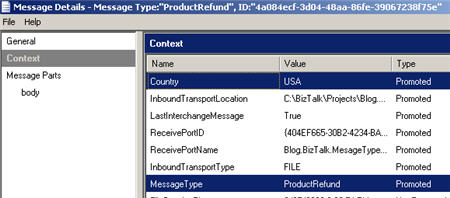
    Neat.  So while it’s important to have BizTalk-defined message types when doing many operations, be aware that you can (a) still have message types without namespaces, and (b) define completely custom message types for use in message routing.

    Technorati Tags:

  • First Stab at Using New Tool to Migrate SQL Server Adapter Solutions

    If you saw the recent announcement about the Adapter Pack 2.0 release, you may have seen the short reference to a tool that migrates “classic” SQL Adapter solutions to the new WCF SQL Adapter.  This tool claims to:

    • Works on the source project files
    • Generates equivalent schema definitions for the operations used in the existing project
    • Generates new maps to convert messages from older formats to the new format
    • Modifies any existing maps to work with the new schemas
    • A new project is created upon completion, which uses the SQL adapters from the BizTalk Adapter Pack v2

    Given how much “migration pain” can be a big reason that old projects never get upgraded, I thought I’d run a quick test and see what happens.

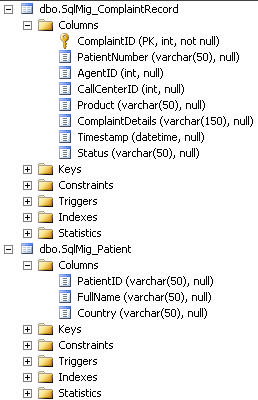
    The SQL Server part of my solution consists of a pair of tables and pair of stored procedures.  In my solution, I poll for new customer complaint records, and receive that data into an orchestration where I take the ID of the customer and query a different database for the full record of that customer.

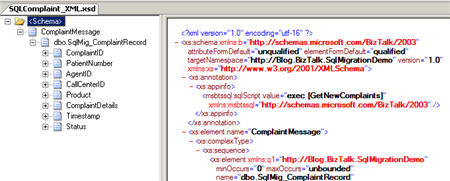
    In my BizTalk Server 2006 R2 environment, I walked through the “Add Generated Items” wizard in Visual Studio.NET and pointed at the classic SQL Adapter in order to generate the schemas necessary to receive and query data.  As you would expect, the message arriving from the SQL Adapter polling port has a single node representing the customer complaint.

    The schema generated by the wizard for the patient record query has nodes for both the stored procedure request and result.

    My orchestration is very straightforward as it receives the polled message, constructs the patient query using a map, executes its query, and broadcasts the result.

    Great.  After deploying this solution, I still need the messaging ports required to absorb and transmit the necessary data.  My classic SQL Adapter receive location has the necessary settings to poll my database.

    After adding two send ports (one using the classic SQL adapter to send my patient query, and another to drop my result to a FILE location), I started everything up and it worked perfectly.  Now the fun part, migrating this bad boy.

    Because this SQL adapter migration tool claims to work on the “project files” and not configuration bindings, I figured that I could package up the working Visual Studio.NET project and perform the migration in my BizTalk Server 2009 environment (which also had the Adapter Pack 2.0 beta installed).

    When you install the Adapter Pack 2.0 beta, you get the SQL Migration tool.   My SQL Server instance uses integrated authentication, so while I had to specify a “username” and “password” in the command line entry, I left them blank.

    MigrationTool Sqlsource=”Blog.BizTalk.SqlMigrationDemo.btproj”

    -dest=”C:\SQL_Mig\Blog.BizTalk.SqlMigrationDemoConverted” –uri=mssql://<server>//DemoDb? –username= –password=

    Once this query completes, you get a notice and a brand new project.

    The new project also contains a conversion report showing what was added and changed in the solution.  I can see two new files added, and two files that the migration tool says it can reuse with the new adapter.

    If I open the actual project that the migration tool built, I can see new folders and a couple new files.  The SqlBindingProcedure.dbo.xsd schema is also new.

    Notice that I have a new (WCF SQL Adapter) binding file for my “send” transmission that looks up patient details.  A note: the BizTalk project system in 2006 R2 is different than the new one in BizTalk 2009.  So, because I transferred my R2 project to my 2009 environment and THEN ran the wizard, my new project is still in the R2 format.  I had to manually create a new 2009 project and include all the files generated by the wizard instead of just opening up the generated btproj file.

    The verdict?  Well, pretty mixed.  The schema it generated to replace my “query” schema is a mess.  I get an untyped result set now.

    And the map that the migration tool created simply took my original “patient query” format and mapped it to their new one.  I guess I’m supposed to apply that at the send port and keep my existing “complaint to patient” map that’s in my orchestration?

    Also, because the migration tool doesn’t appear to look at the runtime application configuration, I still have to manually create the receive location, which also seems like I have to manually recreate my inbound schema that can comply with the new WCF SQL Adapter format.  I haven’t done all that yet because I’m not that motivated to do so.

    So, there could be a few reasons for my non-seamless experience.  First, I used stored procedures on all sides, so maybe that part isn’t fully baked yet.  I also switched environments and took a working BizTalk 2006 R2 solution and ran the conversion tool on a BizTalk 2009 box.  Finally, there’s a good chance this falls under the “Seroter Corollary” which states that when all else fails, let’s assume I’m an idiot.

    Anyone else run this migration tool yet on an existing project?  Any obvious things I may have missed that made my migration more work that rebuilding the project from scratch?

    Technorati Tags: ,

  • Service Security Guide on MSDN

    The Improving Web Services Security: Scenarios and Implementation Guidance for WCF project on CodePlex now has its results in an online browsable from within the MSDN site.    I linked to this project last year, but it’s great that everything has been made available on MSDN as well.

    Even if you aren’t using WCF, this set of deliverables has some very insightful components.  For example, the Security Fundamentals for Web Services chapter barely even mentions WCF but rather focuses on defining services, overarching security principles, as well as a set of security patterns that address topics such as authentication, data confidentiality and message validation.

    Chapter 2, Threats and Countermeasures for Web Services, is also technology-neutral and identifies a set of security threats, vulnerabilities, and countermeasures.

    Of course it is a WCF guide, so expect to find a wealth of information about WCF security options and trade-offs as well as 20+ “how to” walkthroughs that range from hosting services, to impersonation to using certificate-based authentication.

    Finally, if you’re not a “read tons of pages about security” kind of fella, then at least peruse the WCF Security Checklist (which can provide a good development checkpoint prior to service release), the summary of WCF Security Practices at a Glance (which provides a clean list of categories and related articles) and the very important Q&A section that contains dozens of realistic questions with straightforward answers.

    Great job on this.  Thanks J.D. and team.

    Technorati Tags: ,

  • Tips for Successful Software Vendor Evaluations

    In the past six months, I’ve had the pleasure (penalty?) of participating in software vendor evaluations for two distinct projects.  In each case, we looked at three vendors over the course of consecutive days and evaluated them against a series of business scenarios to see which software package was a best fit for our environment.   I learned a lot between those two sessions, and thought I’d share my best tips for participating in such sessions.

    • DO know the business cases ahead of time.  In my earlier vendor evaluation I didn’t know the core business or their use cases particularly well so it was difficult to engage in every business discussion.  Prior to this most recent session, I have spent months sitting in a war room with the business stakeholders refining requirements and hashing out goals for the project.  By deeply knowing what the software had to accomplish, I was able to actively participate in the discussion AND, ask technical questions that had significant relevant context behind them.
    • DO NOT wait to ask common technology questions until the day of the demonstration.  You should make sure to get base technical questions answered before the evaluation session.  We have a strong software vendor evaluation toolkit that we send to the vendors as part of an RFP.  This gets basic questions like “what is your platform built on”, “explain your DR strategy” and “describe your information integration patterns” out of the way.  If you’re looking for ideas when building such a questionnaire, check out the EPIC offering from the SEI. By establishing a foundation of technical background on a vendor, I can better refine business-relevant technical questions and not waste time asking if their product is Java or .NET based.
    • DO prepare a thorough list of technical questions for the session itself.  I defined a list of 2 dozen questions that weren’t in our initial software evaluation toolkit and were specifically relevant to our project.  While I did maintain a running list of new questions that I thought of during the actual demo, it was very beneficial to construct a stock list of questions for each vendor.  Some examples of these questions included:
      • How would I configure / code a punchout to an external service or repository in order to enrich a data entity or perform a data lookup?
      • How do I configure an outbound real time event to a SOAP listener outside the system?
      • Are customizations made via database procedures, custom code, etc and how are each propagated between environments (dev/test/prod)?  What are configurations and what are customizations?
      • How are exceptions captured, displayed and actionable on workflows, rules and business operations?
      • What support does the application have for a federated identity model?
      • How do you load master data from external systems while sharing master data with others?
    • DO strategically use instant messenger to communicate amongst team members.  While the majority of business participants filled out paper scoresheets in order to discourage distraction, a few of us remained on our laptops.  While this could have been an excuse to mess around, one key benefit was the ability to quickly (and stealthily) communicate between one another and find out if someone missed something, had a question to verify before asking, or simply keep ourselves aware of time restraints.
    • DO have a WebEx (aka web conference) set up so that you can (a) observe greater details on a laptop instead of on a projector far away, and (b) be able to take screenshots of the application presented.  The taking of screenshots was the biggest way I stay engaged throughout 4 straight days of presentations and demos.  And the best part was, when all was said and done, I had a captured record of what I saw.  When we met later to discuss each presentation, I could quickly review what was presented and differentiate each vendor.
    • DO agree on a scoring mechanism ahead of time.  If you want to be militant and say that you only give a non-zero score when you see an ACTUAL demonstration of a feature (vs. “oh we can do that, but didn’t build it in”) then everyone must agree on that strategy.  Either way, create a common ranking scale and discuss what sorts of things should fall into each.
    • DO set aside a specific time during the evaluation day for technical discussion.  The majority of the day should be focused on business requirements and objectives.  In our case, we blocked off the last 1.5 hours of each day for targeted technical discussion.  This made the flow of the day much smoother and less prone to tangents.
    • DO NOT get bogged down in deep technical discussion because the goal of this type of session is to determine compatibility, not to necessary model and design the entire solution.  This distracts you from getting to the other big-picture questions you need to get answered.
    • DO be forthright and demanding.  I’ve been on the other side of this while working from Microsoft, and my current employer was great at not beating around the bush.  If you don’t see something you expected, or think you might have missed something, stop the presentation and get your question resolved.  The vendor is there for your benefit, not the other way around.
    • DO be explicit in what you want to see from the vendor.  It helps them and helps you.  In our case, we provided detailed requirements and use case scripts that we expected the vendor to follow.  This allowed us to clearly set expectations and gave our vendors the best chance to show us what we’d like to see.
    • DO NOT provide too much time between when you deliver such scripts / use cases and when you expect them to be presented.  By only allowing a short time for the vendor to digest what we wanted and actually deliver it, we forced them to work with out-of-the-box features and did not give them a chance to completely customize their application in a way we never would.

    Overall, I actually enjoy these evaluations.  It gives me a chance to observe how smart software developers solve diverse business projects.  And, I get free lunches each day, so that’s a plus too.

    Technorati Tags:

  • Should an ODS Have a Query-By-Service Interface?

    My company has an increasingly mature Operational Data Store (ODS) strategy where agreed-upon enterprise entities are added to shared repositories and accessible across the organization.  These repositories are typically populated via batch loads from the source system.  The ODS is used to keep systems which are dependent on the source system from bombarding the source with bulk data load processing requests.  Independent of our ODS landscape, we have BizTalk Server doing fan-outs of real-time data from source systems to subscribers who can handle real-time data events.  My smart architect buddy Ian is proposing a change to our model, and I thought I’d see what you all think.

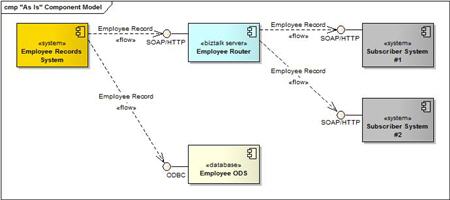
    So this is a summary of what our landscape looks like today:

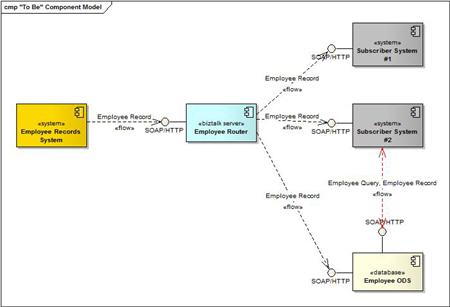
    Notice that in this case, our ESB (BizTalk Server) is populated independently of our ODS.  What Ian wants us to do is populate all of our ODSs from our ESB (thus making it just another real-time subscriber), and then throw a “get” interface on the ODS for request/reply operations which would have previously gone against the source system (see below).  Below notice that the second subscriber of data receives real-time feeds from BizTalk, but also can query the ODS for data as well.

    I guess I’ve typically thought of an ODS as being for batch interactions only, and not something that should be queried via request/response operations.  If I need real-time data, I’d always go to the source itself. However, there are lots of benefits to this proposed model:

    • Decouple clients from source system
    • Remove any downstream  impact on source system maintenance schedules
    • Don’t require additional load, interfaces or adapters on source system (although most enterprise systems should be able to handle the incremental load of request/response queries).
    • All the returned entities are already in a flattened, enterprise format as opposed to how they are represented in the source system

    Now, before declaring that we never go to source systems and always hit an ODS (which would be insane), here are some considerations we’ve thought about:

    • This should only be for shared enterprise entities that are distributed around the organization.
    • There is only a “get by ID” operation on the ODS vs. any sort of “update” or “delete” operations.  Clearly having any sort of “change” operations would be nuts and cause a data consistency nightmare.
    • The availability/reliability of the platform hosting the ODS must meet or exceed that of the source system.
    • We must be assured that the source system can publish a real-time event/data message.  No “quasi-real-time” where updates are pushed out every hour.
    • This model should not be used for entities where we need to be 110% sure that the data is current (e.g. financial data, extremely volatile data).

    Now, there still may be a reliance by clients on the source system if the shared entity doesn’t contain every property required by the client.  And in a truly event-driven model, maybe the non-ODS subscribers should only get event notifications and be expected to ping the ODS (which receives the full data message) if they want more data than what exists in the event message.  But other than that, are there other things I’ve missed or considerations I should weigh more heavily one way or the other?  Share with me.

    Technorati Tags: , ,