Today I was approached with the problem of how to take a flat file input, debatch it, add the “header” to each individual record, and return the results as XML messages.
The first part of the equation was to successfully debatch the flat file. So, I took the header and body schemas that the developer built and added them to a new Receive pipeline’s “flat file disassembler”. On the flat file disassembler, I flipped the Preserve header property to “True” to ensure that the header would be injected into the context collection of each debatched record.

I can prove that Preserve header works by stopping my send port, and checking out the temporarily suspended messages. If I view the context collection for a given message, I’ll see the FlatFileHeaderDocument value and my header message (in XML format) embedded inside.

To transmit a flat file result (with header attached), all I have to do is create a custom Send pipeline, use the flat file assembler component, and once again choose the document and header schemas. This will cause the FlatFileHeaderDocument to be sucked out of context and converted back to delimited text, and slapped on top of each message.
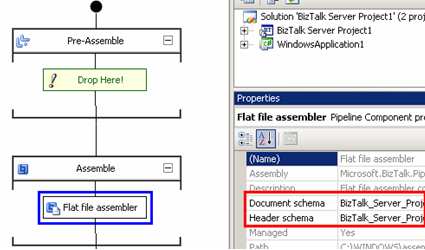
That’s cool, but in our case, we wanted XML output with the header appended. I could have tried some gnarly solution involving orchestrations calling a “flat file” send pipeline (to add the header) and then an “xml” send pipeline to generate XML content, but that didn’t seem clean. Instead, I created an orchestration that first grabs the FlatFileHeaderDocument out of context and creates a valid orchestration message from it.

The XMLNORM.FlatFileHeaderDocument is the specific context value from which I can yank a string representation of the XML header message. I then loaded that into an XmlDocument variable and used that variable to instantiate an orchestration message. Next, I passed both the body AND the newly-constructed header message into a multi-part map. This map takes those two values and outputs a single document format containing both header and body values.
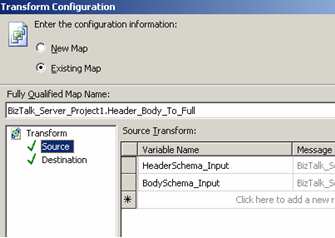
So now, BizTalk can take the flat file containing 20 records, debatch it, and reassemble it (header and all) into valid XML output.
Technorati Tags: BizTalk


 Richard Seroter's Architecture Musings
Leave a reply to MA Cancel reply