Category: General

  • Do these five things to be “effectively decisive”

    Do you want to really frustrate me? Take a looooong time to make a decision. I’m not alone apparently, as most every employee survey I’ve participated in the last fifteen years has some variation of “slow decision making” listed as a top annoyance. Leaders who can make decisions quickly have outsized impact, and frankly, more of my respect. Decisiveness is one of my favorite leadership attributes!

    But it’s not just about making decisions fast. I could decide quickly to bet my house on a hand of poker, kill a promising IT project, or rage-quit a good job. Recklessness isn’t the goal. It’s not just decisiveness we’re after, but effective decisiveness. Good choices.

    In thinking about this, I came up with five things you need to exhibit such decisiveness. In my experience, if you have these, you can make decisions quickly and unblock the people who depend on you.

    You need information. It’s hard to make decisions without information! The mistake we often make is waiting for all the info. You’ll never have it. You’re always working with incomplete information. Can you always have a good baseline of info? The most decisive leaders I know (and what I try to be) are always listening and learning. They pay constant attention to a wide array of things. When decisions need to be made, they don’t have to start from zero.

    You need courage. There’s a riskiness to making decisions. Ideally, you feel “safe” making the decision because those around you will support you regardless of how it turns out. But that’s not always the case. Sometimes you have to make unpopular decisions. Or those without the support of the leaders above you. Decisiveness requires courage to make hard choices.

    You need recognition of the type of decision you face. Are you facing a “type 1” decision that’s irreversible, or a “type 2” decision that’s reversible? Picking a restaurant for dinner tonight? Type 2. Don’t stress it and just make a choice. If the restaurant turns out to be closed, you can pick something else. Selling your home? Be a tad more thoughtful. You can make quick decisions with both, but label the type of decision you’re facing, and analyze accordingly.

    You need authority. It doesn’t matter if you’re decisive in areas that you have no control. You’ve made a firm decision to become the President of the United States? Congrats. Your decision doesn’t make it so. Whether you’re making decisions for yourself or on behalf of a team, recognize where you have authority to execute.

    You need urgency. None of these other things matter if you don’t feel a sense to act quickly. You can have authority, information, courage, and awareness of the decision type. But if you don’t have urgency, you may still drag out a decision for an extended period of time. The best leaders recognize the impact their decision-making pace has on others. They prioritize it. Tomorrow will have its own problems. Don’t procrastinate. Make a call today, and move onto the next thing.

    Maybe all of these are wrong, but I’ve found myself embracing a more decisive leadership style so that I never slow down my team unnecessarily.

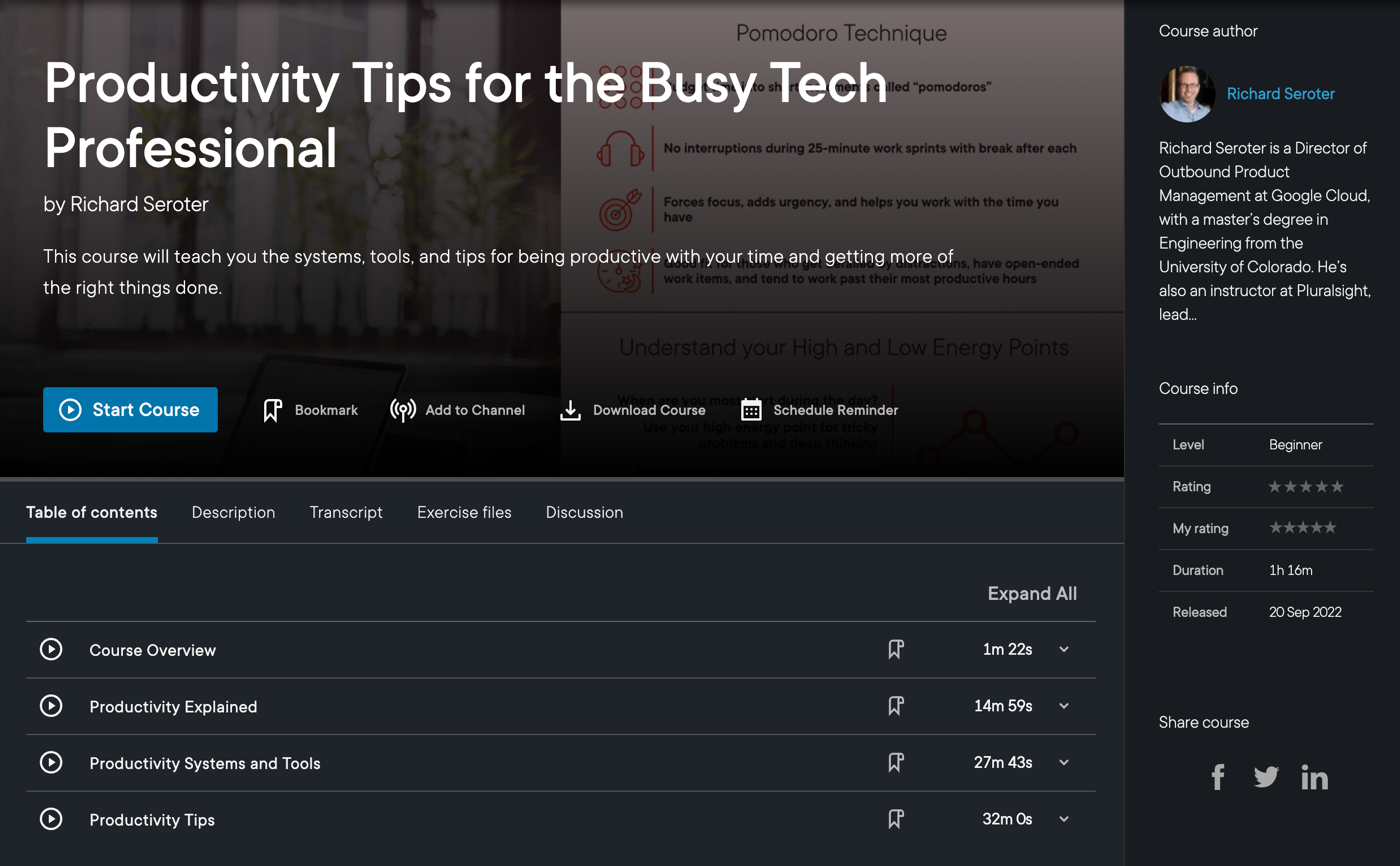
  • Invest in yourself with my new Pluralsight course about personal productivity

    Invest in yourself with my new Pluralsight course about personal productivity

    I’m actively trying to be less productive. You don’t hear that very often, do ya? These past couple pandemic years limited my travel—both to an office or on an airplane—and I found myself working more than ever. But that’s proven temporary, thankfully, and I want to establish a model where I do fewer things, better, while also taking more time to relax and goof around.

    So when Pluralsight folks reached out to me and asked if I wanted to revisit my 2014 course about personal productivity tips, I jumped at the chance.

    I’ve learned a lot since 2014, and this was a good chance to capture new lessons learned, while re-imaging the course as a whole. The result? A 75 minute training course, Productivity Tips for the Busy Tech Professional, that I’m very proud of.

    Whether you’re in tech or not, this course can help you become more intentional about what you do, and complete more tasks that matter. The three modules of the course are:

    1. Productivity Explained. Here, we look at the over-emphasis on busy-ness, what productivity is all about, what we want to try and avoid, and the sorts of things that get in our way.
    2. Productivity Systems and Tools. There are formal and informal systems and habits you can adopt to become more productive. I dig into six different systems and six different categories of tools. In my life, I use a mix of all of it.
    3. Productivity Tips. This module includes a series of specific tips that you can adopt or tweak to establish more control over how you work. Each one includes some examples of how to put it in practice.

    As always, I learned a lot by preparing this course and studying the latest research about personal productivity. I hope you watch and enjoy, and share any tips you have!

  • I want to learn about these six things in 2021

    I want to learn about these six things in 2021

    I know a few things. I don’t know most things. Each year, I try to learn new stuff and challenge my existing knowledge/assumptions. There are always more things to learn than time available in the day, so I have to be selective. What should I focus on? Some folks choose to go deeper in their areas of expertise, others choose to bolster weak areas. Next year, I’m going to do the latter.

    Here are six topics—four related to tech, two related to professional skills—I want to learn more about, and I’ll include some thoughts on my approach to learning each.

    Technology Skills

    Each year, I try out a variety of technologies. Next year won’t be different. Besides these four topics below, I suspect that I’ll keep messing around with serverless technologies, Kubernetes, service meshes, and public cloud services. But I’m going to spend special attention on:

    Identity and access management

    In my 20+ year career, I’ve learned enough about identity management to be dangerous. But in reality, I’m barely competent on this topic. It’s time to truly understand how all this works. With so many folks building increasingly distributed architectures, identity management seems more important than ever. I’d like to dig into things like authorization flows, application identities within clusters, and access management within cloud tenancy structures.

    How? I plan on taking some Pluralsight courses on Google Cloud Identity, OAuth2 flows, and overall security practices. Then I’ll invest in some hands-on time with things like Workload Identity, Identity Aware Proxy, and the BeyondCorp assets we’ve created. May also read some Gartner and Forrester reports on the topic.

    BigQuery

    This is a crown jewel in Google Cloud’s portfolio. It’s a well-built, popular service that stands out among public cloud offerings. I’ve spent precious little time in the data analytics domain, and want to change that. A little. I’m not interested in being a full-on analytics guy, but I want to understand how BigQuery works and the role it can play for companies adopting cloud.

    How? There are a handful of Pluralsight courses that look good here. I’ll also go hands on a lot. That may involve some QwikLabs, or just me playing with datasets.

    Angular

    I’ve mostly declared bankruptcy on front-end frameworks. My career has been server-side, with only enough investment in the front-end to build decent looking demos. But I like what I’m seeing here and it’s obvious how much processing we’re doing client-side now. There are roughly five hundred viable frameworks to choose from, so I might as well pick a popular one with some Google heritage.

    How? Pluralsight has a great Angular learning path. I just need to get some reps with the tech, and make it second nature to use on any apps I build. Plus, learning this gives me an excuse to use compute platforms like Cloud Run and GKE to host my app.

    Application deployment tools and strategies

    While CI/CD is a fairly mature domain, I’m still seeing lots of fresh thinking here. I want to learn more about how forward-thinking companies are packaging up and shipping software. Shipping is more sophisticated now with so many components to factor in, and less tolerance for downtime. The tooling for continuous deployment (and progressive delivery) is getting better.

    How? I’m looking forward to trying out a lot of technologies here. I’m sure i’ll find a lot of books or courses about what I’m after, so this is a very “hands on” journey.

    Professional Skills

    I’m also looking for to building up my business and management skills next year. The two things that I’ll invest the most in are:

    Product management

    Given my position in Google Cloud, I’m supposed to know what I’m doing. But I’m learning new things every day. In 2021, I want to double-down on the practices of product development and full product lifecycle management. I’ve got so much to learn on how to better identify customer problems, scope an experiment, communicate value, measure usage, and build a sustainable business around the product.

    How? Much of this will happen by watching my peers. The product discipline at Google Cloud is excellent. In addition, I’ve got my eye on new books, and some product-focused conferences. I also plan on reading some of the good Gartner research on product management.

    Coaching and sponsorship

    I’ve done some mentorship in my career, but I haven’t done much coaching or sponsorship. Some of that is because of imposter syndrome (“why would anyone want to learn anything from ME?”) and some is because I haven’t made it a priority. I now have more appreciation for what I can give back to others. I’ve been making myself more available this year, and want to intentionally continue that next year.

    How? Some of this will happen through study and watching others, and some by actually doing it! Our industry is full of high-potential individuals who haven’t had someone in their corner, and I’m going to do my part to fix that.

    What about you? What topics deserve your special attention in 2021? I’m looking forward to learning in public and getting your feedback along the way.

  • These three pieces of career advice made a huge impact on me

    Even during a global pandemic, people are job-hopping. Me, for one. Now, I recognize that many folks don’t have a lot of choices when looking for work. Sometimes you take whatever’s available, or decide to stay in a subpar situation to ride out an uncertain economy. At the same time, many of you do have options right now, and if you’re like me, are conscious of making the best choice possible. I was fortunate to have an executive coach for a period of time who helped me with a lot of things, including career planning. Kathrin O’Sullivan is fantastic—if you or your team can get her time, do everything you can to get it—and she gave me three simple, but powerful, pieces of advice that directly impacted my decision to join Google. It’ll probably impact every career decision I make from this point forward, honestly.

    1. Don’t leave just because things get difficult. When tough times arrive, it’s easy to run for the exit. Maybe you got a new boss who’s kinda terrible. Or you’re about to go through a team or company merger. Your employer might be facing an existential crisis about their product-market fit and planning to retool. Or the work just doesn’t feel fun any longer. Any number of things might cause you to dust off the ol’ resume. While it may be a smart decision to leave, it might be smarter to stay around and get some experience navigating difficult waters. You might discover that sticking it out resulted in professional growth, and good times on the other side.
    2. Run towards something, not away from something. When you have decided to do something else (within your company, or outside the company), make sure you’re excited about the new thing, not just eager to leave the old thing. If your primary goal is to “get outta here” then you might choose something uninspiring. This could lead to instant regret at the new place, and yet another cycle of job hunting.
    3. Take the job that won’t be there in six months. I love this idea. If you’re fortunate enough to have options, ask yourself whether that job (or something similar) will be there later. If you turn it down now, could you find something similar six months down the road? Or is this a role/opportunity that feels like right-place-right-time? Depending on where you are in your career, you might be hunting for positions that uniquely challenge you. Those don’t show up all the time, and are worth waiting for.

    The interwebs are full of career advice. Kathrin’s guidance stood out to me, and I hope you tuck it away for when you’re considering your next career move.

  • After 15 years of blogging, here are 6 things I’ve learned

    After 15 years of blogging, here are 6 things I’ve learned

    Today’s my blog-iversary! Fifteen years ago today, a nobody announced to absolutely no one that he was “getting rolling” with a blog at Microsoft. Seven hundred posts and a million+ words later, this nobody is still publishing with regularity. Throughout all sorts of changes in life, this has been a constant for me, and maybe, some of you. I’ve learned a few things along the way, and figured I’d share some of them.

    Keep a backlog so you don’t get stuck.

    I’m not a big “list” guy. I don’t have a todo list. But blogging is different. I like blogs that have a heartbeat, or regularly rhythm of content. That’s hard to maintain if you’re constantly staring at a blank page and panicking about what to write. So, I keep a running tally of things that are interesting to me and warrant a blog post.

    If you’re wondering how you’ll come up with anything to write, let alone a steady stream of material, I’d suggest widening your perspective. For example, don’t pressure yourself to write an essay every week. Maybe you create a list, like I am right now. Or you review someone’s book, video, or conference presentation. Start an interview series. Aggregate interesting links into a weekly or monthly post. Do some “hello world” material for newcomers to your technology domain. Few people I know can just crank out brilliant material on the fly. It’s ok to plan, and switch around your format.

    Create your own blog.

    My blogging career has now stretched through nine roles at five companies—seven if you count the acquiring company of two of them. If all my material lived on corporate blogs, I’d be stuck with a fractured resume. After I left Microsoft, I decided on a standalone blog, and that ended up being a great decision. I still published regularly on the blogs of my employer, but I always kept my own site as well.

    You’ve got lots of choices today. Use something like a hosted WordPress or Medium blog, stand up your own instance, or take advantage of static site generators. Regardless, set up your own brand that survives role changes, job changes, and life changes.

    Write the headline first.

    This probably violates some longstanding rule of writing. I’m a rebel. I like having my thesis defined up front, and writing a headline helps focus me on what the rest of the content should address.

    Struggle writing headlines? That’s fine. Write the content and then figure out how to summarize it. Whatever order you do it in, make sure you always start with your “point.” Why are you writing this? What are you trying to get across to the reader? Is it a call to action? Personally, I can’t just start writing and see where it ends up. I need to know where I’m going.

    Simplify your publishing process.

    Don’t overthink this. You should spend most of your time writing, and as little time as possible getting your material online. In the beginning, I spent too much time switching tools, and fidgeting around with layouts. When you’re staring at all that busywork, it can dissuade you from writing in the first place.

    Now? I publish to WordPress which has built-in formatting for code, and simple configuration. I often write using Hemingway App to ensure I’m not too wordy. I create screenshots with SnagIt, and animated GIFs with Camtasia. Both Docker and the public cloud have made it easier to spin up demo environments. That’s about it. Make it simple.

    Recognize that engagement changes over time.

    In the early blogging days, I did zero self-promotion. I wrote a blog. People subscribed via RSS, and we chatted via comments. There wasn’t Twitter. LinkedIn was a weird place. No, it was just the wild-west of Internet content, where corporate blogs were few, and RSS readers were plentiful.

    Now? I see more micro-sharing on social media, versus long-form posts. RSS feeds are hidden on sites, if they exist at all. Comments on blog post themselves are rare. Instead of being stubborn and nostalgic, I modernized along the way. Instead of assuming people would find me, I’m better about broadcasting and engaging in other places. I’m still uncomfortable with advertising myself, and you may be too, but if you don’t do some of it, you’ll get lost in a sea of alternatives.

    Remember who you’re writing for.

    You may write a blog to provides notes to your future self. If you’re writing just for you, totally fine. I suspect that most people write a blog to share information with others. If that’s the case, always think about that person’s experience.

    350340

    Don’t erect walls of text. Use paragraphs. Use images. Use headers. Write posts using language that normal humans use, versus the synergistic thought-leadering of a marketing bot. Don’t use your blog to show off how smart you are, but rather, write so that others can understand and get smarter themselves. That doesn’t mean talking down to people, but rather, writing clearly and in a helpful way.

    That’s all I got. I hope to be writing for another fifteen years, and that many of you will stick with me for it!

  • Looking to build or sustain a personal brand in technology? Here are 10 things I’ve learned.

    Looking to build or sustain a personal brand in technology? Here are 10 things I’ve learned.

    Let’s get this out of the way: I don’t like the term “personal brand.” It feels … pretentious. Manufactured. Narcissistic. That said, how we represent ourselves to the outside world matters. Allegedly, 85% of US recruiters say online reputation influences hiring decisions. Besides impacting your job prospects, a good “brand” gives you a more influential voice, and the prospect of extra income on the side. I claim very little expertise here, but with fifteen+ years of doing public stuff, I’ve learned a few things.

    First, let’s define personal brand. I’ve heard it described as “the means by which people remember you“, “combination of reputation and credibility that can be wielded to amplify messages“, “the combination of what people think I am and my ‘style‘”, and “who you are, what you stand for, the values you embrace, and the way in which you express those values.” What do you think when you see or hear people like Martha Stewart, Elon Musk, Dwayne “The Rock” Johnson, Oprah Winfrey, Seth Godin, Gene Kim, Kelsey Hightower, Charity Majors, Corey Quinn, or Nicole Forsgren? You think SOMETHING. They’ve left a durable mark.

    Building a reputation or brand is hard. Sustaining it over time is extremely hard. As my colleague Coté told me, you have to “show up a lot and for a long time.” It takes intentional planning, and ongoing effort. It’s hard to just stumble into a durable personal brand. You need to make conscious choices. Worth it? I think so. In no particular order, here’s what I’ve learned about building and sustaining personal brands.

    10. Recognize the characteristics of effective “messengers.”

    The authors of the book Messengers say “we tend to judge an idea not on its merits, but according to how we judge the person putting it forward.” They put forth eight types of messengers, four “hard”—based on superior status—and four “soft”—based on connectedness. Which one will/does represent your brand?

    Hard messengers use:

    • Socio-economic position. We listen to these people because they appear to be successful in life.
    • Expertise/experience. These messengers are listened to because of real or perceived competence.
    • Dominance. This messenger shows dominance over others and is given an advantage.
    • Attractiveness. You’re more effective when you are seen as physically attractive.

    Soft messengers use:

    • Warmth. These people show positivity, compassion and humility.
    • Vulnerability. This messenger shares vulnerabilities—past failures, current concerns and doubts—and is deemed credible.
    • Trustworthiness. Trust is foundational to human interaction, and we believe that these messengers are giving it to us straight.
    • Charisma. This messenger demonstrates self-confidence, energy, creativity, and eloquence.

    Any of these look familiar to you? Resemble someone you know? Neither category is “right” or “wrong” but certain messenger types are more effective in a given situation. Know what type you are, or want to be.

    9. Be good at something.

    What do you want to be known for? Audit yourself and review any feedback others have given you. What are the skills, passion areas, and values that surface? These could be specific hard skills—Java programming, AWS databases, identity management, cloud architecture—or “soft” skills—ability to learn, curiosity, quick wit.

    It probably goes without saying, but also don’t forget to keep investing in that skill area. Even remarkable talent can become stale to observers. I just finished a great Harry Houdini biography, and it was fascinating to see how peopled tired of his amazing act, and he was driven to keep improving it.

    8. Have a focus area.

    Some of the best personal brands are specific. They don’t cover a giant spectrum. They focus primarily on one thing. Charity Majors owns observability. You know that she’ll go deep on that topic and make you smarter. Corey Quinn primarily covers AWS. Nicole Forsgren is a go-to person for insight about DevOps and business performance. Same with Gene Kim who you can count on for everything DevOps. And a Kelsey Hightower covers a fairly wide range of technology, but mostly around cloud and app runtimes.

    Your “focus” could be how you approach things, versus a technology domain. Maybe you record video interviews. Or do introductory exploration into a host of different things. It could be that you do deep investigative research. Regardless, ensure that you say something. Have opinions. Within your focus area, have a point of view and openly share it.

    7.Define your target audience.

    You won’t be everything to everyone. Ideally, you build up a brand that attracts the audience you care about. Your choice of audience impacts your choice of channel and topic. A group of followers on Instagram probably expect something different from those on LinkedIn or Twitch. Twitter might bring a different crowd that the conferences you speak at. Where should you be to meet and woo the people you’re after?

    Some of this audience definition also includes analysis. Is your audience primarily in the UK? Consider that timezone and culture when you tweet or publish blog posts. Are you chasing the after work, do-it-yourself crowd? Consider talking to those folks in the evenings. Also look at what material performs, versus falls flat. Maybe your focus area or channel isn’t resonating with your target audience. Observe, orient, decide, act. Don’t just throw stuff out there randomly hoping to grab people. Be intentional and constantly test and adjust.

    Also, actively consider how much topical variance your audience will tolerate, and if you care. I personally think the “follow the whole person” idea is naive. While I want to know you’re human being (see #4 below), I’m probably following you because of a topic that interests me (see #8 above). The audience gives you leeway to go “off topic” but to a point. If you spend significant time on alternative topics—be it your personal life, politics, sports—expect that your audience size will fluctuate. It’s your brand, do what you want with it.

    6. Be a content creator.

    This is probably the most important thing for long term success. You need to relentlessly generate content that reflects the reputation you want. Your content is how you “prove” your brand. Otherwise, it’s just talk and wishful thinking.

    That said, what is “content”? Sure, blog posts, articles, and whitepapers matter. But that’s not the full scope, nor required. You might create videos or training classes. Or record podcasts. Maybe you create slides and infographics. You could be a prolific public speaker at events. Or create GitHub repos full of example projects. Even tweets count as content, and many tech influencers tweet a heck of a lot more than they write long form pieces.

    I’ll even argue that content aggregation or amplification counts. That is, you might create a weekly newsletter that summarizes content created by others. Or regularly tweet or share interesting material. Your brand may be centered around digesting and filtering content for the community.

    5. Invest in your digital presence.

    How are you discoverable and reachable? Do you have a consistent “brand” across digital sites? Decide which channels you want to use, and ensure that people can readily find you.

    Consider how you can “own” your digital brand. Pick up a personalized domain name, and use that for your email addresses as well. Don’t necessarily rely solely on other people’s properties to host your content. By that, I mean be careful if everything you’ve done only lives on Medium, Youtube, Instagram, LinkedIn, or any other number of sites that own your content. At minimum, back up your content to make sure you have options if one of those sites becomes unfriendly!

    4. Be authentic and relatable.

    To me, it’s hard to fake an image for a very long time. It’s possible, sure. Maybe I’m not the cheerful techie I present myself to be, and in reality, am a horrifying monster. I mean, I hope not but DON’T YOU WANT TO KNOW.

    No, a good personal brand feels like you’re getting to know the person. Maybe not TOO much (see #7) but enough that builds trust and connection with the audience. Don’t hide behind jargon or clichés to present yourself as someone you’re not. Be yourself, get comfortable with some level of vulnerability, and try to be consistent in how you behave.

    3. Follow the example set by others.

    The Farnam Street blog had a great post a couple weeks ago that highlighted that complete originality is overrated and we should “steal” from others. While I don’t encourage you to directly mimic someone else to build your brand, we should observe and take inspiration from others.

    Do you admire someone’s snarky tone and think you can do something similar? Cool, do it. Like the short form blog posts that someone writes? Copy that. Does your tech hero engage directly in two-way Twitter conversations that build their credibility and trustworthiness? Do it too. Explore some of the tech people you admire, and see if you can offer your own twist on how they talk, how they present, what they write, and where they publish.

    2. Brace yourself for criticism.

    Building and sustaining a brand won’t be a lovefest. By putting yourself out there, you are actively inviting comment and criticism. If you don’t want that or can’t handle it, don’t put yourself out there. It doesn’t mean you have to like it, or tolerate harassing trolls. But it does come with the territory.

    Recognize that we obsess over the bad, and forget the good stuff. Read The Power of Bad for a terrific deep dive into this tendency. What happens when you get thirty positive reviews for a conference talk, and one negative one? If you’re like me, you obsess over the negative one. Who was that? Why are they so awful? I memory-hole the positive and get brought down by the negative. Recognize this natural behavior, and push back against it. Rather, use criticism to fuel improvement, and your reaction to criticism may even become part of your brand!

    1. Don’t fear reinvention.

    Life is unpredictable. Things change over time. Don’t be held hostage by your personal brand. You’ll face new challenges, new jobs, and new perspectives. Any of those might trigger an evolution of your brand. Professional athletes do this when they retire and take on new business ventures, some actors change genres, and plenty of technologists adjust their brand as the industry changes.

    Certain parts of your brand are durable, and you should capture those. You may switch your focus to a new technology or domain, but keep your publishing schedule and writing style the same. You could evolve from a DBA to a cloud architect, and shed your old video-watching audience while building a new one. If you’re facing a dramatic reinvention, it’s worth re-introducing yourself and explaining what to expect.

    Wrap up

    There are plenty of good reasons to invest in building a personal brand. It’s also a lot of work, and you might not think it’s worth it. That’s reasonable too. One could easily spend dozens of hours per week to sustain it. Others may be able to maintain a satisfactory personal brand by investing a couple of hours per month. Hopefully your biggest takeaway here is that building a personal brand is an intentional act, and requires conscious effort!

  • Characteristics of great managers

    Take a moment and think about the best manager that you’ve had. I’ll wait. Now, think about the worst manager you’ve had. What characteristics separate the two?

    It’s said that people don’t leave companies, they leave managers. Sure, that happens. So if you’re a manager, how can you keep your employees from “firing” you? If you have a boss, how do you know it’s time to give them the boot?

    While walking my dogs the other night, I mentally stack-ranked the managers I’ve had in my career and tried to think about what made the top managers (and bottom managers) stand out. Below you’ll find the characteristics of my favorite managers. If you agree or disagree, I’d love to hear in the comments!

    Accessible. The best managers are there when you need them. They are reachable, and responsive to email/Slack/whatever. It’s a sign of respect for the team, and indicates that they manage their time well. If you can’t ever seem to get a hold of your manager, that’s a warning sign.

    Provides unsolicited, genuine feedback. We all want to know that we’re on the right (or wrong!) track. I always appreciate when my manager gives me occasional, constructive feedback. In addition, we’re not robots, so unexpected “thanks!” or “good job” are appreciated.

    Dependable. A good manager shows up for scheduled meetings, keeps 1:1 sessions on the calendar at all costs, and can be counted on to participate in time-sensitive conversations. In my opinion, this is table stakes for being in management. If your team can’t count on you, it’s a signal that you’re ill-equipped for the job.

    Measures outcomes, not motion. “Hours worked” is a lousy measurement of value. I’m thrilled when I have a manager that doesn’t care how many hours I worked, how many meetings I had, or how many emails I sent. It just doesn’t matter. What matters is outcomes and whether I delivered something useful. Good managers get that.

    Significant domain knowledge. It’s great when a manager is actually smart about the topic her team owns. I know that’s not always the case with high-level executives who get rotated through positions, but my best managers are the ones that can help me work through challenges because they know the problem space better than I do.

    Demonstrates expertise and creates insightful material. This relates to “domain knowledge” above, but I really like when my manager is a producer, not just a consumer. I want my manager presenting at conferences, creating presentations, writing blog posts, etc. It sets a great example for the team and demonstrates that they care about being knowledgeable in the team’s domain.

    Positive attitude. Look, I’m sarcastic and appreciate gallows humor, but I’m also a happy person and like working for people that have a realistic optimism. Good managers create a positive vibe within the team and company as a whole. Conversely, a lousy manager dwells on mistakes or unnecessarily creates uncertainty by focusing on the potential for negative outcomes.

    Collaborates and trusts, doesn’t dictate. Good managers trust their team. They see their direct reports as colleagues to learn from and partner with, not underlings to boss around. These managers use a “trust but verify” approach instead of a micro-management approach.

    Decisive and makes hard choices. To me, there’s almost nothing worse than a wishy-washy boss who can’t make decisions and shies away from tricky situations. Good managers know it’s their responsibility to remove uncertainty and make thoughtful decisions quickly. The opposite crushes morale and makes the manager appear incompetent.

    Defines success and provides focus when needed. I’m pretty self-sufficient and abhor micro-management. But, we all like to know how we’re being measured and what matters to the company! My best managers were crystal clear about their expectations of me, and if needed, kept me focused on those objectives if I got distracted.

    Takes time to understand my motivations, and provides assignments that help me grow. It can be easy for managers to pigeonhole an employee into one responsibility area. My best managers let me take on stretch assignments and pursue areas of interest, and didn’t live in fear that I’d pursue other opportunities outside the team.

    Celebrates team success without stealing credit. A confident manager doesn’t feel the need to take sole credit for the work their team does. Rather, these managers pause to identify individual accomplishments, and make sure that others in the organization know who did the work.

    Stands up for the team. Some of my favorite managers were those that saw themselves as coaches and advocates for their team. They didn’t badmouth their team or blame them for their own problems. Rather, they lifted them up and defended them as needed. Look at Seattle Seahawks coach Pete Carroll. This past week, his field goal kicker missed a chip shot that cost the team a win. Instead of blasting the kicker for blowing the game, Carroll praised the kicker’s overall contribution and let everyone know that “he’s our guy.” Who wouldn’t want to work for that kind of boss?

    Gives more than they take. My worst manager asked me for lots of random things, and offered no value in return. It was a completely one-sided relationship. Conversely, my best managers were full of good ideas, solutions to problems, and useful advice. I actively looked forward to talking to them!

    Inspires my best performance. A good manager makes it clear why my work matters, and how the company is making a difference for customers. This often requires them to be strong communicators, or at least authentic ones. I don’t want forced cheerleading; I want someone who can motivate teams through the lulls, while putting the team’s contribution into perspective.

    Hopefully you work for a manager that checks all the boxes above. Life is too short to work for a lousy boss! If you’re a manager yourself, don’t take your position for granted, and make sure that you inspire your team and set them up for growth and success.

    Are there other “must have” characteristics for your manager, or items below you don’t really care about? I’d love to hear.

  • I’m Joining Pivotal

    Danny (George Clooney): Saul makes ten. Ten oughta do it, don’t you think?

    2016.04.04.oceans01Rusty (Brad Pitt): …

    Danny: Do you think we need one more?

    Rusty: …

    Danny: You think we need one more.

    Rusty: …

    Danny: Alright. We’ll get one more.

    That’s one of my favorite scenes from the movie Ocean’s Eleven. It was also the analogy used by Pivotal when we started talking about me coming aboard; they’re known for occasionally recruiting folks they want, even if there’s no pre-existing job posting (“we’ll get one more”). After some phone discussions and in-person get-togethers, we all agreed that it would be a great fit. So, I’m happy to announce that I’ve joined Pivotal as a Senior Director of Product, based in Seattle. I’ll be helping frame Pivotal’s all-up platform story, engaging with customers, and working with the team to improve our products and spread the cloud-native message.

    I accepted Pivotal’s offer for three reasons: the people, the purpose, and the products.

    The People

    I’m spoiled. After spending the last four years with a ridiculously talented cloud group at Tier3/CenturyLink, I place a premium on working with exceptional teams. What’s impressed me time and time again with Pivotal is that the talent goes both deep and wide. While you may know many of their more public-facing experts on app dev, distributed systems, and cloud — such as James Watters, Andrew Clay Shafer, Josh McKenty, Ian Andrews, Ben Black, Cotè, Bridget Kromhout, Josh Long, Matt Stine, Casey West, and James Bayer — there seem to be countless, exceptional Pivots across the engineering and Labs groups. My career goal is to always work with people smarter than me, but this is almost excessive! I’m excited to work alongside people at the top of their game (and we’re hiring tons more!), and doing my part to help our customers succeed.

    The Purpose

    I need to feel connected to the mission of the company that I work for. Pivotal makes that easy: Transform how the world builds software. Yes, please. Pivotal is committed to providing products and coaching that help companies of all sizes use technology to innovate faster. If you haven’t watched Pivotal VP of Engineering Onsi Fakhouri’s recent presentation that drives home this message in an inspirational way, you should. What’s great is that besides having 40+ fantastic product engineering teams, Pivotal also has a strong coaching and consulting arm in Pivotal Labs.

    Look at how we’ve traditionally designed, developed, packaged, deployed and managed systems.Everything’s changing and Pivotal is at the forefront of this transformation. But it’s not about changing your technology or methodology just for the sake of it; the core goal is to improve business performance through better software! Pivotal is all about helping companies make a meaningful transformation, and I love it. And this approach is clearly resonating with the largest companies in the world.

    https://twitter.com/wattersjames/status/715040771829841922

    The Products

    Our flagship product is Pivotal Cloud Foundry (PCF), a commercial distribution of Cloud Foundry — the industry-leading, open source cloud-native app platform. PCF is more than just a wrapping of vendor support around something you can get for free. Rather, it represents a complete platform for (1) installing and updating Cloud Foundry software and services on a variety of (cloud) hosts, (2) cataloging and consuming a wide variety of application services, (3) creating, packaging, and deploying custom apps,  and (4) managing the app lifecycle.

    Many people actually know Pivotal because of Pivotal Tracker. It’s one of the first agile planning tools, and remains extremely popular. Pivotal also has an exceptional Big Data Suite where customers can make sense of data faster, and use that new insight to make better business decisions and design more relevant software.

    In addition to building commercial products, Pivotal invests heavily in open source. Did you know that Pivotal puts a significant number of engineers not just on the Cloud Foundry OSS effort, but on projects like RabbitMQ , Concourse CI, and Spring? The adoption of Spring and Spring Cloud  during the past year has been insane as companies embrace the patterns and technology pioneered by industry leaders like Netflix. Pivotal makes a serious commitment to both commercial and open source products, and that makes for a very exciting place to work.

    Pivotal’s people, purpose, and products are hard to match, and it’s made me very eager to show up to the office today.

  • 2015 in Review: Reading and Writing Highlights

    I had a fun year in 2015. I took on some new responsibilities at work, moved my family up to Washington State, spoke at a few conferences, received another Microsoft MVP award, took on a “lead editor” role at InfoQ.com, and delivered Pluralsight courses on Cloud Foundry and AWS Databases. And, I’ve continued to blog for over 10 years now with no interruptions. Thanks to the 130,000 of you who stopped by in 2015. I’ve enjoyed taking this journey with you.

    As I’ve done for the last few years, I thought I’d recap some of the best books that I read this year, and the things that I enjoyed writing the most.

    Favorite Blog Posts and Articles

    I kept up a decent writing pace this year, and here were some of my favorites.

    Favorite Books

    Plowed through twenty four books in 2015, and many of them were focused on either strategy/leadership, or history. Of course, many of the history books are also lessons in leadership!

    • Tribal Leadership: Leveraging Natural Groups to Build a Thriving Organization. I read this after seeing how much it influenced my colleague Jim Newkirk. This is a heavily-researched book that explains how people form “tribes” in all walks of life, and we can categorize (and improve) the performance of a tribe. The authors encourage the reader to use various leverage points to positively adjust language and relationships in a tribe. Any tribe has a dominant culture, and after reading this book, you can easily identify what stage you are at. Stage 1, where life sucks? Stage 2, where my life sucks? Stage 3, where I’m great, but you’re not? Stage 4, where we’re great, and they’re not? Or Stage 5, life is great? This matters, because the authors use data to demonstrate that tribes at higher stages will outperform tribes at lesser stages. This is a great book, easy read, and will likely alter your approach.
    • Starship Troopers. The 1997 movie is a guilty pleasure of mine, but I had heard the book was much less ridiculous. Indeed, the book has a good plot, and has some insightful discussion about duty, allegiance, and leadership. And bugs. Really big bugs.
    • Endurance: Shackleton’s Incredible Voyage. This true story was freakin’ insane and I finished the book in two days. It’s the story of Ernest Shackleton and his Imperial Trans-Antarctic Expedition. Their planned itinerary was cut short when their ship got stuck in the ice, and from then on, they team faced an unbelievable set of obstacles as they fought for survival in one of the most unforgiving environments on Earth. Phenomenal tale of sacrifice and a refusal to succumb to impossible odds. I would have lasted barely a day under these conditions.
    • Barbarians to Bureaucrats: Corporate Lifecycle Strategies. My former boss Jared Wray recommended this book. It goes through the leadership stages in the corporate lifecycle, and identifies characteristics of each stage, the challenges you face, and how to work with leaders in that mode. These stages – prophet, barbarian, builder and explorer, administrator, bureaucrat, and aristocrat – are well explained, and the authors describes how a “synergist” leader can move between stages as the company needs it. Read it, identify where you’re at, and if you’re working at a place functioning in the last couple stages, start looking for work elsewhere!
    • Scaling Up: How a Few Companies Make It … and Why the Rest Don’t. The author identifies three barriers you face when scaling small enterprises to large ones: leadership, scalable infrastructure, and market dynamics. The book includes plenty of techniques for helping companies find the right questions to answer, establish routines, retain great employees, set a strategy, and deal with the inevitable challenges that you face when growing a business. Whether you’re an individual contributor, team leader, senior manager, or executive, there’s something here to help you see things differently and avoid the mistakes that many companies make.
    • Seize the Fire: Heroism, Duty, and Nelson’s Battle of Trafalgar. I seemed to read a lot of “leadership under duress” books this year. Don’t read into that. This book does a wonderful job painting a picture of 19th century Europe, and one of the most significant military victories of that period. Nelson demonstrated many of the leadership characteristics that we value today: authenticity, conviction, creativity, an intense desire to win, and unwavering focus even in the face of brutal conditions. We may get uncomfortable nowadays when (business) leaders unabashedly commit to destroying the enemy, but this book shows the value of strong leaders committed to a cause.
    • American Icon: Alan Mulally and the Fight to Save Ford Motor Company. The book almost made me want to go buy a Ford, and that’s saying something! If you think you work somewhere with a toxic culture, it’s probably not as bad as Ford was. Mulally went from turning around Boeing, to taking on the assignment of “fixing” Ford in a challenging economic climate. His tale is inspiring, in part, because it’s not impossible to follow his blueprint. Mulally came in and simplified the product portfolio, dramatically improved internal transparency, demanded accountability, encouraged collaboration, and established a data-driven mindset, all while maintaining an optimistic outlook devoid of pretense. You’ll find lots of techniques to introduce in your own organization, while seeing a firsthand account of steady leadership when the situation seems hopeless. Great book.
    • The Story of Christianity, Vol. 1: The Early Church to the Dawn of the Reformation. Fascinating, extremely detailed account of the origins of Christianity and how the religion spread through the Middle East and Europe. Impressively researched, very readable, but a tad dry at times. Still, a very interesting read.
    • The Martian: A Novel. Another book that I read over a weekend. Couldn’t put it down. It was released in 2011 and a movie based on the book was released in 2015. While some lamented the thin backstory on the hero, I found the overall story compelling and the supporting scientific details added to the realism. Good plot twists, constant sense of danger. It’s the story of my life.
    • Team of Teams: New Rules of Engagement for a Complex World. Military bodies are often a source of team and strategy innovation, and this book by General Stanley McChrystal explains how the US military needed to fundamentally transform itself to battle the tactics of al-Qaeda. Specifically, he explains how one must stop this obsession with efficiency and also factor in adaptability. This is an excellent book on organization design and the move away from top-down command and control structures, and towards empowered teams that can rapidly adjust course. Great discussion of resilience thinking, cooperation, rapid decision making, driving change even when it makes others uncomfortable, and (physically) breaking down silos.
    • Designing Delivery: Rethinking IT in the Digital Service Economy. Insightful book by Jeff Sussna that asks the reader to re-think their approach to service design and delivery. It’s a great introduction to ideas like promise theory, cybernetics, and continuous design. Sussna explains the new role of IT, and spends considerable time describing how Quality Assurance teams should change their approach. This is an important book that outlines many key principles for companies that want to maintain relevance in the years ahead.
    • Band of Brothers: E Company, 506th Regiment, 101st Airborne from Normandy to Hitler’s Eagle’s Nest. Another great book about teams, difficult circumstances, and leadership based on hard decisions. It’s a compelling, well-written true story that creates a real emotional attachment to the characters. Great example of teams that felt accountable to each other, not their superiors, and how hard-earned trust enabled them to survive WW II together.
    • The Four Steps to the Epiphany. Entrepreneur extraordinaire Steve Blank wrote this book in 2005. It remains a very relevant guide that outlines “the repeatable path to success” for startups. He claims that those who “win” do so because of an obsession with customer learning and discovery. Blank tells the reader to ignore the classic product development model, and instead focus on a deep understanding of customers and their “jobs to be done.” In this easy to read book, Blank includes lots of real-world examples, challenges conventional wisdom, and provides a handful of tools for assessing what kind of startup you’ve got. This book is relevant for those building products within existing organizations, not just startups!
    • We Don’t Need Roads: The Making of the Back to the Future Trilogy. I’m a “Back to the Future” fan, so I picked this book up as soon as it came out. It’s a great behind-the-scenes look at how the movie was made, with plenty of amusing details I had never head about.
    • The Wright Brothers. A wonderful story about perseverance and continuous design. The Wright brothers were up against well-funded groups that were also chasing the dream of flight, but their self-taught knowledge and patience won the day. Fun read, meticulously researched. I have a fundamentally greater appreciation for the magic of flying.
    • The Swimmer. Great non-fiction book with a meaty plot and some unexpected turns. Story about spies, international intrigue, and corruption.
    • The Connected Company. Extremely relevant book about how customers and their networks have changed the nature of the relationship between consumers and companies. Instead of designing services around internal efficiency, successful companies focus on customers and experiences. Almost EVERYTHING you buy today is a service in some fashion. For example, a Kindle is a vehicle for a book-delivery service. The author claims that most companies have yet to adjust to a service delivery model. To succeed, businesses need to empower teams at the edge (and closest to customers), “know” their customer and what they care about, and recognize the co-evolution that comes from today’s hyper-competitive environment. Some good data points and case studies.
    • The Crusades: The Authoritative History of the War for the Holy Land. The Crusades came up in US politics early in 2015, and I realized that most of my knowledge of that period came from Indiana Jones and the Last Crusade. This book looks at the history of the Crusades from both Christian and Muslim perspectives and puts endeavors in context. Well told stories of exciting battles, brutality on all sides, and the efforts by spiritually minded and power-hungry parties.
    • Lean Enterprise: How High Performance Organizations Innovate at Scale. Can established enterprises take advantage of lean concepts in their IT departments? Of course, but until this book, there’s been a dearth of practical guidance targeting large, existing companies. The authors look at how companies have to rethink project management, financial management, risk and compliance, governance, system architecture, and service delivery. Culture matters, and the book spends a significant amount of time discussing the necessary cultural changes, and not accepting a “that won’t work here” answer from those that fear change. Start off your year right by picking up this book and resetting your organization.

    Thanks again for being part of my “tribe” this past year, and I’m looking forward to learning from you all and engaging with you in 2016.

  • 6 Reasons Why Working at the Office Is Much Better Than Working Remote

    Conventional wisdom says that remote work is awesome and we should pity the poor slobs who drag themselves to an office every day. However, I’ve now switched from remote work to office work, and couldn’t be happier about it.

    I’ve worked from home for the past three years while working for Tier 3, and now CenturyLink. I’ve explained some tips for success with that model, and also have a course on personal productivity that was influenced by things that I’ve learned over that time. A month ago, I picked up and moved my family to WA, bought a house, and now drive to the office every day. And I love it. Because of …

    1. Contextual conversations.

    We use Slack a LOT around here. And WebEx, and Skype and all other types of communication tools. But, it’s still asynchronous most of the time, and dependent on the other person engaging. In the past month, I can’t tell you how many times I stood up, walked to a team room, asked a question, had a brief conversation, and resolved an issue. That same interaction could take up to an hour to transpire on Slack. Those conversations are better than simple “yes/no” answers in chat, and lets everyone get on with their day.

    Also, there’s the value of non-verbal communication (and I’m not counting “pug bombs” in our channel – see picture). 2015.07.28remote01 On the phone, you can’t gauge reactions in the room. Since we have very few (none?) dumb meetings, there’s value in being there in person to see how everyone is reacting and if people are engaged. I’ve already changed my approach in a few conversations because I noticed that the original direction wasn’t “landing.”

    2. The commute.

    The commute? Isn’t that the primary reason that most people say that working from home is BETTER? I have a 25 minute commute, and it’s great. I like it because it gives me time in the morning to start thinking about my day, and gives me time on the way home to switch from “work Richard” to “home Richard.” When working from home, I found it extremely difficult to stop my workday, walk out of my home office, and immediately engage my family. I was still thinking about the last email I sent, last blog post I read, or schedule for the next day. Now, I make a few phone calls on my drive home, decompress, and come into my house ready to beat my son at checkers.

    3. Spontaneous engagement.

    Two weeks ago we had a fire drill at our building in Bellevue. Instead of standing around outside, ten of us walked to a coffee shop. It was awesome. Talked about life, work, and microservices. If I were at home, I’d just be on radio silence for an hour while everyone was unavailable. Instead, I got to know my colleagues better and even brainstormed some ideas for new services.

    I’ve also noticed that I’m dragged into more working sessions than before. Instead of setting up dial in numbers, finding a conference room, and starting a meeting, the developers come by office and grab me and we chat in the hallway.

    4. Productive interruptions.

    To be sure, I loved when my 18 month old daughter would stumble into my home office to say hi. However, it was disruptive to work from an active home. I learned to get used to packages being delivered, gardeners buzzing my office window, visitors in the house, and dogs barking. However, it was taxing.

    Now, a typical interruption is someone walking into my office and asking a question. Or my boss stopping by and grabbing me for lunch. While these interruptions may stop me from whatever I’m working on, it drives our product forward in some way.

    5. Less travel.

    I’m not a fan of business travel. I’ve done enough of it, and only do it when I need to. Working remotely meant that I came up to WA at least once a month. That wasn’t bad, but it was tricky to pick the best weeks, and often conditions would change (e.g. customer visit, conducting interviews) that forced me to change trips, extend trips, or make secondary trips in a given month. While I am still traveling to our other CenturyLink offices and visiting customers, it’s not the every-month-grind I had before. Plus, any fewer interactions with our expense tracking system, the better.

    6. Better health.

    I’ve somehow lost 2 pounds since I got here. It’s probably because I walk around this office all day, and have gotten more physically active since coming up to WA. I don’t sit still for more than thirty minutes during the workday, and rarely snack. I know some folks take advantage of working at home to exercise more, but that wasn’t my routine (besides walking the dogs a few times a day!). I like trekking around the office and walking to lunch each day. Free exercise!


    Without a doubt, your enjoyment level for remote work is related to what your role is. If you’re heads down in a job 90% of the time, then working remote is probably fantastic. If your job is primarily collaborative, it just seems more effective to be physically with your colleagues. It’s great that so many people have the choice nowadays, and I wouldn’t have traded my remote work time for anything. But now, I’m amped to be sitting with the smartest group of people I’ve ever worked with. Want to work with me? We’re hiring!