Category: BizTalk

  • BizTalk + WCF Article Series Moved to My Blog

    In 2008 I was paid to write a series of articles about how BizTalk Server and WCF integrated. As a result of that nine-part series, I was pinged about writing my first book, which turned into my second book, and so on. So, I hold a fondness for that series of articles.

    That said, I’ve been bothered that the site that hosted those articles has apparently gone unattended and is, according to my Chrome browser, infested with malware. So, in the interest of the community and sharing what I thought was interested content, I’ve gone ahead and made all of the articles available on this blog. You can find the jump page for the whole series here.

    In the unlikely event that I’m asked by that site to remove the articles from my blog, I will do so.  However, I don’t expect that and hope that folks can benefit from what I wrote a couple years ago.

  • 2010 Year in Review

    I learned a lot this year and I thought I’d take a moment to share some of my favorite blog posts, books and newly discovered blogs.

    Besides continuing to play with BizTalk Server, I also dug deep into Windows Server AppFabric, Microsoft StreamInsight, Windows Azure, Salesforce.com, Amazon AWS, Microsoft Dynamics CRM and enterprise architecture.  I learned some of those technologies for my last book, some was for work, and some was for personal education.  This diversity was probably evident in the types of blog posts I wrote this year.  Some of my most popular, or favorite posts this year were:

    While I find that I use Twitter (@rseroter) instead of blog posts to share interesting links, I still consider blogs to be the best long-form source of information.  Here are a few that I either discovered or followed closer this year:

    I tried to keep up a decent pace of technical and non-technical book reading this year and liked these the most:

    I somehow had a popular year on this blog with 125k+ visits and really appreciate each of you taking the time to read my musings.  I hope we can continue to learn together in 2011.

  • My Co-Authors Interviewed on Microsoft endpoint.tv

    You want this book!

    -Ron Jacobs, Microsoft

    Ron Jacobs (blog, twitter) runs the Channel9 show called endpoint.tv and he just interviewed Ewan Fairweather and Rama Ramani who were co-authors on my book, Applied Architecture Patterns on the Microsoft Platform.  I’m thrilled that the book has gotten positive reviews and seems to fill a gap in the offerings of traditional technology books.

    Ron made a few key observations during this interview:

    • As people specialize, they lose perspective of other ways to solve similar problems, and this book helps developers and architects “fill the gaps.”
    • Ron found the dimensions our “Decision Framework” to be novel and of critical importance when evaluating technology choices.  Specifically, evaluating a candidate architecture against design, development, operational and organizational factors can lead you down a different path than you might have expected.  Ron specifically liked the “organizational direction” facet which can be overlooked but should play a key role in technology choice.
    • He found the technology primers and full examples of such a wide range of technologies (WCF, WF, Server AppFabric, Windows Azure, BizTalk, SQL Server, StreamInsight) to be among the unique aspects of the book.
    • Ron liked how we actually addressed candidate architectures instead of jumping directly into a demonstration of a “best fit” solution.

    Have you read the book yet?  If so, I’d love to hear your (good or bad) feedback.  If not, Christmas is right around the corner, and what better way to spend the holidays than curling up with a beefy technology book?

  • Error with One-Way WSDL Operations and BizTalk Receive Locations

    Do you ever do WSDL-first web service development?  Regardless of the reason that you do this (e.g. you’re an architectural-purist, your mother didn’t hold you enough), this style of service design typically works fine with BizTalk Server solutions.  However, if you decide to build a one-way input service, you’ll encounter an annoying, but understandable error.

    Let’s play this scenario out.  I’ve hand-built a WSDL that takes in an “employee update” message through a one-way service.  That is, no response is needed by the party that invokes the service.

    The topmost WSDL node defines some default namespace values and then has a type declaration which describes our schema.

    <wsdl:definitions name="EmployeeUpdateService"
    targetNamespace="http://Seroter.OneWayWsdlTest.EmployeeProcessing"
    xmlns:wsdl="http://schemas.xmlsoap.org/wsdl/"
    xmlns:soap="http://schemas.xmlsoap.org/wsdl/soap/"
    xmlns:tns="http://Seroter.OneWayWsdlTest.EmployeeProcessing">
      <!-- declare types-->
      <wsdl:types>
        <xs:schema xmlns="http://Seroter.OneWayWsdlTest.EmployeeProcessing" xmlns:b="http://schemas.microsoft.com/BizTalk/2003" targetNamespace="http://Seroter.OneWayWsdlTest.EmployeeProcessing" xmlns:xs="http://www.w3.org/2001/XMLSchema">
          <xs:element name="EmployeeUpdate">
            <xs:complexType>
              <xs:sequence>
                <xs:element name="EmpId" type="xs:string" />
                <xs:element name="UpdateType" type="xs:string" />
                <xs:element name="DateUpdated" type="xs:string" />
              </xs:sequence>
            </xs:complexType>
          </xs:element>
        </xs:schema>
      </wsdl:types>
    

    Next, I defined my input message, port type with an operation that accepts that message, and then a binding that uses that port type.

    <!-- declare messages-->
      <wsdl:message name="Request">
        <wsdl:part name="part" element="tns:EmployeeUpdate" />
      </wsdl:message>
      <!-- decare port types-->
      <wsdl:portType name="EmployeeUpdate_PortType">
        <wsdl:operation name="PublishEmployeeRequest">
          <wsdl:input message="tns:Request" />
        </wsdl:operation>
      </wsdl:portType>
      <!-- declare binding-->
      <wsdl:binding name="EmployeeUpdate_Binding" type="tns:EmployeeUpdate_PortType">
        <soap:binding transport="http://schemas.xmlsoap.org/soap/http"/>
        <wsdl:operation name="PublishEmployeeRequest">
          <soap:operation soapAction="PublishEmployeeRequest"
          style="document"/>
          <wsdl:input>
            <soap:body use ="literal"/>
          </wsdl:input>
        </wsdl:operation>
      </wsdl:binding>
    

    Finally, I created a service declaration that has an endpoint URL selected.

    <!-- declare service-->
      <wsdl:service name="EmployeeUpdateService">
        <wsdl:port binding="tns:EmployeeUpdate_Binding" name="EmployeeUpdatePort">
          <soap:address location="http://localhost:8087/EmployeeUpdateService/Service.svc"/>
        </wsdl:port>
      </wsdl:service>
    </wsdl:definitions>
    

    I copied this WSDL to the root of my web server that so that it has a URL that can be referenced later.

    Let’s jump into a BizTalk project now.  Note that if you design a service this way (WSDL-first), you CAN use the BizTalk WCF Service Consuming Wizard to generate the schemas and orchestration messaging ports for a RECEIVE scenario.  We typically use this wizard to build artifacts to consume a service, but this actually works pretty well for building services as well.  Anyway, I’m going to take the schema definition from my WSDL and manually create a new XSD file.

    2010.12.05oneway01

    This is the only artifact I need to develop.  I deployed the BizTalk project and switched to the BizTalk Administration Console where I will build a receive port/location that hosts a WCF endpoint.   First though, I created a one-way Send Port which subscribes to my message’s type property and emits the file to disk.
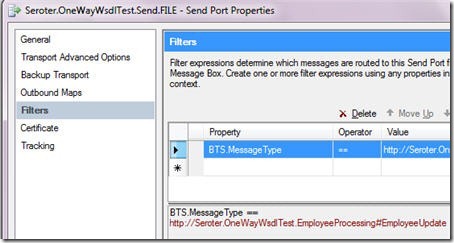
    2010.12.05oneway02

    Next I added a new one-way receive port that will host the service.  It uses the WCF-Custom adapter so that I can host the service in-process instead of forcing me to physically build a service to reside in IIS.
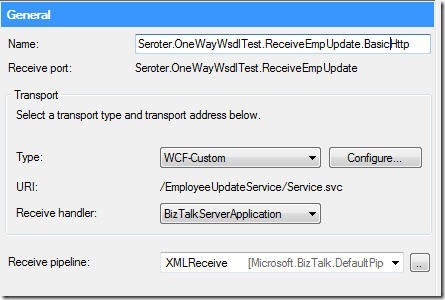
    2010.12.05oneway03

    On the General tab I set the address to the value from the WSDL (http://localhost:8087/EmployeeUpdateService/Service.svc).  On the Binding tab I chose the basicHttpBinding.  Finally, on the Behavior tab, I added a Service Behavior and selected the serviceMetadata behavior from the list.  I set the externalMetadataLocation to the URL of my custom WSDL and flipped the httpGetEnabled value to True.
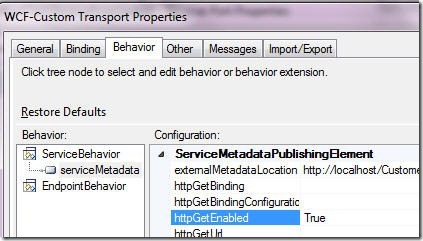
    2010.12.05oneway04

    If everything is configured correctly, the receive location is started, and the BizTalk host is started (and thus, the WCF service host is opened), I can hit the URL of my BizTalk endpoint and see the metadata page.
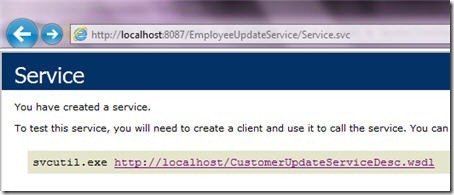
    2010.12.05oneway05

    All that’s left to do is consume this service.  Instead of building a custom application that calls this service, I can leverage the WCF Test Client that ships with the .NET Framework.  After adding a reference to my BizTalk-hosted service, and invoking the service, two things happened.  First, the message is successfully processed by BizTalk and a file is dropped to disk (via my Send Port).  But secondly, and most important, my service call resulted in an error:

    The one-way operation returned a non-null message with Action=”.

    Yowza.  While I could technically catch that error in code and just ignore it (since BizTalk processed everything just fine), that’d be pretty lazy.  We want to know why this happened!  I got this error because a“one way” BizTalk receive location still sends a message back to the caller and my service client wasn’t expecting it.  A WSDL file with a true one-way operation results in a WCF client that expects an IsOneWay=true interaction pattern.  However, BizTalk doesn’t support true one-way interactions.  It supports operations that return no data (e.g. “void”) only.  So, by putting a hand-built WSDL that demanded an asynchronous service on a BizTalk receive location that cannot support it, we end up with a mismatch.

    How do I fix this?  Actually, it’s fairly simple.  I returned to my hand-built WSDL and added a new, empty message declaration.

    <!-- declare messages-->
      <wsdl:message name="Request">
        <wsdl:part name="part" element="tns:EmployeeUpdate" />
      </wsdl:message>
      <wsdl:message name="Response" />
    

    I then made that message the output value of my operation in both my port type and binding.

    <!-- decare port types-->
      <wsdl:portType name="EmployeeUpdate_PortType">
        <wsdl:operation name="PublishEmployeeRequest">
          <wsdl:input message="tns:Request" />
          <wsdl:output message="tns:Response" />
        </wsdl:operation>
      </wsdl:portType>
      <!-- declare binding-->
      <wsdl:binding name="EmployeeUpdate_Binding" type="tns:EmployeeUpdate_PortType">
        <soap:binding transport="http://schemas.xmlsoap.org/soap/http"/>
        <wsdl:operation name="PublishEmployeeRequest">
          <soap:operation soapAction="PublishEmployeeRequest"
          style="document"/>
          <wsdl:input>
            <soap:body use ="literal"/>
          </wsdl:input>
          <wsdl:output>
            <soap:body use ="literal"/>
          </wsdl:output>
        </wsdl:operation>
      </wsdl:binding>
    

    After copying the WSDL back to IIS (so that my service’s metadata was up to date), I refreshed the service in the WCF Test Client.  I called the service again, and this time, got no error while the file was once again successfully written to disk by the send port.
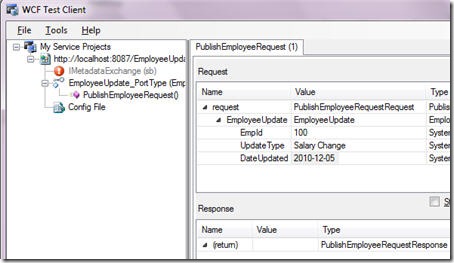
    2010.12.05oneway06

    BizTalk Server, and the .NET Framework in general, have decent, but not great support for WSDL-first development.  Therefore, it’s wise to be aware of any gotchas or quirks when going this route.

  • Interview Series: Four Questions With … Ben Cline

    Hello and welcome to my 26th interview with a thought leader in the “connected technology” domain.  This month we are chatting with Ben Cline.  Ben is a BizTalk architect at Paylocity, Microsoft MVP for BizTalk Server, blogger, and super helpful guy on in the Microsoft forums.

    We’re going to talk to Ben about BizTalk best practices.  Let’s jump in.

    Q: What does your ideal BizTalk development environment look like (e.g. single VM, multiple VMs, desktop, shared database) and what are the trade-offs for one vs. another?

    A: My typical dev environment is a single VM with everything on it, usually not on a domain. The typical deployment environment is always on a domain and distributed across many different servers. There are many trade-offs to this development VM approach, and some of them are difficult to manage effectively. For me, domain differences are usually resolved in the first level of integration testing in a DEV/testing domain-based environment so I usually forgo attempting to make my VM match the domain structure. 

    To offset the trade-offs, I attempt to model the VM on the intended production deployment environment. So examples of this include having the same OS, SQL version, and many other related configuration details. I also try to avoid having any server software on the host OS for performance reasons. I use SQL server synonyms and self-referencing linked servers to simplify the production environment for development usage. The SQL workarounds represent a collapsed accordion in the development environment and an expanded version in production.

    Q: What BizTalk development shortcuts do you occasionally accept?  When are some shortcuts ok in one project but strictly forbidden in others?

    A:I usually implement overloaded .NET methods so that any SSO calls can be alternately pulled from configuration files when in development mode. Also, I always implement overloads in .NET methods that have parameter types of XLANGMessage using XmlDocument so I can unit test the XmlDocument ones effectively. In development I will also occasionally implement stubbed or mocked methods to focus on certain more interesting code sections and come back to the boring plumbing later.

    If I am working on a project where I need to have extremely rapid turnaround I will typically avoid making orchestration message types and just go with schema message types. Some other shortcuts I will use include having single scope orchestrations for global error handling, etc. On some very small scope projects I have coded .NET logic in an in-line method rather than a pipeline component or just used a fixed size buffer like a StringBuilder rather than a custom stream. Most projects where I am more interested in the level of reuse or performance I will (ironically) have more time to implement and I will avoid the shortcuts.

    Q: From your experience over the past year, what are the top 4 most common technologies that your BizTalk solutions have integrated with?  Do you find that WCF services are becoming more mainstream or have you encountered ASP.NET web services in 2010?

    A: The past year for me has been a great mixture of integrations. For the first half of the year I integrated BizTalk with a large e-Commerce website using Commerce Server as well as some call center applications with SalesForce.com. The Commerce Server web service APIs are still using ASMX and the SalesForce.com web service API that I used was not based on WCF but on Java SOAP web services. WCF is becoming more mainstream but there are still many non WCF web services and there will probably always be. I am always surprised when I encounter WSE in applications out too there but even these still exist.

    I recently took a new job at Paylocity, which is a payroll processing and HR company. For the second half of the year I have actually been doing very little web services (with the exception of using the ESB Toolkit WCF services), and have been working more with flat file formats and Payroll applications. With so much more contextual information available with Xml-based formats it seems like flat files would just disappear as companies modernize. But I have found flat files to be very common and I think that like with EDI they will probably be around for a long time to come. So similar to web services, the old implementation technologies always seem to stick around.

    Q [stupid question]: One thing that my colleagues at work dread is being "verbed."  That is, having their name treated as a verb.  For instance, if I have a colleague named Bob who never shuts up, I may start saying that "I was late for this meeting because I got Bob-ed in the hallway."  Or if I have a co-worker named Tim who always builds flashy PowerPoint presentations, I might say that "I haven’t had a chance yet to Tim-up my deck." So, what would "being Cline-ed" mean?

    A: I do not get verbed too often but quite a few people like to “rhyme” me. In my family we sometimes verb ourselves about being inClined (when someone marries in) or deClined (you can guess this one). When I get rhymed people associate me with other last names  that rhyme with Cline. Rhyming is usually always in a good context. With other people it is always about win Ben Cline’s money (a reference to a game show called Win Ben Stein’s money). Back in college some friends spoofed the game show and guess who was the host…

    When my wife and I were picking a name for our son we had brainstorming sessions about the way kids could abuse his name and picked a hard name to abuse – Nicodemus. Perhaps we are sheltering him from name abuse but we think he will be better off anyway. 🙂

    Good insight, Ben.  Any other acceptable development shortcuts, or ideal development environments that people want to share?

  • Metadata Handling in BizTalk Server 2010 AppFabric Connect for Services

    Microsoft just announced the new BizTalk Server 2010 AppFabric Connect for Services which is a set of tools used to expose BizTalk services to the cloud.  Specifically, you can expose BizTalk endpoints and LOB adapter endpoints to the Azure Service Bus.

    The blog post linked to above has a good overview, but seemed to leave out a lot of details.  So, I downloaded, installed and walked through some scenarios and thought I’d share some findings.  Specifically, I want to show how service metadata for BizTalk endpoints is exposed to cloud consumers. This has been a tricky thing up until now since AppFabric endpoints don’t respect the WCF metadataBehavior so you couldn’t just expose BizTalk receive location metadata without some slight of hand.  I’ve shown previously how you could just handcraft a WSDL and use it in the port and with Azure clients, but that’s a suboptimal solution.

    First off, I built a simple schema that I will expose as a web service.

    2010.10.28.cloud01

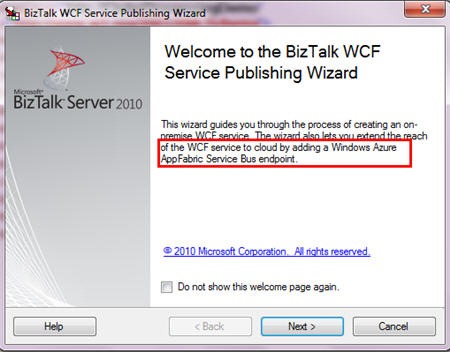
    Next up, I started the BizTalk WCF Service Publishing Wizard and noticed the new wording that came with installing the BizTalk Server 2010 Feature Pack.

    2010.10.28.cloud02

    Interesting.  Next up, I’m asked about creating my on-premises service endpoint and optionally, a receive location and a new on-premise metadata exchange point.

    2010.10.28.cloud03

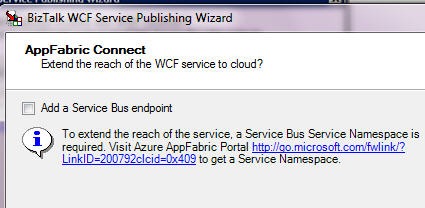
    On the next wizard page, I’m able to optionally choose to extend this service to the Azure AppFabric cloud.

    2010.10.28.cloud04

    After this, I choose whether to expose an orchestration or schemas as a web service.  I chose to expose schemas as a service (i.e., build a service from scratch vs. using orchestration ports and messages to auto-produce a service).

    2010.10.28.cloud05

    As you can see, I have a one-way service to publish order messages.  Following this screen is the same “choose an on-premises location” page where you set the IIS directory for the new service.

    2010.10.28.cloud06

    After this wizard page is a new one where you set up a Service Bus endpoint.  You pick which Service Bus binding that you want and apply your own service namespace.  You can then choose to enable both a discovery behavior and a metadata exchange behavior.

    2010.10.28.cloud07

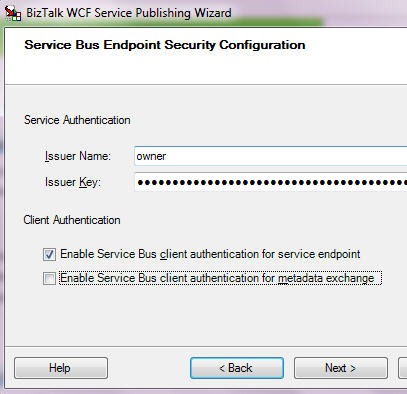
    Finally, we apply our Service Bus credentials for listening to the cloud.  Notice that I force authentication for the service endpoint itself, but not the metadata retrieval.

    2010.10.28.cloud08

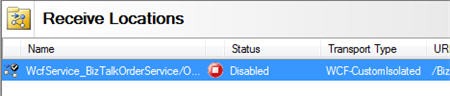
    After the wizard is done, what I expected to see was a set of receive locations.  However, the only receive location that I have is the one using the on-premises WCF binding.

    2010.10.28.cloud09

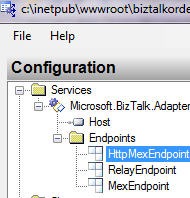
    What the what?  I expected to see a receive location that used the Service Bus binding.  So what happened to all those configuration values I just set?  If you open up the WCF service created in IIS, you can see a whole host of Service Bus configuration settings.   First, we see that there are now three service endpoints.  The three service endpoints below include an on-premises MEX endpoint, a RelayEndpoint that binds to the cloud, and a MEX endpoint that binds to the cloud.

    2010.10.28.cloud10

    That’s a pretty smart way to go.  Instead of trying to hack up the receive location, Microsoft instead beefed up the proxy services to do all the cloud binding.

    I can use IIS 7.5 autostart to make sure that my cloud binding occurs as soon as the service starts (vs. waiting for the first invocation).  Once my receive location and service are started, I can hit my local service, and, see my service is also in my cloud registry.

    2010.10.28.cloud11

    If I drill into my service, I can also see my primary service and my MEX endpoint.

    2010.10.28.cloud12 

    When I click the primary service name in the Azure AppFabric registry, I get an HTTP 401 (unauthorized) error which makes sense since we have a client authentication requirement on this service. 

    If I click the MEX endpoint, I get a weird error.  I seem to recall that you can’t retrieve a MEX WSDL over HTTP.  Or maybe I’m crazy.  But, to test that my MEX endpoint really works, I plugged the MEX URL into an Add Service Reference window in Visual Studio.NET, and sure enough, it pulls back the metadata for my BizTalk-exposed service.

    2010.10.28.cloud14

    All that said, this looks really promising.  Seems like a smart decision to stay away from the receive location and move cloud configuration to the WCF service where it belongs.

  • Behavior of BizTalk WCF Publishing Wizard When Creating Multiple Operations or Services at Once

    So what happens when you create a few operations or services during a single instance of the BizTalk WCF Service Publishing wizard?  What types of web service projects and BizTalk messaging configurations get produced?  I was messing around with this the other day, and thought I’d quickly show the output.  Maybe this is common knowledge, but I hadn’t tried all these scenarios before.

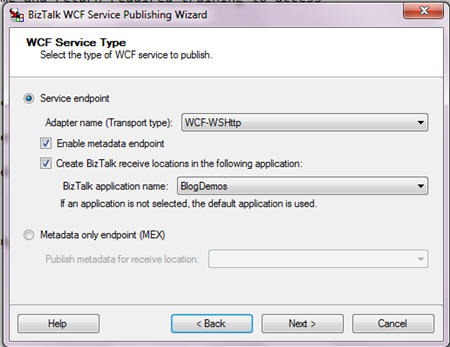
    Let’s assume you have a schema to use for the wizard, and a BizTalk application to hold the generated ports.  In this first scenario, I’m creating two operations for the single service.  I started out the wizard by saying that I wanted my receive locations (notice that “locations” is plural here) in a particular BizTalk application.

    2010.10.22.wizard01

    I then decided to build a service from existing schemas instead of an orchestration.  I’ve created two one-way service operations on the root service.

    2010.10.22.wizard02

    I accept the rest of the wizard’s default values and complete this wizard instance.   The first thing that I end up with is a web service application in IIS that contains a single service file.

    2010.10.22.wizard03

    When I browse that service, I can clearly see in its metadata that there are two operations available for consumption.

    2010.10.22.wizard05

    On the BizTalk side, the application has a single new receive port and a single receive location that points to my web service.

    2010.10.22.wizard04

    In my next run through the wizard, I’ve once again selected to have a metadata endpoint enabled and to put my receive locations in a particular BizTalk application.  I’ve also chosen to build my services from schemas.  In this case, I’ve created two services, each with a single one-way operation underneath.

    2010.10.22.wizard06

    With all the other default values selected (but using a different output service location), I completed the wizard.  As you’d probably expect, my generated web service application now has two services within it.

    2010.10.22.wizard07

    The generated BizTalk output surprised me slightly.  What I ended up with where a distinct receive port and receive location for each service.  I was expecting to have a single receive port with two locations.  I could see why they’d have to be different if the exchange pattern (two-way vs. one-way) was different for the services, but both of my services are one-way, and could theoretically live fine in the same receive port.

    2010.10.22.wizard08

    I can only guess that the reason for doing this is because folks could use the single wizard instance to build completely unrelated services while trying to save the time of opening a new wizard for each new service.

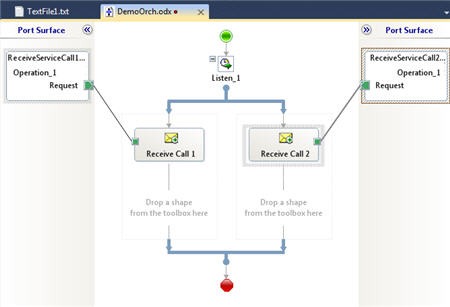
    To be thorough, let’s compare this against a multi-operation orchestration-generated service.  I’ve built an orchestration that has two (public) receive ports.

    2010.10.22.wizard09

    After deploying this and starting the BizTalk WCF Service Publishing Wizard again, I chose to build a service from an orchestration.  Here I get a different interface and both of my public ports are shown.  I’ve NOT selected the “merge ports into a single service” option for this pass through the wizard.

    2010.10.22.wizard10

    With the wizard complete, I confirmed that I have a web service application with two services, and a BizTalk application containing two receive ports, each with a single receive location.

    In my last pass through the wizard, I’ve again chosen to build a service from an orchestration and chose to merge my selected ports.    I have to change my orchestration itself before I proceed since my orchestration used the default Operation_1 operation name for each port and I get an error from the wizard saying that I cannot merge the operation because of the name collision.  After dealing with that unpleasantness, I completed the wizard instance with my ports merged.

    What did I get?  I have a single service in my IIS web application.  and a single receive port with a single receive location in my BizTalk application.

    The wizard works consistently whether you are building services from schemas or orchestrations.   It’d be great if you had a choice to merge ports from a BizTalk messaging sense in addition to the orchestration sense, but such is life.

    Do any of you use the wizard to build up a whole set of services at once, or do you typically fly through it for each individual service?

  • Interview Series: Four Questions With … Johan Hedberg

    Hi there and welcome to the 24th interview with someone who doesn’t have the good sense to ignore my email.  This month we are chatting with Johan Hedberg who is an architect, Microsoft MVP, blogger, and passable ship captain.  Let’s jump in.

    Q: In the near future you are switching companies and tasked with building up a BizTalk practice.  What are the most important initial activities for establishing such expertise from scratch?  How do you prioritize the tasks?

    A: There is a couple that comes to mind. Some of them are catch-22. What comes first, the task or the consultant to perform the task? Generating business and balancing that with attracting and educating resources is core. Equally important will be to help adjust the baseline the company has today for the BizTalk platform – how we go about marketing, architecting and building our solutions and converting that from theory to BizTalk practice. The company I’m switching to (Enfo Zystems) already has a reputation of being expert integrators, but they are new to the Microsoft platform. So gaining visibility and credibility in that area is also high on the agenda. If I need to pick a first task I’d say that the internal goals are my top priority. Likely that will happen during a time where I will also have one or more customers (getting work is seldom the problem), which is why it must be prioritized to happen at all. As a consultant – customer assignments have a tendency to take over from internal tasks if you don’t stand fast.

    Q: I recently participated in the European BizTalk Summit that you hosted and I am always impressed by the deep BizTalk expertise and awareness in your area of the world.  Why do you think that BizTalk has such a strong presence in Sweden and the surrounding countries? Does it have to do with the types of companies there,  Microsoft marketing/sales people who articulate the value proposition well, or something else?

    A: I believe that we (Swedes) in general are a technology friendly and interested bunch and generally adopt new technology trends quite rapidly. Back in the day we were early with adopting things like mass availability of broadband connections and the web. At that time much of it was consumer targeted. I don’t think we adopted integration platforms in a broad sense very early. And those that did didn’t have BizTalk as an obvious first choice. Even though I wasn’t really in the business of integration five years ago I can’t remember it being a hot topic. That has picked up a lot lately. Sweden has also gotten out of the economic downturn reasonably good and finances still hold the possibility of investment within IT – especially for things that in themselves might add to cost savings. And there is a huge potential for that in companies all around Sweden where many still have the “spaghetti integration” scenario as their reality. Also, in the last couple of years, there has been an increased movement from other (more expensive) platforms to BizTalk as a first choice and even a replacer of existing technology. The technology interest is very much still there, and now to a much larger extent includes integration. And now the business is on it as well; a recent study among Swedish CIOs shows that integration today is considered a key enabler for both business and IT.

    Q: In a pair of your recent blog posts, you mention the “it depends” aspect of BizTalk infrastructure sizing, as well as learning and leveraging the Azure cloud.  What are things in BizTalk (e.g. design, development, management) that you consider absolute “must do” and “it depends” doesn’t apply?

    A: The last couple of years at Logica we’ve been delivering integration as a service and the experience from that is that there are two points of interaction that’s crucial to get right if you want to minimize trouble during development and subsequent release and support. They are both about communication, and to some smaller part about documentation. It starts with requirements. To ask the right questions, interpret the answers, document and agree upon what needs to be done. To have a contract. You still need to be aware of and flexible enough to handle change, but it needs to be clear that it is a change. It makes the customer/supplier relationship easier and more structured. The next checkpoint is that from integration development to the operations group that will subsequently support the solution in production. It’s equally important to give them what they need so that they can do a good job. In the end it’s the full lifecycle of the solution that decides whether the implementation was successful and not just the two days where actual development took place. I guess the message is that the processes around the development work is just as important, if not more so.

    With development it’s easier to state do not’s than must do’s. Don’t do orchestrations if you don’t need them. Don’t tick all tracking checkboxes just because you might need them someday. Don’t do XmlDocument or intensive stream seek operations. Don’t say ok to handling 500mb xml messages in BizTalk without putting up a fight. If BizTalk serves as an integration platform – don’t implement business logic in BizTalk that belongs to the adjoining systems; don’t create an operations and management nightmare. Don’t reinvent solutions that already have samples available. Don’t be too smart, be simple. And it can go on and on… But it is what it is (right? 😉 )

    Q [stupid question]: Google (or Bing) auto-complete gives an interesting (and frightening) look into the popular questions being asked of our search engines.  It’s amusing to ask the beginning of questions and see what comes back.  Give us a few fun auto-complete searches that worry or amuse you.

    2010.10.04interview01

    2010.10.04interview02

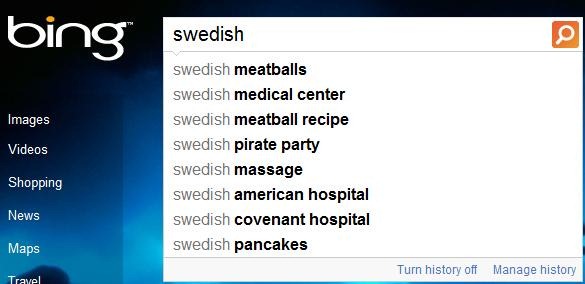
    A: Since you mention Sweden as being a place you recognize as having a strong technical community let’s see what people in general want to know about what it’s like to be Swedish …

    2010.10.04interview03

    Food, medical aid, pirates and massage seems to be on top.

    Also, since we both have sons, let’s see what we can find out about sons…

    2010.10.04interview04

    A fanatic bullying executioner who hates me. Not good.

    But let’s move the focus back to me…

    2010.10.04interview05

    That pretty much sums it up I guess. No need to go any further.

    Thanks Johan, and good luck with the new job.

  • Book’s Sample Chapter, Articles and Press Release

    The book is now widely available and our publisher is starting up the promotion machine.  At the bottom of this post is the publisher’s press release.  Also, we now have one sample chapter online (Mike Sexton’s Debatching Bulk Data) as well as two articles representing some of the material from my Content Based Routing chapter (Part 1 – Content Based Routing on the Microsoft Platform, Part II – Building the Content Based Routing Solution on the Microsoft Platform).  This hopefully provides a good sneak peak into the book’s style.

    ## PRESS RELEASE ##

    Solve business problems on the Microsoft application platform using Packt’s new book

     Applied Architecture Patterns on the Microsoft Platform is a new book from Packt that offers an architectural methodology for choosing Microsoft application platform technologies. Written by a team of specialists in the Microsoft space, this book examines new technologies such as Windows Server AppFabric, StreamInsight, and Windows Azure Platform, and their application in real-world solutions.

     Filled with live examples on how to use the latest Microsoft technologies, this book guides developers through thirteen architectural patterns utilizing code samples for a wide variety of technologies including Windows Server AppFabric, Windows Azure Platform AppFabric, SQL Server (including Integration Services, Service Broker, and StreamInsight), BizTalk Server, Windows Communication Foundation (WCF), and Windows Workflow Foundation (WF).

     This book is broken down into 4 different sections. Part 1 starts with getting readers up to speed with various Microsoft technologies. Part 2 concentrates on messaging patterns and the inclusion of use cases highlighting content-based routing. Part 3 digs into bulk data processing, and multi-master synchronization. Finally the last part covers performance-related patterns including low latency, failover to the cloud, and reference data caching.

     Developers can learn about the core components of BizTalk Server 2010, with an emphasis on BizTalk Server versus Windows Workflow and BizTalk Server versus SQL Server. They will not only be in a position to develop their first Windows Azure Platform AppFabric, and SQL Azure applications but will also learn to master data management and data governance of SQL Server Integration Services, Microsoft Sync Framework, and SQL Server Service Broker.

     Architects, developers, and managers wanting to get up to speed on selecting the most appropriate platform for a particular problem will find this book to be a useful and beneficial read. This book is out now and is available from Packt. For more information, please visit the site.

    [Cross posted on Book’s dedicated website]

  • And … The New Book is Released

    Nearly 16 months after a book idea was born, the journey is now complete.  Today, you can find our book, Applied Architecture Patterns on the Microsoft Platform, in stock at Amazon.com and for purchase and download at the Packt Publishing site.

    I am currently in Stockholm along with co-authors Stephen Thomas and Ewan Fairweather delivering a 2 day workshop for the BizTalk User Group Sweden.  We’re providing overviews of the core Microsoft application platform technologies and then excerpting the book to show how we analyzed a particular use case, chose a technology and then implemented it.  It’s our first chance to see if this book was a crazy idea, or actually useful.  So far, the reaction has been positive.  Of course, the Swedes are such a nice bunch that they may just be humoring me.

    I have absolutely no idea how this book will be received by you all.  I hope you find it to be a unique tool for evaluating architecture and building solutions on Microsoft technology.  If you DON’T like it, then I’ll blame this book idea on Ewan.