Author: Richard Seroter

  • My Book "SOA Patterns with BizTalk Server 2009" is Up for Pre-order

    Well look at that.  I just happen to check my publisher’s website today and noticed that they put my book description online and made it available for pre-order.

    The book, entitled SOA Patterns with BizTalk Server 2009, is due out by May 2009 (hopefully sooner).  I’m still in the process of editing the book and responding to technical review comments, but we’re nearing completion of that phase.  I have three fantastic technical reviewers (Charles Young, Zach Bonham, Ewan Fairweather) who have added a ton of great comments that I’m almost done wading through and addressing.

    This publisher (Packt Publishing) specializes in short, targeted technical books that address specific topics.   I tried to be “short” but still went over my suggested page count by nearly double.  Oh well, hopefully that’s better for the readers. 

    The high level chapter summaries are …

    • Chapter 1 – Building BizTalk Server 2009 Solutions – A brief walkthrough of creating a new BizTalk project from scratch
    • Chapter 2 – Windows Communication Foundation Primer – An overview of WCF with examples of developing, hosting, and consuming WCF services
    • Chapter 3 – Using WCF Services in BizTalk Server 2009 – An explanation of the marriage between BizTalk and WCF and how to both expose and consume WCF services within BizTalk Server
    • Chapter 4 – Planning Service Oriented BizTalk Solutions – A discussion of the core aspects of SOA, the types of services one can construct, available message exchange patterns, and how service-oriented principles apply to BizTalk solutions
    • Chapter 5 – Schema and Endpoint Patterns – How to build effective schemas and endpoints depending on the type of service constructed
    • Chapter 6 – Asynchronous Communication Patterns – A look at options for asynchronous communication and how to exploit this pattern in BizTalk solutions
    • Chapter 7 – Orchestration Patterns – We analyze the role of orchestration in service solutions and see how to build loosely coupled workflow processes
    • Chapter 8 – Versioning Patterns – We see here how to effectively version our SOA solutions and cleanly introduce updates to our BizTalk components
    • Chapter 9 – New SOA Capabilities in BizTalk Server 2009 – A first look at the latest additions to the BizTalk product. This includes the new UDDI v3 registry, WCF SQL Server Adapter, and ESB Guidance 2.0

    So there you go.  Once the book actually hits the shelves, I’ll make another mention of it on the blog.

    Technorati Tags: , ,

  • Presentations from 2009 Microsoft SOA/BPM Conference Available Online

    Hadn’t noticed this before, but found the complete collection of videos and presentations from this year’s SOA & BPM Conference.  I didn’t make it up to Redmond for this, so it’ll be nice to peruse the content which covers topics such as:

    • Customer case studies
    • Designing services for “Dublin”
    • Using BAM for Service and SLA monitoring
    • Supporting WS*, REST and POX simultaneously with WCF
    • SOA patterns from the field
    • Lap around “Oslo”

    Check it out.

    Technorati Tags: , ,

  • New "WCF Adapter FAQ" Whitepaper From Microsoft

    The folks over at the BizTalk Adapter Development blog pointed out their new paper which answers a number of questions about the WCF adapters for BizTalk Server 2006 R2.

    This collection of FAQs address topics such as:

    • Deciding which WCF adapter to use
    • When to use the two custom adapters
    • How do messages flow in from WCF adapters and flow back out
    • How to preserve the entire inbound message arriving via a WCF adapter
    • Accessing WCF message properties within a BizTalk solution
    • Decision criteria when choosing the WCF LOB Adapter SDK vs. the old BizTalk Adapter Framework
    • How BizTalk uses the WCF adapters
    • The difference between WCF behaviors and BizTalk pipelines

    There are plenty more besides these.  If you are doing WCF development alongside your BizTalk solution and need to integrate the two, you really should check this out.  The document is well written and nicely explains the concepts.

    Technorati Tags: ,

  • What I Learned at the 2009 Microsoft MVP Summit

    Just returned from the Summit, and had a really great time meeting colleagues and seeing interesting content.  Without breaking any NDAs, I thought I’d share some thoughts on what I saw this past week.

    • The CSD/BizTalk MVP group remains a smart bunch of guys with a diverse set of backgrounds.  I shared a hotel room with Yossi Dahan, and was thrilled to spend time with the likes of Mick Badran, Michael Stephenson, Saravana Kumar, Stephen Thomas, Leonid Ganeline, Ben Cline, Jon Fancey, Kevin Smith, Alan Smith, Mikael Håkansson, Jon Flanders, Matt Meleski, Tim Rayburn, Kent Weare, Bill Chestnut and many others.  The practical experiences these guys have with customers should be milked dry by the product teams.
    • I finally spent some time on Azure (thanks to Steve Marx’s session) from a development platform perspective (i.e. not .NET Services) and I am quite impressed by the developer experience.  This seems to be something Microsoft will really bang on when trying to differentiate its offering from those of others in the “cloud computing” space.
    • The Summit was also the first time I’ve REALLY looked at “M” since last year’s Summit, and I think it has potential to be useful.  I made this observation in a previous blog post, and plan to actively mess around with “M” for both data solutions and to emit actionable content.  The interesting thing is, the lengthiest work doesn’t seem to be writing the textual DSL as much as constructing the parser to do something with the output.  That is, in the examples referenced in the link above, “M” models are used to create orchestrations and BizTalk build processes, respectively.  Once the “M” part is done, both Yossi and Dana had to write the parser which took the MGraph and cycled through the objects to generate the final output (i.e., ODX file and executable deployment script).  Not a bad thing, just something that’s seemingly glossed over.
    • We had a “BizTalk Next” brainstorming session, and I was happy to see some big ticket items on the minds of the BizTalk architecture team.  After sitting on the same runtime engine for 5 years, and mostly surface-level changes during the past 2 releases, it seems like “put up or shut up” time for these guys.  And they seem to be working hard to be in the former category.
    • Ewan Fairweather led a strong session on BizTalk performance with a special focus on the impact of virtualizing BizTalk solutions in Hyper-V.  Ewan authored the BizTalk Server R2 Hyper-V Guide and BizTalk Server Performance Guide.  The results of Ewan’s recent exploits with his giant server farm will be making their way into public documentation shortly.  A few takeaways (which I was assured aren’t NDA!): (a) performance of “inline sends” vs. “logical ports” within orchestrations is nearly 4x faster with regards to throughput, (b) the performance impact of virtualization on BizTalk solutions is fairly negligible and (c) making a few well-known platform tweaks can nearly double performance.  Look for more approachable guidance in the near future (vs. massive, detailed whitepapers) as the team realizes that with such a developer-centric product as BizTalk, you need to remember that you aren’t always talking to your standard system administrators.

    As for non-content related observations …

    • Tim Rayburn can sing a mean Black Hole Sun, as experienced during one of the social parties of the week.
    • Those two white guys who sang California Love?  Not so much.
    • Mick Badran is a wild man, and a helluva great guy.  However, I worry that any “guys night out” with him always ends with something like “… and that’s how we ended up in a Chinese prison with two 85 year old women and $450 in nickels.”
    • People need to stop with the corny gifts to Ballmer and the general Q&A shenanigans.  You’re embarrassing yourself folks.
    • Conference attendees will take pictures of ANYTHING.  Seriously, random speakers, crowds, buses (inside and out), signs, buildings, hotel lobbies, plant life.  And what’s with the incessant picture taking of NDA slides?  SLIDES, people.  Write down the content if it’s that freakin’ important.  I’m convinced that these people are either (a) IBM spies or (b) crafting the most sleep-inducing scrapbook since my 3rd grade trip to the Liberty Bell.

    Great time overall, looking forward to doing it again.

    Technorati Tags: ,

  • Interview Series: Four Questions With … Jesus Rodriguez

    I took a hiatus last month with the interview, but we’re back now.  We are continuing my series of interviews with CSD thought leaders and this month we are having a little chat with Jesus Rodriguez.  Jesus is a Microsoft MVP, blogger, Oracle ACE, chief architect at Tellago, and a prolific speaker.  If you follow Jesus’ blog, then you know that he always seems to be ahead of the curve with technology and can be counted on for thoughtful insight. 

    Let’s see how he handles the wackiness of Seroter’s Four Questions.

    Q: You recently published a remarkably extensive paper on BAM.  Did you learn anything new during the creation of this paper, and what do you think about the future of BAM from Microsoft?

    A:  Writing an extensive paper is always a different experience. I am sure you are familiar with that feeling given that these days you are really busy authoring a book. A particular characteristic of our BAM whitepaper is the diversity of the target audience. For instance, while there are sections that are targeting the typical BizTalk audience, others are more intended to a developer that is really deep with WCF-WF and yet others sections are completely centered on Business Intelligence topics. I think I learned a lot in terms of how to structure content that targets a largely diverse audience without confusing everybody. I am not sure we accomplish that goal but we certainly tried 😉

    I think BAM is one of the most appealing technologies of the BizTalk Server family. In my opinion, in the next releases, we should expect BAM to evolve beyond being a BizTalk-centric technology to become a mainstream infrastructure for tracking and representing near real time business information. Certainly the WCF-WF BAM interceptors in BizTalk R2 were a step on that direction but there are a lot of other things that need to be done. Specifically, BAM should gravitate towards a more integrated model with the different Microsoft’s Business Intelligence technologies such as the upcoming Gemini. Also, having interoperable and consistent APIs is a key requirement to extend the use of BAM to non Microsoft technologies. That’s why the last chapter of our paper proposes a BAM RESTful API that I believe could be one of the channels for enhancing the interoperability of BAM solutions.

    Q: You spoke at SOA World late last year and talked about WS* and REST in the enterprise.    What sorts of enterprise applications/scenarios are strong candidates for REST services as opposed to WS*/SOAP services and why?

    A: Theoretically, everything that can be modeled as a resource-oriented operation is a great candidate for a RESTful model. In that category we can include scenarios like exposing data from databases or line of business systems. Now, practically speaking, I would use a RESTful model over a SOAP/WS-* alternative for almost every SOA scenario in particular those that require high levels of scalability, performance and interoperability. WS-* still has a strong play for implementing capabilities such as security, specifically for trust and federation scenarios, but even there I think we are going to see RESTful alternatives that leverages standards like OpenID, OAuth and SAML in the upcoming months. Other WS-* protocols such as WS-Discovery are still very relevant for smart device interfaces.

    In the upcoming years, we should expect to see a stronger adoption of REST especially after the release the JSR 311 (http://jcp.org/en/jsr/detail?id=311 ) which is going to be fully embraced by some of the top J2EE vendors such as Sun, IBM and Oracle.

    Q: What is an example of a “connected system” technology (e.g. BizTalk/WCF/WF) where a provided GUI or configuration abstraction shields developers from learning a technology concept that might actually prove beneficial?

    A:  There are good examples of configuration abstractions in these three technologies (BizTalk, WCF and WF). Given the diversity of its feature set, WCF hides a lot of things behind its configuration that could be very useful on some situations. For instance, each time we configure a specific binding on a service endpoint we are indicating the WCF runtime the configuration of ten or twelve components such as encoders, filters, formatters or inspectors that are required in order to process a message. Knowing those components and how to customize them allows developers to optimize the behavior of the WCF runtime to specific scenarios.

    Q [stupid question]: Many of us have just traveled to Seattle for the Microsoft MVP conference.  This year they highly encouraged us to grab a roommate instead of residing in separate rooms.  I’ve been told that one way to avoid conference roommates is to announce during registration some undesirable characteristic that makes you an lousy roommate choice.  For instance, I could say that I have a split personality and that my alter ego is a nocturnal, sexually-confused 15th century sea pirate with a shocking disregard for the personal space of others.  Bam, single room.  Give us a (hopefully fictitious) characteristic that could guarantee you a room all to yourself.

    A:  My imaginary friend is a great Opera singer 🙂 We normally practice signing duets after midnight and sometimes we spend all night rehearsing one or two songs. We are really looking have our MVP roommate as our audience and, who knows, maybe we can even try a three-voice song.

    Seriously now, given work reasons I had to cancel my attendance to the MVP summit but I am sure you guys (BizTalk MVP gang) had a great time and drove your respective roommates crazy 😉

    As always, I had fun with this one.  Hopefully Jesus can say the same.

    Technorati Tags: , ,

  • Good Example of Oslo "M" Modeling for BizTalk-related Use Cases

    While at the Microsoft MVP Conference this week, I’ve added “modeling in ‘M’” to my “to do” list.  While I’ve kept only a peripheral view on “M” to date, the sessions here on “M” modeling have really gotten my mind working.  There seem to be plenty of opportunities to build both practical data sets and actionable content through textual DSLs. 

    One great example of applying “M” to existing products/technologies is this great post by Dana Kaufman entitled A BizTalk DSL using “Oslo” which shows how one could write a simple textual language that gets converted to an ODX file.  It’ll be fun watching folks figure out cool ways to take existing data and tasks and make them easier to understand by abstracting them into a easily maintained textual representation.

    Update: Yossi Dahan has also posted details about his current side project of creating an “M” representation of a BizTalk deployment process.  He’s done a good job on this, and may have come up with a very clean way of packaging up BizTalk solutions. Keep it coming.

    Technorati Tags: ,

  • Not Using "http://namespace#root" as BizTalk Message Type

    This has come up twice for me in the past week: once while reading the tech review comments on my own book (due out in April), and again while I was tech reviewing another BizTalk book (due out in July).  That is, we presumptively say that the BizTalk “message type” always equals http://namespace#root when that’s not necessarily true.  Let’s look at two cases demonstrated here.

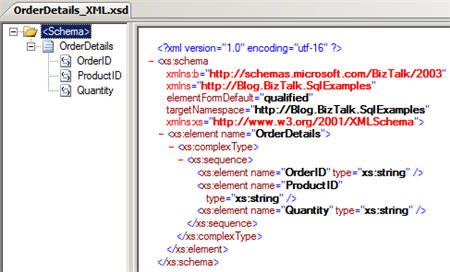
    This first simple case looks at a situation where an XML schema actually has no namespace.  Consider this schema:

    Perfectly fine schema, no target namespace.  I’ve gone ahead and created another schema (with namespace) and mapped the no-namespace schema to the namespace schema.  After I deploy this solution and create the necessary ports to both pick up and drop off the message, I can stop the send port and observe the context properties of the inbound message.


    Notice that my message type is set to ReturnRequest which is the name of the root node of my schema.  Obviously, no namespace is required here.  If I throw my map on the send port, I can also see that the source schema is successfully found and used when mapping to my destination format.

    So, for case #1, you can have schemas with no namespace, and the message type for that message traveling through BizTalk is in no worse shape.

    For case #2, I wanted to try creating my own message type arbitrarily and keep it as something BizTalk doesn’t generate.  For instance, let’s say I receive binary files (e.g. PDFs) but want to add not only promoted fields about the PDF, but also type the message itself.  The PDF file has a specific name which reflects the type of data it contains (e.g. ProductRefund_982100.pdf and ProductReturn_20032.pdf).  The file location where these PDFs are dropped have names based on the country of origin, like so:

    So I can set a “type” for the message based on the file name prefix, and I can set a promoted “country” value based on the location I picked it up from.  After adding a new property schema to my existing BizTalk solution, I next built a custom pipeline component which could work this magic for me.  The guts of the pipeline component, the Execute operation, is shown here:

    public IBaseMessage Execute(
         IPipelineContext pContext, 
         IBaseMessage pInMsg)
    {
     //get context pointer
     IBaseMessageContext context = pInMsg.Context;
    
     //read file name and path 
     string filePath = context.Read("ReceivedFileName", 
     "http://schemas.microsoft.com/BizTalk/2003/file-properties").ToString();
                
     //parse file name to determine message type
     string fileName = Path.GetFileNameWithoutExtension(filePath);
     string[] namePieces = fileName.Split('_');
     string messageType = namePieces[0];
                
     //get last folder which indicates country this pertains to
     string[] directories = filePath.Split(Path.DirectorySeparatorChar);
     string country = directories[directories.Length - 2];
    
     //set message type
     pInMsg.Context.Promote("MessageType", 
      "http://schemas.microsoft.com/BizTalk/2003/system-properties", 
       messageType);	
    
     //set promoted data value
     pInMsg.Context.Promote("Country", 
       "http://Blog.BizTalk.MessageTypeEvaluation.ProductReturn_PropSchema", 
       country);
    
     return pInMsg;
    }
    

    After compiling this and adding to the “Pipeline Components” directory in the BizTalk install folder, I added a new receive pipeline to my existing BizTalk solution and added my BinaryPromoter component.

    After deploying, I added a single receive port with two receive locations that each point to a different “country” pickup folder.  Each receive location uses my new custom receive pipeline.

    I have two send ports, each subscribing to a different “message type” value.  My second send port, shown here, also subscribes on my custom “country” promoted value.

    When I drop a PDF “product refund” file into the “USA” folder, I can observe that my message (of PDF type) has a message type and promoted data value.

    Neat.  So while it’s important to have BizTalk-defined message types when doing many operations, be aware that you can (a) still have message types without namespaces, and (b) define completely custom message types for use in message routing.

    Technorati Tags:

  • First Stab at Using New Tool to Migrate SQL Server Adapter Solutions

    If you saw the recent announcement about the Adapter Pack 2.0 release, you may have seen the short reference to a tool that migrates “classic” SQL Adapter solutions to the new WCF SQL Adapter.  This tool claims to:

    • Works on the source project files
    • Generates equivalent schema definitions for the operations used in the existing project
    • Generates new maps to convert messages from older formats to the new format
    • Modifies any existing maps to work with the new schemas
    • A new project is created upon completion, which uses the SQL adapters from the BizTalk Adapter Pack v2

    Given how much “migration pain” can be a big reason that old projects never get upgraded, I thought I’d run a quick test and see what happens.

    The SQL Server part of my solution consists of a pair of tables and pair of stored procedures.  In my solution, I poll for new customer complaint records, and receive that data into an orchestration where I take the ID of the customer and query a different database for the full record of that customer.

    In my BizTalk Server 2006 R2 environment, I walked through the “Add Generated Items” wizard in Visual Studio.NET and pointed at the classic SQL Adapter in order to generate the schemas necessary to receive and query data.  As you would expect, the message arriving from the SQL Adapter polling port has a single node representing the customer complaint.

    The schema generated by the wizard for the patient record query has nodes for both the stored procedure request and result.

    My orchestration is very straightforward as it receives the polled message, constructs the patient query using a map, executes its query, and broadcasts the result.

    Great.  After deploying this solution, I still need the messaging ports required to absorb and transmit the necessary data.  My classic SQL Adapter receive location has the necessary settings to poll my database.

    After adding two send ports (one using the classic SQL adapter to send my patient query, and another to drop my result to a FILE location), I started everything up and it worked perfectly.  Now the fun part, migrating this bad boy.

    Because this SQL adapter migration tool claims to work on the “project files” and not configuration bindings, I figured that I could package up the working Visual Studio.NET project and perform the migration in my BizTalk Server 2009 environment (which also had the Adapter Pack 2.0 beta installed).

    When you install the Adapter Pack 2.0 beta, you get the SQL Migration tool.   My SQL Server instance uses integrated authentication, so while I had to specify a “username” and “password” in the command line entry, I left them blank.

    MigrationTool Sqlsource=”Blog.BizTalk.SqlMigrationDemo.btproj”

    -dest=”C:\SQL_Mig\Blog.BizTalk.SqlMigrationDemoConverted” –uri=mssql://<server>//DemoDb? –username= –password=

    Once this query completes, you get a notice and a brand new project.

    The new project also contains a conversion report showing what was added and changed in the solution.  I can see two new files added, and two files that the migration tool says it can reuse with the new adapter.

    If I open the actual project that the migration tool built, I can see new folders and a couple new files.  The SqlBindingProcedure.dbo.xsd schema is also new.

    Notice that I have a new (WCF SQL Adapter) binding file for my “send” transmission that looks up patient details.  A note: the BizTalk project system in 2006 R2 is different than the new one in BizTalk 2009.  So, because I transferred my R2 project to my 2009 environment and THEN ran the wizard, my new project is still in the R2 format.  I had to manually create a new 2009 project and include all the files generated by the wizard instead of just opening up the generated btproj file.

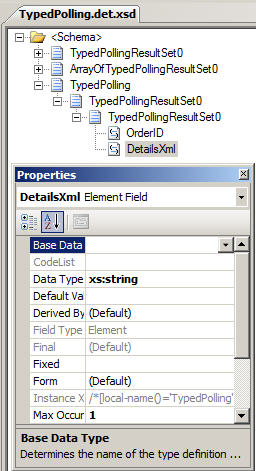
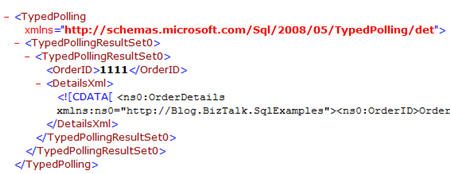
    The verdict?  Well, pretty mixed.  The schema it generated to replace my “query” schema is a mess.  I get an untyped result set now.

    And the map that the migration tool created simply took my original “patient query” format and mapped it to their new one.  I guess I’m supposed to apply that at the send port and keep my existing “complaint to patient” map that’s in my orchestration?

    Also, because the migration tool doesn’t appear to look at the runtime application configuration, I still have to manually create the receive location, which also seems like I have to manually recreate my inbound schema that can comply with the new WCF SQL Adapter format.  I haven’t done all that yet because I’m not that motivated to do so.

    So, there could be a few reasons for my non-seamless experience.  First, I used stored procedures on all sides, so maybe that part isn’t fully baked yet.  I also switched environments and took a working BizTalk 2006 R2 solution and ran the conversion tool on a BizTalk 2009 box.  Finally, there’s a good chance this falls under the “Seroter Corollary” which states that when all else fails, let’s assume I’m an idiot.

    Anyone else run this migration tool yet on an existing project?  Any obvious things I may have missed that made my migration more work that rebuilding the project from scratch?

    Technorati Tags: ,

  • Service Security Guide on MSDN

    The Improving Web Services Security: Scenarios and Implementation Guidance for WCF project on CodePlex now has its results in an online browsable from within the MSDN site.    I linked to this project last year, but it’s great that everything has been made available on MSDN as well.

    Even if you aren’t using WCF, this set of deliverables has some very insightful components.  For example, the Security Fundamentals for Web Services chapter barely even mentions WCF but rather focuses on defining services, overarching security principles, as well as a set of security patterns that address topics such as authentication, data confidentiality and message validation.

    Chapter 2, Threats and Countermeasures for Web Services, is also technology-neutral and identifies a set of security threats, vulnerabilities, and countermeasures.

    Of course it is a WCF guide, so expect to find a wealth of information about WCF security options and trade-offs as well as 20+ “how to” walkthroughs that range from hosting services, to impersonation to using certificate-based authentication.

    Finally, if you’re not a “read tons of pages about security” kind of fella, then at least peruse the WCF Security Checklist (which can provide a good development checkpoint prior to service release), the summary of WCF Security Practices at a Glance (which provides a clean list of categories and related articles) and the very important Q&A section that contains dozens of realistic questions with straightforward answers.

    Great job on this.  Thanks J.D. and team.

    Technorati Tags: ,

  • Tips for Successful Software Vendor Evaluations

    In the past six months, I’ve had the pleasure (penalty?) of participating in software vendor evaluations for two distinct projects.  In each case, we looked at three vendors over the course of consecutive days and evaluated them against a series of business scenarios to see which software package was a best fit for our environment.   I learned a lot between those two sessions, and thought I’d share my best tips for participating in such sessions.

    • DO know the business cases ahead of time.  In my earlier vendor evaluation I didn’t know the core business or their use cases particularly well so it was difficult to engage in every business discussion.  Prior to this most recent session, I have spent months sitting in a war room with the business stakeholders refining requirements and hashing out goals for the project.  By deeply knowing what the software had to accomplish, I was able to actively participate in the discussion AND, ask technical questions that had significant relevant context behind them.
    • DO NOT wait to ask common technology questions until the day of the demonstration.  You should make sure to get base technical questions answered before the evaluation session.  We have a strong software vendor evaluation toolkit that we send to the vendors as part of an RFP.  This gets basic questions like “what is your platform built on”, “explain your DR strategy” and “describe your information integration patterns” out of the way.  If you’re looking for ideas when building such a questionnaire, check out the EPIC offering from the SEI. By establishing a foundation of technical background on a vendor, I can better refine business-relevant technical questions and not waste time asking if their product is Java or .NET based.
    • DO prepare a thorough list of technical questions for the session itself.  I defined a list of 2 dozen questions that weren’t in our initial software evaluation toolkit and were specifically relevant to our project.  While I did maintain a running list of new questions that I thought of during the actual demo, it was very beneficial to construct a stock list of questions for each vendor.  Some examples of these questions included:
      • How would I configure / code a punchout to an external service or repository in order to enrich a data entity or perform a data lookup?
      • How do I configure an outbound real time event to a SOAP listener outside the system?
      • Are customizations made via database procedures, custom code, etc and how are each propagated between environments (dev/test/prod)?  What are configurations and what are customizations?
      • How are exceptions captured, displayed and actionable on workflows, rules and business operations?
      • What support does the application have for a federated identity model?
      • How do you load master data from external systems while sharing master data with others?
    • DO strategically use instant messenger to communicate amongst team members.  While the majority of business participants filled out paper scoresheets in order to discourage distraction, a few of us remained on our laptops.  While this could have been an excuse to mess around, one key benefit was the ability to quickly (and stealthily) communicate between one another and find out if someone missed something, had a question to verify before asking, or simply keep ourselves aware of time restraints.
    • DO have a WebEx (aka web conference) set up so that you can (a) observe greater details on a laptop instead of on a projector far away, and (b) be able to take screenshots of the application presented.  The taking of screenshots was the biggest way I stay engaged throughout 4 straight days of presentations and demos.  And the best part was, when all was said and done, I had a captured record of what I saw.  When we met later to discuss each presentation, I could quickly review what was presented and differentiate each vendor.
    • DO agree on a scoring mechanism ahead of time.  If you want to be militant and say that you only give a non-zero score when you see an ACTUAL demonstration of a feature (vs. “oh we can do that, but didn’t build it in”) then everyone must agree on that strategy.  Either way, create a common ranking scale and discuss what sorts of things should fall into each.
    • DO set aside a specific time during the evaluation day for technical discussion.  The majority of the day should be focused on business requirements and objectives.  In our case, we blocked off the last 1.5 hours of each day for targeted technical discussion.  This made the flow of the day much smoother and less prone to tangents.
    • DO NOT get bogged down in deep technical discussion because the goal of this type of session is to determine compatibility, not to necessary model and design the entire solution.  This distracts you from getting to the other big-picture questions you need to get answered.
    • DO be forthright and demanding.  I’ve been on the other side of this while working from Microsoft, and my current employer was great at not beating around the bush.  If you don’t see something you expected, or think you might have missed something, stop the presentation and get your question resolved.  The vendor is there for your benefit, not the other way around.
    • DO be explicit in what you want to see from the vendor.  It helps them and helps you.  In our case, we provided detailed requirements and use case scripts that we expected the vendor to follow.  This allowed us to clearly set expectations and gave our vendors the best chance to show us what we’d like to see.
    • DO NOT provide too much time between when you deliver such scripts / use cases and when you expect them to be presented.  By only allowing a short time for the vendor to digest what we wanted and actually deliver it, we forced them to work with out-of-the-box features and did not give them a chance to completely customize their application in a way we never would.

    Overall, I actually enjoy these evaluations.  It gives me a chance to observe how smart software developers solve diverse business projects.  And, I get free lunches each day, so that’s a plus too.

    Technorati Tags: