Month: April 2014

  • Join Me at Microsoft TechEd to Talk DevOps, Cloud Application Architecture

    In a couple weeks, I’ll be invading Houston, TX to deliver a pair of sessions at Microsoft TechEd. This conference – one of the largest annual Microsoft events – focuses on technology available today for developers and IT professionals. I made a pair of proposals to this conference back in January (hoping to increase my odds), and inexplicably, they chose both. So, I accidentally doubled my work.

    The first session, titled Architecting Resilient (Cloud) Applications looks at the principles, patterns, and technology you can use to build highly available cloud applications. For fun, I retooled the highly available web application that I built for my pair of Pluralsight courses, Architecting Highly Available Systems on AWS and Optimizing and Managing Distributed Systems on AWS. This application now takes advantage of Azure Web Sites, Virtual Machines, Traffic Manager, Cache, Service Bus, SQL Database, Storage, and CDN. While I’ll be demonstrating a variety of Microsoft Azure services (because it’s a Microsoft conference), all of the principles/patterns apply to virtually any quality cloud platform.

    My second session is called Practical DevOps for Data Center Efficiency. In reality, this is a talk about “DevOps for Windows people.” I’ll cover what DevOps is, what the full set of technologies are that support a DevOps culture, and then show off a set of Windows-friendly demos of Vagrant, Puppet, and Visual Studio Online. The best DevOps tools have been late-arriving to Windows, but now some of the best capabilities are available across OS platforms and I’m excited to share this with the TechEd crowd.

    If you’re attending TechEd, don’t hesitate to stop by and say hi. If you think either of these talks are interesting for other conferences, let me know that too!

  • Call your CRM Platform! Using an ASP.NET Web API to Link Twilio and Salesforce.com

    I love mashups. It’s fun to combine technologies in unexpected ways. So when Wade Wegner of Salesforce asked me to participate in a webinar about the new Salesforce Toolkit for .NET, I decided to think of something unique to demonstrate. So, I showed off how to link Twilio – which in an API-driven service for telephony and SMS – with Salesforce.com data. In this scenario, job applicants can call a phone number, enter their tracking ID and hear the current status of their application. The rest of this blog post walks through what I built.

    The Salesforce.com application

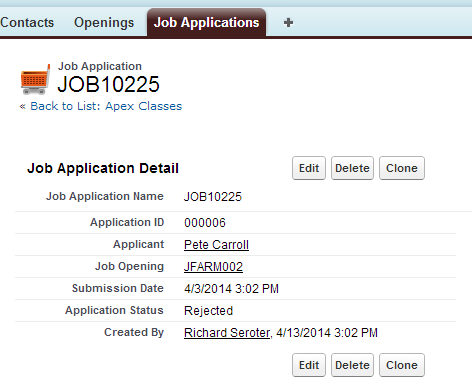
    In my developer sandbox, I added a new custom object called Job Application that holds data about applicants, which job they applied to, and the status of the application (e.g. Submitted, In Review, Rejected).

    2014.04.17forcetwilio01

    I then created a bunch of records for job applicants. Here’s an example of one applicant in my system.

    2014.04.17forcetwilio02

    I want to expose a programmatic interface to retrieve “Application Status” that’s an aggregation of multiple objects. To make that happen, I created a custom Apex controller that exposes a REST endpoint. You can see below that I defined a custom class called ApplicationStatus and then a GetStatus operation that inflates and returns that custom object. The RESTful attributes (@RestResource, @HttpGet) make this a service accessible via REST query.

    @RestResource(urlMapping='/ApplicationStatus/*')
    global class CandidateRestService {
    
        global class ApplicationStatus {
    
            String ApplicationId {get; set; }
            String JobName {get; set; }
            String ApplicantName {get; set; }
            String Status {get; set; }
        }
    
        @HttpGet
        global static ApplicationStatus GetStatus(){
    
            //get the context of the request
            RestRequest req = RestContext.request;
            //extract the job application value from the URL
            String appId = req.requestURI.substring(req.requestURI.lastIndexOf('/')+1);
    
            //retrieve the job application
            seroter__Job_Application__c application = [SELECT Id, seroter__Application_Status__c, seroter__Applicant__r.Name, seroter__Job_Opening__r.seroter__Job_Title__c FROM seroter__Job_Application__c WHERE seroter__Application_ID__c = :appId];
    
            //create the application status object using relationship (__r) values
            ApplicationStatus status = new ApplicationStatus();
            status.ApplicationId = appId;
            status.Status = application.seroter__Application_Status__c;
            status.ApplicantName = application.seroter__Applicant__r.Name;
            status.JobName = application.seroter__Job_Opening__r.seroter__Job_Title__c;
    
            return status;
        }
    }
    

    With this in place – and creating an “application” that gave me a consumer key and secret for remote access – I had everything I needed to consume Salesforce.com data.

    The ASP.NET Web API project

    How does Twilio know what to say when you call one of their phone numbers? They have a markup language called TwiML that includes the constructs for handling incoming calls. What I needed was a web service that Twilio could reach and return instructions for what to say to the caller.

    I created an ASP.NET Web API project for this service. I added NuGet packages for DeveloperForce.Force (to get the Force.com Toolkit for .NET) and Twilio.Mvc, Twilio.TwiML, and Twilio. Before slinging the Web API Controller, I added a custom class that helps the Force Toolkit talk to custom REST APIs. This class, CustomServiceHttpClient, copies the base ServiceHttpClient class and changes a single line.

    public async Task<T> HttpGetAsync<T>(string urlSuffix)
            {
                var url = string.Format("{0}/{1}", _instanceUrl, urlSuffix);
    
                var request = new HttpRequestMessage()
                {
                    RequestUri = new Uri(url),
                    Method = HttpMethod.Get
                };
    

    Why did I do this? The class that comes with the Toolkit builds up a particular URL that maps to the standard Salesforce.com REST API. However, custom REST services use a different URL pattern. This custom class just takes in the base URL (returned by the authentication query) and appends a suffix that includes the path to my Apex controller operation.

    I slightly changed the WebApiConfig.cs to add a “type” to the route template. I’ll use this to create a pair of different URIs for Twilio to use. I want one operation that it calls to get initial instructions (/api/status/init) and another to get the actual status resource (/api/status).

    public static class WebApiConfig
        {
            public static void Register(HttpConfiguration config)
            {
                // Web API configuration and services
    
                // Web API routes
                config.MapHttpAttributeRoutes();
    
                config.Routes.MapHttpRoute(
                    name: "DefaultApi",
                    routeTemplate: "api/{controller}/{type}",
                    defaults: new { type = RouteParameter.Optional }
                );
            }
        }
    

    Now comes the new StatusController.cs that handles the REST input. The first operation takes in VoiceRequest object that comes from Twilio and I build up a TwiML response. What’s cool is that Twilio can collect data from the caller. See the “Gather” operation where I instruct Twilio to get 6 digits from the caller, and post to another URI. In this case, it’s a version of this endpoint hosted in Windows Azure. Finally, I forced the Web API to return an XML document instead of sending back JSON (regardless of what comes in the inbound Accept header).

    The second operation retrieves the Salesforce credentials from my configuration file, gets a token from Salesforce (via the Toolkit), issues the query to the custom REST endpoint, and takes the resulting job application detail and injects it into the TwiML response.

    public class StatusController : ApiController
        {
            // GET api/<controller>/init
            public HttpResponseMessage Get(string type, [FromUri]VoiceRequest req)
            {
                //build Twilio response using TwiML generator
                TwilioResponse resp = new TwilioResponse();
                resp.Say("Thanks for calling the status hotline.", new { voice = "woman" });
                //Gather 6 digits and send GET request to endpoint specified in the action
                resp.BeginGather(new { action = "http://twilioforcetoolkit.azurewebsites.net/api/status", method = "GET", numDigits = "6" })
                    .Say("Please enter the job application ID", new { voice = "woman" });
                resp.EndGather();
    
                //be sure to force XML in the response
                return Request.CreateResponse(HttpStatusCode.OK, resp.Element, "text/xml");
    
            }
    
            // GET api/<controller>
            public async Task<HttpResponseMessage> Get([FromUri]VoiceRequest req)
            {
                var from = req.From;
                //get the digits the user typed in
                var nums = req.Digits;
    
                //SFDC lookup
                //grab credentials from configuration file
                string consumerkey = ConfigurationManager.AppSettings["consumerkey"];
                string consumersecret = ConfigurationManager.AppSettings["consumersecret"];
                string username = ConfigurationManager.AppSettings["username"];
                string password = ConfigurationManager.AppSettings["password"];
    
                //create variables for our auth-returned values
                string url, token, version;
                //authenticate the user using Toolkit operations
                var auth = new AuthenticationClient();
    
                //authenticate
                await auth.UsernamePasswordAsync(consumerkey, consumersecret, username, password);
                url = auth.InstanceUrl;
                token = auth.AccessToken;
                version = auth.ApiVersion;
    
                //create custom client that takes custom REST path
                var client = new CustomServiceHttpClient(url, token, new HttpClient());
    
                //reference the numbers provided by the caller
                string jobId = nums;
    
                //send GET request to endpoint
                var status = await client.HttpGetAsync<dynamic>("services/apexrest/seroter/ApplicationStatus/" + jobId);
                //get status result
                JObject statusResult = JObject.Parse(System.Convert.ToString(status));
    
                //create Twilio response
                TwilioResponse resp = new TwilioResponse();
                //tell Twilio what to say to the caller
                resp.Say(string.Format("For job {0}, job status is {1}", statusResult["JobName"], statusResult["Status"]), new { voice = "woman" });
    
                //be sure to force XML in the response
                return Request.CreateResponse(HttpStatusCode.OK, resp.Element, "text/xml");
            }
         }
    

    My Web API service was now ready to go.

    Running the ASP.NET Web API in Windows Azure

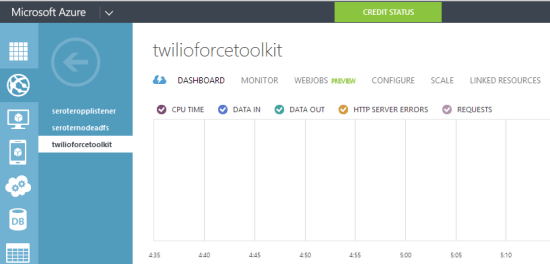
    As you can imagine, Twilio can only talk to services exposed to the public internet. For simplicity sake, I jammed this into Windows Azure Web Sites from Visual Studio.

    2014.04.17forcetwilio04

    Once this service was deployed, I hit the two URLs to make sure that it was returning TwiML that Twilio could use. The first request to /api/status/init returned:

    2014.04.17forcetwilio05

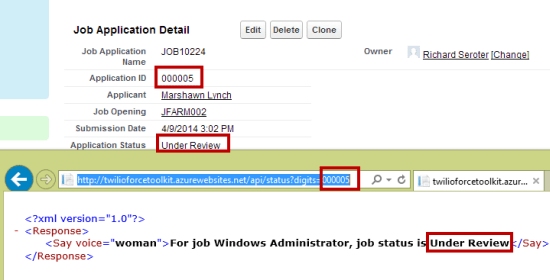
    Cool! Let’s see what happens when I call the subsequent service endpoint and provide the application ID in the URL. Notice that the application ID provided returns the corresponding job status.

    2014.04.17forcetwilio06

    So far so good. Last step? Add Twilio to the mix.

    Setup Twilio Phone Number

    First off, I bought a new Twilio number. They make it so damn easy to do!

    2014.04.17forcetwilio07


    With the number in place, I just had to tell Twilio what to do when the phone number is called. On the phone number’s settings page, I can set how Twilio should respond to Voice or Messaging input. In both cases, I point to a location that returns a static or dynamic TwiML doc. For this scenario, I pointed to the ASP.NET Web API service and chose the “GET” operation.

    2014.04.17forcetwilio08

    So what happens when I call? Hear the audio below:

    [audio https://seroter.com/wp-content/uploads/2014/07/twiliosalesforce.mp3 |titles=Calling Twilio| initialvolume=30|animation=no]

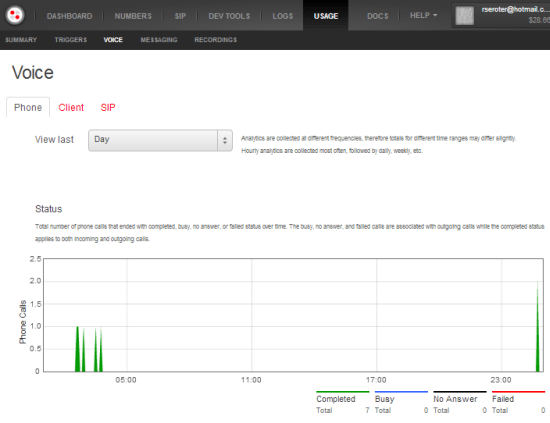
    One of the other great Twilio features is the analytics. After calling the number, I can instantly see usage trends …

    2014.04.17forcetwilio09

    … and a log of the call itself. Notice that I see the actual TwiML payload processed for the request. That’s pretty awesome for troubleshooting and auditing.

    2014.04.17forcetwilio10


    Summary

    In the cloud, it’s often about combining best-of-breed capabilities to deliver innovative solutions that no one technology has. It’s a lot easier to do this when working with such API-friendly systems as Salesforce and Twilio. I’m sure you can imagine all sorts of valuable cases where an SMS or voice call could retrieve (or create) data in a system. Imagine walking a sales rep through a call and collecting all the data from the customer visit and creating an Opportunity record! In this scenario, we saw how to query Salesforce.com (using the Force Toolkit for .NET) from a phone call and return a small bit of data. I hope you enjoyed the walkthrough, and keep an eye out for the recorded webcast where Wade and I explain a host of different scenarios for this Force Toolkit.

  • Co-Presenting a Webinar Next Week on Force.com and .NET

    Salesforce.com is a juggernaut in the software-as-a-service space and continues to sign up a diverse pool of global customers. While Salesforce relies on its own language (Apex) for coding extensions that run within the platform, developers can use any programming framework to integrate with Salesforce.com from external apps. That said, .NET is one of the largest communities in the Salesforce developer ecosystem and they have content specifically targeted at .NET devs.

    A few months back, a Toolkit for .NET was released and I’m participating in a fun webinar next week where we show off a wide range of use cases for it. The Toolkit makes it super easy to interact with the full Force.com platform without having to directly consume the RESTful interface. Wade Wegner – the creator of the Toolkit – will lead the session as we look at why this Toolkit was built, the delivery pipeline for the NuGet package, and a set of examples that show off how to use this in web apps, Windows Store apps, and Windows Phone apps.

    Sign up and see how to take full advantage of this Toolkit when building Salesforce.com integrations!

  • DevOps, Cloud, and the Lean “Wheel of Waste”

    I recently finished up a graduate program in Engineering Management and one of my last courses was on “Lean and Agile Management.” This was one of my favorite courses as it focused on understanding and improving process flow by reducing friction and waste. My professor claimed that most processes contain roughly 95% waste. At first that seemed insane, but when you think about most processes from a flow perspective and actually see (and name) the waste, it doesn’t sound as crazy. What *is* waste – or muda – in this context? Anything the customer isn’t willing to pay for! So much of the DevOps movement borrows from Lean, and I thought I’d look at eight types of waste (represented below from the excellent book The Remedy) and see how a DevOps focus (and cloud computing!) can help get rid of these non-value adding  activities.

    2014.04.07waste01

    Waste #1 – Motion

    Conveyance waste (outlined below) is refers to moving products themselves, while motion waste is all about the physical toll on those creating the product itself. This manifests itself in machine failures, ergonomic issues, and mental exhaustion resulting from (repetitive) actions inflicted by the process.

    Does it take you and your team multiple hours to push software? Do your testers run through 100 page scripts to verify that the software is working as expected? Are you wiped out after trying to validate a patch on countless servers in different environments and geographies? This is where some of the principles and technologies that make up DevOps provide some relief. Continuous integration tools make testing more routine and automated, thus reducing motion waste. Deployments tools (whether continuous deployment or not) have made it simpler to push software without relying on manual packaging, publishing, and configuration activities. Configuration management tools make it possible to define a desired state for a server and avoid manual setup and verification steps. All of these reduce the human toll on deploying software.

    The cloud helps reduce motion waste as well. Instead of taking ANY time patching and maintaining servers, you can build immutable servers (using templating tools like Packer) that simply get torn down regularly and replaced with fresh templates running the latest software and configuration. You can also use a variety of configuration management tools to orchestrate server builds and save repetitive (and error prone) manual activities that take hours or days to perform.

    Waste #2 – Waiting

    This is probably the one that most IT people can name immediately. We all know what it’s like to frustratingly wait for one step of a process to finish. You see waiting waste in action whenever a product/service spends much of its life waiting to be worked on. What’s the result of this waste in IT? Teams are idle while waiting for their turn to work on the product, paying for materials (deployment tools, contract resources) that aren’t being used, and your end users giving up because they can’t wait any longer for the promised service.

    A DevOps mindset helps with this as its all about efficiency. Teams may share the same ticketing system so that a development team can immediately start working on a defect as soon as its logged by front-line support person. It’s also about empowerment where teams can take action on items that need it, versus waiting around for someone with a VP title to tell them to get on it. One place that VPs can help here is to invest in the tools (e.g. high performing dev workstations, automated test suites) that developers need to build and deploy faster, thus reducing the waiting time between “code finished” and “application ready for use.”

    Consider a just-in-time mentality where resources are acquired (e.g. perf test environments) whenever they are needed, and discarded immediately afterwards. The cloud helps make that sort of thing possible.  Cloud is famous (infamous?) for helping devs get access to compute resources instantly. Instead of waiting 6-8 weeks for an Ops person to approve a server request (or upgrade request), the cloud user can simply spin up machines, resize them, and tear them down before an Ops person even starts working on the request. Ideally in a DevOps environment, those teams work together to establish gold images hardened by Ops but easily accessible (and deployable!) by devs.

    Waste #3 – Conveyance / Transportation

    Transportation waste occurs when material (physically or digitally) is moved around in ways that add no value to the product itself. There’s cost in moving the product itself, lost time while waiting for movement to occur, damage to the product in transit, or waiting to ship the product until there’s “enough” that makes shipping worth it.

    We see this all the time, right? If you don’t have a continuous deployment mindset, you wait for major “releases” and leave valuable, working code sitting still because it’s too costly to transport it to production. Or, when you don’t have a mature source control infrastructure for both code and environment configurations, there can be “damage” to the product as it moves between developers and deployment environments.  DevOps thinking helps change how the organization views “shipping” as less of an event and more of a regular occurrence. When the delivery pipeline is tuned properly, there are a minimum number of stops along the way for a product, there are few chances to introduce defects along the way, and shipment occurs immediately instead of waiting for a right-sized batch.

    Waste #4 – Correction / Defects

    Defects seem to be more inevitable in software than physical products, but they still are a painful source of waste. When a defect occurs, a team spends time figuring out the issue, updating the software, and deploying it again. All of this takes time away from working on new, valuable work items. Why does this happen? Teams don’t build quality in up front, don’t emphasize prevention and mistake-proofing, have an “acceptable amount” of defects allowed, or relying on spot inspections to validate quality.

    You probably see this when you have distinct project management, development, QA, and operations teams that don’t work together or have shared goals. Developers crank out code to hit a date specified by a project manager and may rely on QA to catch any errors or missed requirements. Or, the project team quickly finishes and throws an application over the wall to Operations where ongoing quality issues force churn back and forth.

    A DevOps approach is about collaboration and empathy for stakeholders. Quality is critical and its baked into the entire process. Defects may occur, but they aren’t acceptable and you don’t wait until the end to discover them. With automation around the deployment process, defects can be quickly addressed and deployed without unnecessary thrashing between development and support organizations. Code quality and service uptime are metrics that the WHOLE organization should care about and no team should be rewarded for “finishing early” if the quality was subpar.

    Waste #5 – Over-processing

    Over-processing occurs any time that we do more work on a product than is necessary. Developers make a particular feature more complicated than required, or of a higher quality than is truly needed. This can also happen when we replicate data between systems “just in case” or engage in gold-plating something that’s “good enough.” We all love to delight our users, but there are also plenty of statistics out there that show how few features of any software platform are actually used. When we waste time on items that don’t matter, we take time away from those that do.

    DevOps (and the cloud) can help this a bit as you focus on continual, incremental progress versus massive releases. By constantly revisiting scope, collaborating across teams, and having a culture of experimentation, we can publish software in more of a minimum viable product manner that solves a need and solicits feedback. A tighter coupling between product management and development ensures that teams know what’s needed and when to stop. Instead of product managers or business analysts writing 150 page specs and throwing them over the wall to developers, those upstream teams should be using deep understanding of a business domain to craft initial stories that developers can start running with immediately instead of waiting for a perfect spec to be completed.

    Waste #6 – Over-production

    This is considered one of the worst wastes as it often hides or produces all the others! Over-production waste occurs when you produce more of the product or service than required. This means building large batches because you want to keep people busy or the setup costs are high and it’s “easier” to just build more of the product than constantly switch the delivery pipeline between products. You may see this in action when you do work even when no one asked for it, producing more than needed in anticipation of defects, or when IT departments have more projects than resources to deliver them.

    In Lean and DevOps, we want to deliver what the customer needs, when they need it. If you’re keeping the test team busy writing unnecessary scripts just because they’re bored waiting for some code to test, that’s indicative of another problem. There’s likely a bottleneck or constraint elsewhere that blocking flow and causing you to over-produce in one area to compensate. In another example, consider provisioning application environments and purposely asking for more capacity than needed, just to avoid going back and asking for more later. In a cloud environment, that sort of over-production is not needed. You can provision a server or PaaS container at one size, and then adjust as needed. Instead of producing more capacity than requested, you can acquire and pay for exactly what’s needed.

    Waste #7 – Inventory

    Inventory waste happens when you’re holding on to resources that aren’t generating any revenue. In IT, this can be application code that is stuck waiting for manual QA checks or a batched release window. Customers would be seeing value from that product or service if it was just available and not stuck in the digital holding pen. Inventory can back up at multiple stages in an IT delivery pipeline. There could be a backlog of requirements that aren’t released to development teams until a gate check, infrastructure resources that are sitting idle until someone releases them for use, or code stuck in a pre-release stage waiting for a rolling deployment to occur.

    DevOps again makes a difference here as we actively look for ways to reduce inventory and improve flow between teams. You’re constantly asking yourself “how do I reduce friction?” and one way is to prevent inventory backlogs that release in spurts and cause each subsequent part of the delivery chain to get overwhelmed. If you even out the flow and use communication and automation to constantly move ideas from requirements to code to production, everything becomes much more predictable.

    Waste #8 – Knowledge

    This “bonus” waste happens when there’s a disruption of the flow of knowledge because of physical barriers, constant reorganizations, teams that don’t communicate, non-integrated software systems, and the host of annoying things that make it difficult to share knowledge easily. Haven’t we all seem mind-numbing written procedures or complex reports that hide the relevant information? Or how about the “rock star dev” who doesn’t share their wisdom with the team? What about tribal knowledge that the first few hires at a startup know about, and each subsequent dev thrashes because they aren’t aware of it?

    Those following a DevOps model focus on information sharing, collaboration, and empowering their teams with the information they need to do their job. It’s never been easier to set up Wikis of gotchas, have daily standups to disseminate useful info across teams, and simplify written procedures because of the use of automated (and auditable) platforms. If someone leaves or joins the team, that shouldn’t cause a complete meltdown. Instead, to avoid knowledge waste, make sure that developers have access to repositories and tools that make it simple to deploy a standard dev environment (using something like Vagrant), understand the application architecture, check in code, test it out, simulate the results, and understand the impact.

    Summary

    DevOps is about much more than just technology. Understanding and putting a name to the various wastes within a process can help you apply the right type of (continuous) improvement to make. The improvement could be with people, process, technology, or a combination of the three. The cloud by itself doesn’t do anything to streamline an organization if corresponding process (and culture) changes don’t accompany it. I’ve been learning to “see the system” more and recognize where constraints and waste exist and “name and shame” them. Agree? Disagree?